Tiny rulers to measure nanoscale structures
August 31, 2010
Tiny rulers to measure nanoscale structures

Enlarge

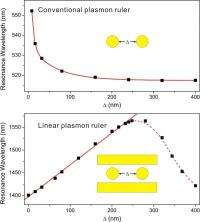
In contrast to a conventional nanoparticle dimer plasmon ruler, this new one shows an approximately linear relationship between the resonance wavelength shifts and nanosphere dimer interparticle separation for a linear plasmon ruler.

With the advent of nanometer-sized machines, there is considerable demand for stable, precise tools to measure absolute distances and distance changes. One way to do this is with a plasmon ruler. In physics jargon, a "plasmon" is the quasiparticle resulting from the quantization of plasma oscillation; it's essentially the collective oscillations of the free electron gas at a metallic surface, often at optical frequencies.

A noble metallic dimer (a molecule that results from combining two entities of the same species) has been used as a plasmon ruler to make absolute distance and distance change measurements.

Physicists at China's Wuhan University discovered that combined with a nanorod dimer could be used to solve the problem of measurement sensitivity. They provide details about their findings in the American Institute of Physics' .

Shao-Ding Liu and Mu-Tian Cheng used a nanostructure as a linear plasmon ruler. Nanospheres were used to modify surface plasmon coupling of a nanorod dimer. They found that the resonance wavelength shift increases approximately linearly with the increasing of a nanosphere's interparticle separations -- resulting in a structure that's useful as a plasmon ruler with homogenous measurement sensitivity.

"A nanoparticle dimer plasmon ruler possesses many advantages because its measurement sensitivity is homogeneous, it can operate in the near-infrared region, and the structure's size and nanorod aspect ratio can be modified freely to get the desired measurement range and sensitivity," notes Liu.

Applications for the linear plasmon ruler extend beyond studies of optical properties of metallic nanostructures to single-molecule microscopy, surface-enhanced Raman spectroscopy, waveguiding and .

More information: The article, "Linear plasmon ruler with tunable measurement range and sensitivity" by Shao-Ding Liu and Mu-Tian Cheng will appear in the Journal of Applied Physics. http://jap.aip.org … 3/p034313_s1

Provided by American Institute of Physics


Rank not rated yet
Relevant PhysicsForums posts

More news stories

'Dark plasmons' transmit energy

Microscopic channels of gold nanoparticles have the ability to transmit electromagnetic energy that starts as light and propagates via "dark plasmons," according to researchers at Rice University.

Nanotechnology / Nanophysics

created 12 hours ago | popularity 5 / 5 (5) | comments 0 | with audio podcast

Nanotube therapy takes aim at breast cancer stem cells

Wake Forest Baptist Medical Center researchers have again proven that injecting multiwalled carbon nanotubes (MWCNTs) into tumors and heating them with a quick, 30-second laser treatment can kill them.

Nanotechnology / Bio & Medicine

created 17 hours ago | popularity 5 / 5 (1) | comments 0 | with audio podcast

Inspired by steel, nanomanufacturing gets wear-resistant carbide tip

(PhysOrg.com) -- Scientists at the University of Pennsylvania, the University of Wisconsin-Madison and IBM Research - Zurich have fabricated an ultrasharp silicon carbide tip possessing such high strength ...

Nanotechnology / Nanophysics

created 22 hours ago | popularity 5 / 5 (3) | comments 1 | with audio podcast

New kind of solar cell could capture significantly more energy than current cells

New solar cells could increase the maximum efficiency of solar panels by over 25%, according to scientists from the University of Cambridge.

Nanotechnology / Nanophysics

created Feb 08, 2012 | popularity 4.5 / 5 (11) | comments 14 | with audio podcast

New technology platform for molecule-based electronics

Researchers at the Nano-Science Center at the University of Copenhagen have developed a new nano-technology platform for the development of molecule-based electronic components using the wonder material graphene. At the same ...

Nanotechnology / Nanomaterials

created 19 hours ago | popularity 5 / 5 (2) | comments 0


Humans may have helped the decline of African rainforests 3000 years ago

(PhysOrg.com) -- Large areas of rainforests in Central Africa mysteriously disappeared over three thousand years ago, to be replaced by savannas. The prevailing theory has been that the cause was a change ...

Japan scientist makes 'Avatar' robot

A Japanese-developed robot that mimics the movements of its human controller is bringing the Hollywood blockbuster "Avatar" one step closer to reality.

Fighting crimes against biodiversity: How to catch a killer weed

Invasive species which have the potential to destroy biodiversity and influence global change could be tracked and controlled in the same way as wanted criminals, according to new research from Queen Mary, University of London.

Metastatic breast cancer hitches a free ride from the immune system

Inflammatory breast cancer (IBC) is the most lethal form of breast cancer . It spreads easily through the lymphatic and blood vessels, forming metastasis which can lead to multi-organ failure. New research published in BioMed ...

A novel method for simultaneously measuring blood pressure and arterial stiffness

Arterial stiffness due to is a major contributor to cardiovascular disease but is very difficult to measure. It also can influence blood pressure readings since these rely on the time taken for arteries to return to normal ...

India's global pharmacy role threatened by EU pact

(AP) -- Efforts by India and the European Union to strengthen trade are threatening India's ability to deliver lifesaving medicines to the world's poorest, analysts say as the two sides push through protracted ...