First direct observation of unusual magnetic structure could lead to novel electronic, magnetic memory devices
August 30, 2010
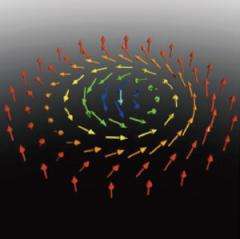
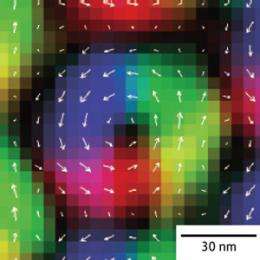
An overhead view of skyrmions observed directly using a Lorentz transmission electron microscope. © 2010 X.Z. Yu et al.
In conventional ferromagnets, the individual magnetic moments of the atoms that together comprise the magnetism of the material are all aligned parallel, pointing in a common direction. In some magnets, quantum-mechanical interactions between the electrons of a material or the presence of internal electric fields, for example, mean that the magnetic arrangements are more complex.
Now, a rare arrangement of magnetic moments, so-called skyrmions, has been directly imaged by a team led by Yoshinori Tokura of the RIKEN Advanced Science Institute, Wako, Japan. Tokura and his colleagues from RIKEN and other research institutes in Japan and Korea confirmed that skyrmions are very stable and that their manipulation could form the basis for novel magnetic memories or electronic devices.
A skyrmion can be envisaged as a vortex-like arrangement of magnetic moments that, towards the center of the structure, increasingly twist and bend in downwards direction. In earlier experiments by other research groups, the existence of skyrmions had been inferred indirectly but efforts to image them, and to confirm their structure, failed owing to their small size with diameters of around 90 nanometers.
Tokura and his team accomplished their direct observation of skyrmions by using a Lorentz transmission electron microscope, which is suited to image magnetic structures at very high resolution. Previously, physicists considered this type of experiment impossible because observing skyrmions would require the application of external magnetic fields that they thought would disturb the imaging process of the microscope. The team realized, however, that this problem could be overcome by applying the external magnetic fields perpendicular to the imaging lens of the microscope. Tokura says that this led to the breakthrough that allowed them to show the emergence of skyrmions unambiguously.
An overhead view of skyrmions observed directly using a Lorentz transmission electron microscope. © 2010 X.Z. Yu et al.
In addition to observing the expected periodic arrangement of many skyrmions, the researchers were able to observe isolated skyrmions and establish that they are also stable entities. The manipulation of individual skyrmions could find application in novel magnetic memories or in electronic devices, Tokura notes.Realization of such applications, however, still requires substantial work. Thus far, skyrmions have been observed only at temperatures of around 40 Kelvin. “In future, we not only need to find new materials where skyrmions are stable at room temperature, but also find ways to manipulate their motion through electromagnetic effects,” explains Tokura. He says that a number of known oxide magnetic materials could fulfill these criteria and may eventually lead to skyrmion-based devices.
More information: Yu, X. Z., Onose, Y., Kanazawa, N., Park, J, H., Han, J. H., Matsui, Y., Nagaosa, N. & Tokura, Y. Real-space observation of a two-dimensional skyrmion crystal. Nature 465, 901-904 (2010).
Provided by RIKEN
-
Nanoscale Dominoes: Magnetic Moments Topple Over in Rows
Sep 24, 2008 |
not rated yet |
0
-
Novel magnets made from the strongest known hydrogen bond
Dec 06, 2006 |
not rated yet |
0
-
Shape matters in the case of cobalt nanoparticles
Jun 17, 2009 |
not rated yet |
0
-
Multiferroic compounds used to produce smaller and cheaper digital memories
Nov 27, 2009 |
not rated yet |
0
-
Iron-nitrogen compound forms strongest magnet known
Mar 22, 2010 |
not rated yet |
0
-
Engineers build first sub-10-nm carbon nanotube transistor
Feb 01, 2012 |
4.9 / 5 (31) |
30
-
Something old, something new: Evolution and the structural divergence of duplicate genes
Jan 31, 2012 |
4.6 / 5 (7) |
1
-
The hidden nanoworld of ice crystals: Revealing the dynamic behavior of quasi-liquid layers
Jan 30, 2012 |
5 / 5 (3) |
1
-
Stock market network reveals investor clustering
Jan 27, 2012 |
3.9 / 5 (23) |
8
-
Of microchemistry and molecules: Electronic microfluidic device synthesizes biocompatible probes
Jan 26, 2012 |
5 / 5 (1) |
0
-
How to calculate theoretical initial velocity?
57 minutes ago
-
Question about Gravity?
2 hours ago
-
Wearing black in a desert
3 hours ago
-
Did space exist before mass?
3 hours ago
-
How can E&M Waves be polarized?
3 hours ago
-
Does light travel for ever?
4 hours ago
- More from Physics Forums - General Physics
More news stories
Putting the squeeze on planets outside our solar system
(PhysOrg.com) -- Using high-powered lasers, scientists at Lawrence Livermore National Laboratory and collaborators discovered that molten magnesium silicate undergoes a phase change in the liquid state, abruptly ...
10 hours ago |
4.3 / 5 (7) |
0
|
Hovering not hard if you're top-heavy, researchers find
Top-heavy structures are more likely to maintain their balance while hovering in the air than are those that bear a lower center of gravity, researchers at New York University's Courant Institute of Mathematical Sciences ...
11 hours ago |
5 / 5 (1) |
1
|
SLAC, Stanford team focuses on high-energy electrons to treat cancer
Accelerator physicists at SLAC and cancer specialists from Stanford are working on a new technology that could dramatically reduce the time needed for cancer radiation treatments. The team ran an initial experiment ...
14 hours ago |
5 / 5 (2) |
0
Measurements from high-energy collisions lead to better understanding of why meson particles disappear
For several years, physicists at the Relativistic Heavy Ion Collider (RHIC) at Brookhaven National Laboratory (BNL), USA, have studied an unusual state of matter called the quarkgluon plasma, which they ...
15 hours ago |
4.5 / 5 (4) |
0
Explained: Sigma
It's a question that arises with virtually every major new finding in science or medicine: What makes a result reliable enough to be taken seriously? The answer has to do with statistical significance -- but ...
Feb 09, 2012 |
5 / 5 (16) |
53
Google users warned of threat to smartphone wallets
Users of Google smartphone wallets were being warned on Friday that there is a way to crack pass codes intended to thwart thieves from going on illicit shopping sprees.
Anonymous knocks CIA website offline (Update)
The website of the Central Intelligence Agency was inaccessible on Friday after the hacker group Anonymous claimed to have knocked it offline.
New error-correcting codes guarantee the fastest possible rate of data transmission
Error-correcting codes are one of the triumphs of the digital age. Theyre a way of encoding information so that it can be transmitted across a communication channel such as an optical fiber o ...
Humans may have helped the decline of African rainforests 3000 years ago
(PhysOrg.com) -- Large areas of rainforests in Central Africa mysteriously disappeared over three thousand years ago, to be replaced by savannas. The prevailing theory has been that the cause was a change ...
Complex wiring of the nervous system may rely on a just a handful of genes and proteins
Researchers at the Salk Institute have discovered a startling feature of early brain development that helps to explain how complex neuron wiring patterns are programmed using just a handful of critical genes. ...
New power source discovered
(PhysOrg.com) -- Researchers at the Massachusetts Institute of Technology (MIT) and RMIT University have made a breakthrough in energy storage and power generation.
Aug 30, 2010
Rank: 3 / 5 (2)
Could this mean we have finally discovered the graviton?
Looking forward to your thoughts.
Harris
Aug 30, 2010
Rank: 1 / 5 (1)
No this obviously means that we've found the charged Higgs which couples to skyrmions..
Aug 31, 2010
Rank: 1 / 5 (1)
Aug 31, 2010
Rank: 3 / 5 (2)
Sep 03, 2010
Rank: 5 / 5 (1)
And then posts "This was already observed before 40 years ago, in John-Jingleheimer experiment with foamy density ripples at watter surface."
Sep 07, 2010
Rank: not rated yet