Scientists find new invasive fresh water clam species in Lake George
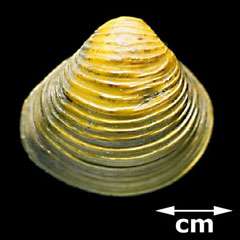
(PhysOrg.com) -- The new species (Corbicula fluminea) was located in the Village of Lake George and poses a serious threat to native mussels and the Lake George ecosystem, according to Sandra Nierzwicki-Bauer, director of the Rensselaer Darrin Fresh Water Institute.
The Rensselaer Polytechnic Institute Darrin Fresh Water Institute (DFWI) has discovered a new invasive fresh water clam species in Lake George. This species, found last week by DFWI student Jeremy Farrell, was located in the Village of Lake George and poses a serious threat to native mussels and the Lake George ecosystem, according to Sandra Nierzwicki-Bauer, director of DFWI.
Nierzwicki-Bauer said the species - Corbicula fluminea - is an invasive clam from Asia, capable of self fertilization, achieving densities of thousands per square meter, and crowding native species from their typical habitats. Commonly known as the Asian clam, it is a light brown triangular clam that can survive in fresh and brackish waters. If the invasion is a localized one, it may be possible to eradicate, she added. The dominant native mussel in Lake George is Elliptio complanata.
“It is imperative that we move quickly to determine the extent of this infestation to assess the best treatment options that can be undertaken immediately,” said Nierzwicki-Bauer, who is also a professor of biology at Rensselaer. “We have reached out to the regulatory agencies to assess all our options.”
The Lake George environmental organizations have contracted to bring in an expert in invertebrate biology and scientific SCUBA: Dan Marelli, from Florida. He has worked with DFWI scientists for over 15 years to help coordinate SCUBA surveys, and he will direct new surveys that will be carried out by FUND for Lake George, DFWI, Bateaux Below Inc., and volunteer divers. Immediate plans include a survey of the shallow and embayment areas to establish the extent of infestation. Possible eradication or management strategies include use of a benthic barrier, essentially a plastic mat that could “smother” the clams, suction harvesting, or a combination of these methods. Currently, benthic mats are being used on a one-acre area in Lake Tahoe, Calif., to help manage the infestation there. Preliminary field work by DFWI staff indicates that a minimum of 2.5 acres in Lake George is infested.
The environmental groups will be coordinating with the Adirondack Park Agency and the New York Department of Environmental Conservation.
An initial plan of action has been organized to complete a SCUBA survey during the next two weeks to determine the geographical range of the infestation. This will involve surveys by divers of the lake bottom sediment. Other nearby areas with suitable habitat will be surveyed soon. Initial surveys will be supervised by Marelli. Once the extent of the infestation has been quantified, either a management or eradication strategy will be determined. The initial survey work will utilize the eight-diver crew of Aquatic Invasives Management (AIM) of Lake Placid, which is currently working in Lake George on management of Eurasian watermilfoil, under a contract with the FUND for Lake George.
Peter Bauer, executive director of the FUND for Lake George, said, “This is the newest invader to be found in Lake George. We’ve long had Eurasian watermilfoil and curlyleaf pond weed, as well as zebra mussels. We’ve seen a few plants of Brittle Naiad, too. We don’t know the current extent of the Asian clam infestation, but if we’re lucky maybe this is an isolated infestation in Lake George that we caught early.”
Once field investigations are completed, further information on the extent of the infestation will be provided.
“It is now most important that we pull together with other organizations and the public to mount a rapid and effective response to this disturbing discovery,” said Bruce E. Young, chairman of the Lake George Park Commission. “The community should be reassured that steps are under way to assess the extent of the Asian clam colony and if possible, eradicate it.”
“While the discovery of an established Asian clam population in the lake was not good news to hear, the good news is that all the groups involved are taking swift action and rallying the troops. We are all divvying up the tasks, and LGA is heading up public outreach. It is very important to spread the word to area boaters and business owners, as we do not want the clam to spread further within our own lake or to other nearby bodies of water as well. We will be providing educational materials about the Asian clam and its spread to boaters, businesses, and residents all around the lake in the next few days,” said Walt Lender, executive director, Lake George Association.
“It will take a concerted partnership effort to address Asian clam in Lake George. Key partners have already begun the rapid response process to survey, evaluate, and determine feasible control and spread prevention options. The Lake Champlain Basin Program will assist management efforts in any way possible as this species affects not only Lake George but the entire Lake Champlain Basin watershed and beyond,” said Meg Modley, Aquatic Invasive Species management coordinator, Lake Champlain Basin Program.
Background on Corbicula fluminea
Asian clams (Corbicula fluminea) are native to South East Asia and were first documented on the west coast of the United States in 1938. Since then they have spread to over 40 states. Asian clams are small, averaging less than 25mm (1.5 inches) with an oval triangular shape, deep at the hinge. Its outer shell is yellow brown, light brown to black with distinctive elevated, evenly spaced concentric ridges on the surface.
The Asian clam is a very hardy and persistent freshwater mollusk, capable of rapid growth and spread. The Asian clam prefers to colonize on sandy substrates in quiet, warmer, sunlit waters, and can be found with one-third of its shell protruding above the substrate (although it has been found at water depths to 250 feet and within the sediment buried up to 7 inches in Lake Tahoe). Asian clams can form dense clusters, with up to 5,000 animals per square meter. Asian clams are able to withstand freezing conditions, but their ability to reproduce decreases with exposure to lower temperatures (below 10oC/50oF). For a long time, New England was considered environmentally inhospitable to the Asian clam.
The Asian clam is hermaphroditic and therefore capable of self-fertilization. A single clam can release over 400 offspring per day, depending on the conditions. The microscopic pediveligers (the final veliger or larval stage) travel along the substrate to a new location, attaching with byssus fibers to any available suitable substrate. The young that are hatched in the spring usually attain maturity by the fall (at 6-10 mm) and live an average of two to four years, with a maximum life span of seven years.
Geoffrey Schladow, director of the Tahoe Environmental Research Center of the University of California, Davis, said the Asian clams promote so much algae growth that they can turn some waters from blue to green. As they filter the water and consume plankton, they deposit high concentrations of nutrients in their excretions. Another significant impact of the Asian clams infestations is the “biofouling” or the impairment or degradation of intake pipes for power plants and drinking water treatment systems.
Provided by Rensselaer Polytechnic Institute


