Glass magic -- a film that changes what glass can do
August 31, 2010
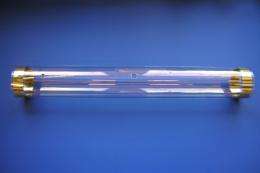
A transparent heatable film made out of indium tin oxide surrounds this glass tube used by BASF. (© Fraunhofer IST)
Fogged or frozen windows are the bane of drivers' lives in winter. German researchers have developed a process that allows them to manufacture not just transparent, but heatable films. These films also prevent condensation, ensuring ice cannot build up on the windscreen overnight - and, once and for all, consigning the ice scraper to the trash can.
Drivers do not relish the winter: it is cold, driving on icy roads is no fun. Added to which is poor visibility if the windows mist up, and the laborious morning ritual of having to scrape off the ice. Likewise, the winter poses its own problems for anyone with a greenhouse. The more condensation you have inside, the greater the threat to plants if the temperature falls below freezing. While heaters may be a solution in many cases, a better option - especially concering energy costs - would be to ensure the problem does not arise in the first place. And that means preventing condensation on windows. All of which would save a great deal of hassle - and car owners can save the time they once spent scraping off the ice.
Researchers at the Fraunhofer Institute for Surface Engineering and Thin Films IST in Braunschweig, Germany, have now solved the problem by developing a process that can be used to manufacture transparent, conductive - and therefore heatable - films. Moreover, their surface films also provide another decisive advantage: the low emitting properties of the outer film ensure the window cools down much more slowly, preventing condensation. The window remains dry and ice-free. Films that up to now have been produced with tin oxide are both mechanically and optically still far from ideal. Cracks may form as a result of excessive temperature loads - a problem encountered during the glass bending process. As a result, tin-oxide films only have limited industrial applications. "Our new film is extremely resilient", says Dr. Bernd Szyszka from the Fraunhofer IST. "Temperatures up to 900 degrees Celsius are no problem, and even if you bend it aggressively - the film remains intact." The coating can therefore also be used in large industrial plants where transparent protective heaters are often required to monitor the process chain safely.
What can the new film do that tin oxide cannot? "Our coating system is based on nanocrystalline indium tin oxide (ITO)", says Szyszka. "This material doesn't just have outstanding optical and electrical properties; it is also mechanically and chemically much more stable than tin oxide." While the advantages of the ITO coating have been known for many years, it is only now - thanks to the Fraunhofer engineers - that these kinds of film systems can be manufactured industrially for a much larger range of applications. The researchers are utilizing High Power Impulse Magnetron Sputtering technology, or HIPIMS. With magnetron sputtering, accelerated noble-gas ions shoot atoms from an ITO plate, much like what happens with billiard balls. These atoms are deposited on the required substrate in vacuum. "Yet instead of 10 amperes we use 1000 amperes with HIPIMS", explains Szyszka. "We ionize the sputtered material; therefore the film is build up by higher energetic particles and shows superior properties." All of which provide the engineers with a major advantage: depending on the pulse and power conditions during sputtering, the engineers can adjust the texture and morphology of the film so that it subsequently takes on the desired properties during a subsequent tempering process. "We can then bend the film and even coat three-dimensional materials with the technology", says the researcher. The HIPIMS process can also be conducted at room temperature, so that even temperature-sensitive plastics can be coated.
The Fraunhofer IST researchers will be showcasing a prototype at glasstec, due to be held in Dusseldorf from September 28 to October 1. An ITO film on a glass tube demonstrates the outstanding properties achieved. Not only is the film easy to heat - without any of the annoying wires commonly found in a rear-heated window - the film boasts an optical transmission ratio of over 80 percent. The coating is also corrosion- and scratch-resistant. It can even provide scratch protection for float glass, a special type of flat glass.
-
Will carbon nanotubes replace indium tin oxide?
Mar 09, 2009 |
not rated yet |
0
-
Industry’s First Conductive Polymer Film Touch Panels from Fujitsu
May 31, 2004 |
not rated yet |
0
-
Large sheets of graphene film produced for transparent electrodes (w/ Video)
Jun 21, 2010 |
not rated yet |
0
-
Transparent Carbon Nanotube Films Likely Successor to ITO for Commercial Applications
Apr 10, 2009 |
not rated yet |
0
-
As fast as a shark in water
Dec 15, 2006 |
not rated yet |
0
-
Engineers build first sub-10-nm carbon nanotube transistor
Feb 01, 2012 |
4.9 / 5 (31) |
30
-
Something old, something new: Evolution and the structural divergence of duplicate genes
Jan 31, 2012 |
4.6 / 5 (7) |
1
-
The hidden nanoworld of ice crystals: Revealing the dynamic behavior of quasi-liquid layers
Jan 30, 2012 |
5 / 5 (3) |
1
-
Stock market network reveals investor clustering
Jan 27, 2012 |
3.9 / 5 (23) |
8
-
Of microchemistry and molecules: Electronic microfluidic device synthesizes biocompatible probes
Jan 26, 2012 |
5 / 5 (1) |
0
-
Stoichiometry
Feb 10, 2012
-
Boiling and melting point of impure substances
Feb 10, 2012
-
Safe nitrogen compound to decompose a 500 deg C in a furnace?
Feb 09, 2012
-
[ask]electron inside drinking water
Feb 08, 2012
-
How to avoid formation of Lithium Chromate ???
Feb 08, 2012
-
how to choose a reduced or oxidated form in a redox
Feb 08, 2012
- More from Physics Forums - Chemistry
More news stories
Fool's gold may prove an unlikely alternative to overexploited catalytic materials
Catalytic materials, which lower the energy barriers for chemical reactions, are used in everything from the commercial production of chemicals to catalytic converters in car engines. However, with current catalytic materials ...
18 hours ago |
4.4 / 5 (8) |
6
|
Unpicking HIV’s invisibility cloak
Drug researchers hunting for alternative ways to treat human immunodeficiency virus (HIV) infections may soon have a novel targetits camouflage coat. HIV hides inside a cloak unusually rich in a sugar ...
18 hours ago |
5 / 5 (5) |
0
Hydrogen from acidic water: Researchers develop potential low cost alternative to platinum for splitting water
A technique for creating a new molecule that structurally and chemically replicates the active part of the widely used industrial catalyst molybdenite has been developed by researchers with the Lawrence Berkeley ...
Feb 09, 2012 |
4.8 / 5 (14) |
15
|
No entry without protein recycling: Researchers discover new coherence in enzyme transport
The group of Prof. Dr. Ralf Erdmann at the Ruhr-Universität Bochum, Germany, discovered a connection of peroxisomal protein import and receptor export. In the Journal of Biological Chemistry, they disclo ...
18 hours ago |
not rated yet |
0
Under the microscope #7
In this video Dr Ingrid Graz shows us a thin layer of gold on top of rubber. Cracks in the gold allow it to stretch and we can use this for stretchable electronics.
20 hours ago |
not rated yet |
0
Anonymous knocks CIA website offline (Update)
The website of the Central Intelligence Agency was inaccessible on Friday after the hacker group Anonymous claimed to have knocked it offline.
New error-correcting codes guarantee the fastest possible rate of data transmission
Error-correcting codes are one of the triumphs of the digital age. Theyre a way of encoding information so that it can be transmitted across a communication channel such as an optical fiber o ...
Humans may have helped the decline of African rainforests 3000 years ago
(PhysOrg.com) -- Large areas of rainforests in Central Africa mysteriously disappeared over three thousand years ago, to be replaced by savannas. The prevailing theory has been that the cause was a change ...
New power source discovered
(PhysOrg.com) -- Researchers at the Massachusetts Institute of Technology (MIT) and RMIT University have made a breakthrough in energy storage and power generation.
Small modular reactor design could be a 'SUPERSTAR'
(PhysOrg.com) -- Though most of today's nuclear reactors are cooled by water, we've long known that there are alternatives; in fact, the world's first nuclear-powered electricity in 1951 came from a reactor ...
Google users warned of threat to smartphone wallets
Users of Google smartphone wallets were being warned on Friday that there is a way to crack pass codes intended to thwart thieves from going on illicit shopping sprees.