IceCube neutrino observatory nears completion
August 31, 2010
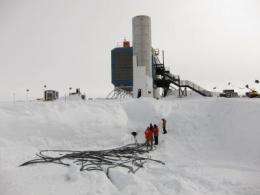
Signals from the sensors are carried by cables to the IceCube counting house that houses a large cluster of computers to reconstruct in real time some 2,000 muon tracks every second. Credit: J. Haugen
In December 2010, IceCube -- the world's first kilometer-scale neutrino observatory, which is located beneath the Antarctic ice -- will finally be completed after two decades of planning. In an article in the AIP's Review of Scientific Instruments, Francis Halzen, the principal investigator of the IceCube project, and his colleague Spencer Klein of Lawrence Berkeley National Laboratory provide a comprehensive description of the observatory, its instrumentation, and its scientific mission -- including its most publicized goal: finding the sources of cosmic rays.
"Almost a century after their discovery, we do not know from where the most energetic particles to hit the Earth originate and how they acquire their incredible energies," says Halzen, a professor of physics at the University of Wisconsin in Madison.
After light, neutrinos, which are created in the decay of radioactive particles, are the most abundant particles in the universe. High-energy neutrinos are formed in the universe's most violent events, like exploding stars and gamma ray bursts. Because the neutrino has no charge, essentially no mass, and only interacts weakly with matter, trillions of neutrinos pass through our bodies each day, without effect. On extremely rare occasions, a neutrino will strike the nucleus of an atom, creating a particle, called a muon, and blue light that can be detected with optical sensors. The trick is spying those collisions—and, in particular, the collisions of high-energy neutrinos. IceCube does it by sheer virtue of its size.
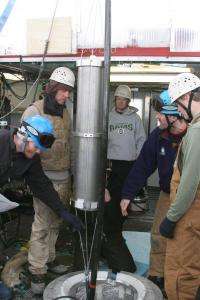
IceCube scientists deploy a calibration light source, called the Standard Candle in one of the 2.5 km deep holes. Each of the 86 holes contains a string of 60 Digital Optical Modules (DOMs) that detect the blue light from neutrino events in the deep, clear ice. Credit: J. Haugen
At 1 kilometer on a side -- with 5,160 optical sensors occupying a gigaton of ice -- the observatory is orders of magnitude bigger than other neutrino detectors; the Superkamiokande detector in the Japanese Alps, for example, is only 40 meters on a side."IceCube has been totally optimized for size in order to be sensitive to the very small neutrino fluxes that may reveal the sources of cosmic rays and the particle nature of dark matter," Halzen says.
More information: The article, "IceCube: An instrument for neutrino astronomy" by Francis Halzen and Spencer R. Klein appears in the journal Review of Scientific Instruments. See: http://rsi.aip.org … 8/p081101_s1
Provided by American Institute of Physics
-
IceCube building goals exceeded at South Pole
Feb 25, 2009 |
not rated yet |
0
-
Antarctic "Telescopes" Look for Cosmic Rays
Feb 08, 2005 |
not rated yet |
0
-
New results confirm standard neutrino theory
Feb 16, 2010 |
not rated yet |
0
-
First critical parts of giant neutrino telescope in place
Feb 15, 2005 |
not rated yet |
0
-
CERN neutrino project on target
Aug 16, 2005 |
not rated yet |
0
-
Engineers build first sub-10-nm carbon nanotube transistor
Feb 01, 2012 |
4.9 / 5 (31) |
30
-
Something old, something new: Evolution and the structural divergence of duplicate genes
Jan 31, 2012 |
4.6 / 5 (7) |
1
-
The hidden nanoworld of ice crystals: Revealing the dynamic behavior of quasi-liquid layers
Jan 30, 2012 |
5 / 5 (3) |
1
-
Stock market network reveals investor clustering
Jan 27, 2012 |
3.9 / 5 (23) |
8
-
Of microchemistry and molecules: Electronic microfluidic device synthesizes biocompatible probes
Jan 26, 2012 |
5 / 5 (1) |
0
-
Simple Torque from Gravity Problem
2 hours ago
-
Books To Inspire a Beginnig Physics Student
4 hours ago
-
Pith balls problem
5 hours ago
-
Electrostatics
5 hours ago
-
what is phase constant
5 hours ago
-
Basics In electromagnetic wave
5 hours ago
- More from Physics Forums - General Physics
More news stories
Putting the squeeze on planets outside our solar system
(PhysOrg.com) -- Using high-powered lasers, scientists at Lawrence Livermore National Laboratory and collaborators discovered that molten magnesium silicate undergoes a phase change in the liquid state, abruptly ...
16 hours ago |
4.3 / 5 (7) |
0
|
Hovering not hard if you're top-heavy, researchers find
Top-heavy structures are more likely to maintain their balance while hovering in the air than are those that bear a lower center of gravity, researchers at New York University's Courant Institute of Mathematical Sciences ...
17 hours ago |
5 / 5 (2) |
1
|
Borexino Collaboration succeeds in spotting pep neutrinos emitted from the sun
(PhysOrg.com) -- To learn more about how the sun works, scientists study particles that are emitted from it into space due to thermonuclear reactions that occur inside; by applying known physics principles, ...
Transparent iron? For the first time, an experiment shows that atomic nuclei can become transparent
At the high-brilliance synchrotron light source PETRA III, a team of DESY scientists headed by Dr. Ralf Röhlsberger has succeeded in making atomic nuclei transparent with the help of X-ray light. At the ...
Feb 08, 2012 |
4.8 / 5 (11) |
3
|
SLAC, Stanford team focuses on high-energy electrons to treat cancer
Accelerator physicists at SLAC and cancer specialists from Stanford are working on a new technology that could dramatically reduce the time needed for cancer radiation treatments. The team ran an initial experiment ...
20 hours ago |
5 / 5 (2) |
0
Google users warned of threat to smartphone wallets
Users of Google smartphone wallets were being warned on Friday that there is a way to crack pass codes intended to thwart thieves from going on illicit shopping sprees.
New error-correcting codes guarantee the fastest possible rate of data transmission
Error-correcting codes are one of the triumphs of the digital age. Theyre a way of encoding information so that it can be transmitted across a communication channel such as an optical fiber o ...
The power of estrogen -- male snakes attract other males
A new study has shown that boosting the estrogen levels of male garter snakes causes them to secrete the same pheromones that females use to attract suitors, and turned the males into just about the sexiest ...
Anonymous knocks CIA website offline (Update)
The website of the Central Intelligence Agency was inaccessible on Friday after the hacker group Anonymous claimed to have knocked it offline.
Humans may have helped the decline of African rainforests 3000 years ago
(PhysOrg.com) -- Large areas of rainforests in Central Africa mysteriously disappeared over three thousand years ago, to be replaced by savannas. The prevailing theory has been that the cause was a change ...
Complex wiring of the nervous system may rely on a just a handful of genes and proteins
Researchers at the Salk Institute have discovered a startling feature of early brain development that helps to explain how complex neuron wiring patterns are programmed using just a handful of critical genes. ...

Aug 31, 2010
Rank: 1.4 / 5 (11)
Aug 31, 2010
Rank: 3.8 / 5 (10)
Sep 01, 2010
Rank: not rated yet
Sep 01, 2010
Rank: 5 / 5 (4)
And its true that we could understand neutrinos and other particle interactions better, that's why scientists go to such extravagant lengths to stretch the boundaries of engineering even in the most hostile environments on the planet and in space.
A project of this epic scale will very likely answer one or two of its mission questions, and if we're lucky it'll raise some even more interesting questions in the process. Have a hot cocoa on me, boys!
Sep 01, 2010
Rank: 1.5 / 5 (6)
It's not my fault you are too incompetent to find it :)
Sep 01, 2010
Rank: 3.3 / 5 (3)
Ah, an internal Socratic dialogue! Well done, I take back my jab about your diploma.
Sep 01, 2010
Rank: not rated yet
However, if they dont know from where the neutrions are coming, why did they assume that the best direction to look was in the sky of the northern hemishere?
Surely any place on earth would do , and no doubt for a lot less money .. Unless drilling in ice is a very cheap endeavor.
Ideas??
and do please email:
tkjtkj@gmail.com
ADDENDUM:
actually, perhaps i can second guess my previous question:
for constant viewing, yes, it'd have to be at one of the earth's poles , to avoid rotational effects. And the south pole is drillable, whereas the north one is not..
Could it be so simple?
Sep 05, 2010
Rank: not rated yet
Sep 05, 2010
Rank: 5 / 5 (1)
They already do!
Among those operating, three are located in the Mediterranean Sea:
ANTARES http://antares.in...dex.html
NESTOR http://www.nestor.noa.gr/
and NEMO. A detector with a cubic kilometer detector in the Med is also planned (KM3NeT http://www.km3net.org/home.php ). These observatories carry on the search for discrete neutrino sources and are complementary to IceCube.