NASA's Terra Satellite captures 3 tropical cyclones in the northwestern Pacific Ocean
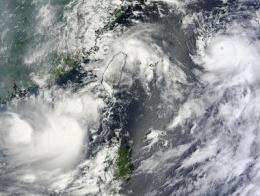
August 31, 2010
NASA's Terra satellite flew over the Northwestern Pacific Ocean at 02:30 UTC on Aug. 31 (10:30 p.m. EDT Aug. 30) and captured Tropical Storm Lionrock (lower left), Tropical Storm Namtheun (center), and Typhoon Kompasu (top right) off the Asian coast. Credit: NASA/MODIS Rapid Response Team
NASA's Terra satellite flew over the Northwestern Pacific Ocean at 10:30 p.m. EDT Aug. 30 and captured Tropical Storm Lionrock, Tropical Storm Namtheun, and Typhoon Kompasu in one incredible image. Two of these tropical cyclones are expected to merge, while the other is headed for a landfall in China.
On August 31, at 0900 UTC (5 a.m. EDT), Typhoon Kompasu had maximum sustained winds near 109 mph and is 45 nm east-southeast of Kadena AB, Japan. The cyclone will track over Okinawa within the next few hours and continue on a northwestward track for the next 12 to 24 hours, then cross the Korean Peninsula (from western to eastern Korea) into the Sea of Japan, cross northern Japan and exit into the Northwestern Pacific Ocean by September 4.
When the Moderate Resolution Imaging Spectroradiometer (MODIS) instrument that flies on Terra captured the image of all three storms the center of circulation was apparent in Tropical Storm Namtheun, and the eye was visible in Typhoon Kompasu, although some high clouds were filling in the center.
At 1 a.m. EDT, Kadena Air Base wasn't reporting tropical storm force winds from Typhoon Kompasu yet. Kadena Air Base is a United States Air Force base located in the towns of Kadena and Chatan and the city of Okinawa, in Okinawa Prefecture, Japan. Kadena Air Base is the hub of U.S. airpower in the Pacific, and home to the USAF's 18th Wing and a variety of associate units. Kadena Air Base did report, however, that sea level pressure dropped and amazing 44 millibars in less than 2 hours, indicating the Typhoon was approaching.
After impacting Kadena Air Base, Typhoon Kompasu is expected to turn north, then northeast and track over the Korean Peninsula and into the Sea of Japan
The other two tropical cyclones, Tropical Storm Lionrock and Tropical Storm Namtheun, are forecast to merge in the next day or two. NASA satellite data show that the two storms are in close proximity of each other. On August 31 at 0900 UTC (5 a.m. EDT), Tropical Storm Lionrock, formerly Tropical Depression 07W, had maximum sustained winds near 57 mph. It was located about 195 nm southwest of Kaohsiung, Taiwan and it is forecast to merge with Tropical Storm Namtheun (formerly Tropical Depression 09W). Lionrock has moved east-northeastward at 2 mph. Infrared satellite imagery, such as that from the Atmospheric Infrared Sounder (AIRS) instrument that flies aboard NASA's Aqua satellite was showing a decrease in convection in the storm's center. By mid-day (Eastern Time) on Thursday, Lionrock should make the merge with Namtheun and turn northwestward. It is expected to make landfall in eastern China late on Thursday, September 2 and dissipate.
On August 31 at 0900 UTC (5 a.m. EDT) Namtheun was about 80 nautical miles west of Taipei, Taiwan and moving west-southwestward at 8 mph. Its winds were sustained near 39 mph, so it was just at the threshold for being a tropical storm. The storm's low level center is partially exposed because of an upper level trough (elongated area of low pressure) to its north causing wind shear. Despite this, Namtheun is expected to remain the dominant circulation when it merges with Lionrock.
-
Nida getting knocked by winds, and 97W piquing interest
Dec 02, 2009 |
not rated yet |
0
-
A 2-for-1 for NASA's Aqua satellite: Lupit and 23W in Western Pacific
Oct 26, 2009 |
not rated yet |
0
-
Winds blow off Omais' thunderstorm tops
Mar 26, 2010 |
not rated yet |
0
-
NASA's Aqua Satellite sees Dianmu enter the Sea of Japan
Aug 11, 2010 |
not rated yet |
0
-
NASA infrared image of Tropical Storm Chanthu shows convection missing on west side
Jul 20, 2010 |
not rated yet |
0
-
Engineers build first sub-10-nm carbon nanotube transistor
Feb 01, 2012 |
4.9 / 5 (31) |
30
-
Something old, something new: Evolution and the structural divergence of duplicate genes
Jan 31, 2012 |
4.6 / 5 (7) |
1
-
The hidden nanoworld of ice crystals: Revealing the dynamic behavior of quasi-liquid layers
Jan 30, 2012 |
5 / 5 (3) |
1
-
Stock market network reveals investor clustering
Jan 27, 2012 |
3.9 / 5 (23) |
8
-
Of microchemistry and molecules: Electronic microfluidic device synthesizes biocompatible probes
Jan 26, 2012 |
5 / 5 (1) |
0
-
Discrepancy between oxygen and carbon-dioxide levels
Feb 09, 2012
-
where gems are found in the world
Feb 09, 2012
-
Wind Waves in Reservoir ~ Wind run-up and Wind set-up
Feb 08, 2012
-
Balance of oxygen in the atmosphere
Feb 01, 2012
-
The case for a methanol-based economy
Jan 30, 2012
-
Weather in a rotating cylinder
Jan 25, 2012
- More from Physics Forums - Earth
More news stories
Humans may have helped the decline of African rainforests 3000 years ago
(PhysOrg.com) -- Large areas of rainforests in Central Africa mysteriously disappeared over three thousand years ago, to be replaced by savannas. The prevailing theory has been that the cause was a change ...
Could Venus be shifting gear?
(PhysOrg.com) -- ESAs Venus Express spacecraft has discovered that our cloud-covered neighbour spins a little slower than previously measured. Peering through the dense atmosphere in the infrared, the ...
Space & Earth / Space Exploration
20 hours ago |
5 / 5 (7) |
8
|
NASA budget will axe Mars deal with Europe: scientists
US President Barack Obama's budget proposal to be submitted next week for 2013 will cut NASA's budget by 20 percent and eliminate a major partnership with Europe on Mars exploration, scientists said Thursday.
Space & Earth / Space Exploration
23 hours ago |
5 / 5 (2) |
20
Mars Science Laboratory computer issue resolved
(PhysOrg.com) -- Engineers have found the root cause of a computer reset that occurred two months ago on NASA's Mars Science Laboratory and have determined how to correct it.
Space & Earth / Space Exploration
21 hours ago |
4.7 / 5 (6) |
4
|
Two new moons for Jupiter
Advances in technology have lead to the discovery of new planets outside of our Solar System, and now even new moons in our own backyard.
Space & Earth / Space Exploration
20 hours ago |
4 / 5 (1) |
7
Anonymous knocks CIA website offline (Update)
The website of the Central Intelligence Agency was inaccessible on Friday after the hacker group Anonymous claimed to have knocked it offline.
New error-correcting codes guarantee the fastest possible rate of data transmission
Error-correcting codes are one of the triumphs of the digital age. Theyre a way of encoding information so that it can be transmitted across a communication channel such as an optical fiber o ...
Small modular reactor design could be a 'SUPERSTAR'
(PhysOrg.com) -- Though most of today's nuclear reactors are cooled by water, we've long known that there are alternatives; in fact, the world's first nuclear-powered electricity in 1951 came from a reactor ...
New power source discovered
(PhysOrg.com) -- Researchers at the Massachusetts Institute of Technology (MIT) and RMIT University have made a breakthrough in energy storage and power generation.
The power of estrogen -- male snakes attract other males
A new study has shown that boosting the estrogen levels of male garter snakes causes them to secrete the same pheromones that females use to attract suitors, and turned the males into just about the sexiest ...
Google users warned of threat to smartphone wallets
Users of Google smartphone wallets were being warned on Friday that there is a way to crack pass codes intended to thwart thieves from going on illicit shopping sprees.
Aug 31, 2010
Rank: not rated yet