Species cooperate out of self-interest rather than to be mutually beneficial, study says
August 31, 2010 By Steve Bradt
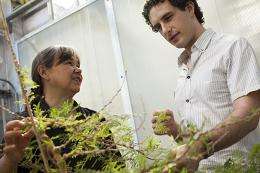
Harvard biologist Naomi Pierce and economist Glen Weyl, a junior fellow in Harvard's Society of Fellows, are co-authors on a new paper suggesting that the mutually beneficial relationships that species create are maintained because of simple self-interest. Photo: Stephanie Mitchell
(PhysOrg.com) -- Applying employment contract theory to symbiosis, a new paper suggests that the mutually beneficial relationships that species create are maintained because of simple self-interest, with partners benefiting from healthy hosts, much as employees benefit from robust employers.
The new work would discount the theory that host species have evolved to promote symbiosis, the close and helpful interaction of species, by promising rewards or threatening punishment.
Economists and biologists from Harvard University, the University of Toronto, and the University of East Anglia are presenting the work in the journal Proceedings of the National Academy of Sciences.
“Cooperation between species, known as ‘mutualism,’ is remarkably commonplace in nature, but the evolutionary origins of such partnerships remain murky,” said Naomi E. Pierce, the Sidney A. and John H. Hessel Professor of Biology at Harvard. “Since symbiotic host species essentially ‘employ’ their symbionts, it occurred to us that economic theories explaining how and why employers reward or punish their workers might give us deeper insights into symbiosis. This approach reveals that punishment is far from ubiquitous in nature.”
Most mutualism involves species, such as plants, that host smaller symbionts, such as bacteria or insects. Studies have observed that hosts can selectively reward cooperative symbionts and punish cheaters, such as when soybean plants direct food and oxygen only to root nodules colonized by nitrogen-fixing bacteria, and kill off nodules with unhelpful bacteria. But it has remained unclear how such symbioses evolved.
“The prevailing consensus, known as ‘host sanction’ theory, has been that host species have evolved to punish cheaters and to reward cooperators,” said Megan Frederickson, assistant professor of ecology and evolutionary biology at the University of Toronto. “However, an alternative explanation known as ‘partner fidelity feedback’ holds that instead of hosts evolving to punish and reward, symbionts have evolved to help their hosts, because a healthy host automatically feeds back benefits to the symbionts. A cheating symbiont would seem to be treated like any other environmental setback, such as infertile soil, and a mutualistic symbiont elicits the same sort of investments that are triggered by the availability of new resources, like a patch of sunlight.”
The researchers said their application of economic theory supports the latter explanation. Lead author E. Glen Weyl, an economist, used employment contract theory to design two tests to probe the evolution of mutualism. The team found that published data from two well-known pairs of symbiotic species better supported the view that symbionts have evolved to help their hosts rather than the hosts evolving to monitor and manage their symbionts.
“We proved the host sanction theory wrong by trying to prove it right,” said Weyl, a junior fellow in Harvard’s Society of Fellows. “Every time I created a model, it was in-consistent with the natural biological predictions and with the available evidence. The great virtue of economic theory is not exactly that it is so often right, but that its precision allows it to be easily falsified when it is not.”
The analysis by Weyl and his colleagues showed that in two classic mutualisms where host sanctions were thought to prevent cheating — one between a legume and a soil bacterium, and the other between a yucca and a moth — the evidence is actually more consistent with the competing theory of partner fidelity feedback.
“The mathematical tools in economic contract theory and mutualisms make quite a natural pairing, but in a way we hadn’t anticipated,” said Douglas W. Yu, lecturer in biological sciences at the University of East Anglia. “Rather than just confirming expectations, the theory let us design powerful tests to choose between hypotheses. It’s always tempting to start with the assumption that an interesting behavior, such as punishment, is the product of specific adaptations, but Glen’s model forcefully reminds us that there is already a lot of biology out there, which natural selection makes use of.”
More information: http://www.pnas.org/
-
Evolution of root nodule symbiosis with nitrogen-fixing bacteria
Mar 04, 2008 |
not rated yet |
0
-
Microbes and their hosts -- exploring the complexity of symbiosis in DNA and cell biology
Jul 28, 2009 |
not rated yet |
0
-
Bacterial gut symbionts are tightly linked with the evolution of herbivory in ants
Dec 01, 2009 |
not rated yet |
0
-
Ocean sampling yields environmental sources of coral symbionts
Dec 04, 2006 |
not rated yet |
0
-
In sync: Squid, glowing companions march in genetic harmony
Jan 19, 2010 |
not rated yet |
0
-
Engineers build first sub-10-nm carbon nanotube transistor
Feb 01, 2012 |
4.9 / 5 (31) |
30
-
Something old, something new: Evolution and the structural divergence of duplicate genes
Jan 31, 2012 |
4.6 / 5 (7) |
1
-
The hidden nanoworld of ice crystals: Revealing the dynamic behavior of quasi-liquid layers
Jan 30, 2012 |
5 / 5 (3) |
1
-
Stock market network reveals investor clustering
Jan 27, 2012 |
3.9 / 5 (23) |
8
-
Of microchemistry and molecules: Electronic microfluidic device synthesizes biocompatible probes
Jan 26, 2012 |
5 / 5 (1) |
0
-
Mitosis
2 hours ago
-
Stem cell question.
3 hours ago
-
Protease cleavage
10 hours ago
-
Pertubance in a model
16 hours ago
-
Cancer drugs and Alzheimer's, Oh my!
Feb 09, 2012
-
Squishing cells
Feb 09, 2012
- More from Physics Forums - Biology
More news stories
The power of estrogen -- male snakes attract other males
A new study has shown that boosting the estrogen levels of male garter snakes causes them to secrete the same pheromones that females use to attract suitors, and turned the males into just about the sexiest ...
14 hours ago |
4.8 / 5 (6) |
1
|
Grass to gas: Researchers' genome map speeds biofuel development
Researchers at the University of Georgia have taken a major step in the ongoing effort to find sources of cleaner, renewable energy by mapping the genomes of two originator cells of Miscanthus x giganteus, a large perenn ...
11 hours ago |
3.8 / 5 (5) |
0
|
Experts reveal how plants don't get sunburn
(PhysOrg.com) -- Experts at the University of Glasgow have discovered how plants survive the harmful rays of the sun.
14 hours ago |
4.8 / 5 (5) |
0
|
Miami battling invasion of giant African snails
No one knows how they got there. But an invasion of African giant snails has southern Florida in a panic over potential crop damage, disease and general yuckiness surrounding the slimy gastropods.
18 hours ago |
4 / 5 (1) |
4
Protein libraries in a snap
(PhysOrg.com) -- A Rice University undergraduate will depart with not only a degree but also a possible patent for his invention of an efficient way to create protein libraries, an important component of biomolecular ...
18 hours ago |
4.8 / 5 (4) |
0
|
Google users warned of threat to smartphone wallets
Users of Google smartphone wallets were being warned on Friday that there is a way to crack pass codes intended to thwart thieves from going on illicit shopping sprees.
Anonymous knocks CIA website offline (Update)
The website of the Central Intelligence Agency was inaccessible on Friday after the hacker group Anonymous claimed to have knocked it offline.
New error-correcting codes guarantee the fastest possible rate of data transmission
Error-correcting codes are one of the triumphs of the digital age. Theyre a way of encoding information so that it can be transmitted across a communication channel such as an optical fiber o ...
Humans may have helped the decline of African rainforests 3000 years ago
(PhysOrg.com) -- Large areas of rainforests in Central Africa mysteriously disappeared over three thousand years ago, to be replaced by savannas. The prevailing theory has been that the cause was a change ...
New power source discovered
(PhysOrg.com) -- Researchers at the Massachusetts Institute of Technology (MIT) and RMIT University have made a breakthrough in energy storage and power generation.
Complex wiring of the nervous system may rely on a just a handful of genes and proteins
Researchers at the Salk Institute have discovered a startling feature of early brain development that helps to explain how complex neuron wiring patterns are programmed using just a handful of critical genes. ...
Aug 31, 2010
Rank: 3 / 5 (1)
Aug 31, 2010
Rank: 1 / 5 (1)
Say hi to that cad Dawkins for me....
Aug 31, 2010
Rank: 3.7 / 5 (3)
30 years ago I was hearing Mutualism described in much the same terms as this "Employment Contract theory". I don't remember any reference to "host sanction", which is obviously a weak, non flying model, any way, and -odd as it may seem, appears to have been used as a straw man here! Is this evidence for the politicization of Scientific thought? I sure hope not. But if it is, then it has gotten much worse than I was aware...
Sep 01, 2010
Rank: not rated yet