'Dark silicon' to improve smartphone battery life
September 1, 2010
Dark silicon to improve smartphone battery life

Enlarge

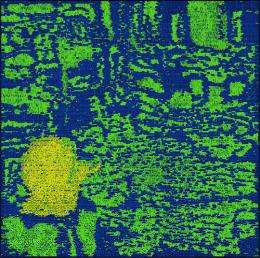
One example of a conservation core. The small boxes in the image are the pattern of logic gates that are spatially placed over a small portion of the GreenDroid chip.

(PhysOrg.com) -- A new smartphone chip prototype under development at the University of California, San Diego will improve smartphone efficiency by making use of "dark silicon" - the underused transistors in modern microprocessors. On August 23, UC San Diego computer scientists presented GreenDroid, the new smartphone chip prototype at the HotChips symposium in Palo Alto, CA.

Dark silicon refers to the huge swaths of silicon transistors on today’s chips that are underused because there is not enough power to utilize all the transistors at the same time. The new GreenDroid chip prototype from at UC San Diego will deliver improved performance through specialized processors fashioned from dark silicon. These processors are designed to run heavily used chunks of code, called “hot code,” in Google’s Android smartphone platform.

Computer science professors Michael Taylor and Steven Swanson from the Department of Computer Science and Engineering (CSE) at the UC San Diego Jacobs School of Engineering are leading the project.

“This is an exciting time for UCSD. Our students are designing a real multicore processing chip, in an advanced technology, that is simultaneously advancing the state-of-the art in both smartphone and processor design. This marks the first of what I hope is many such chips that will come out of the UCSD research community,” said Taylor.

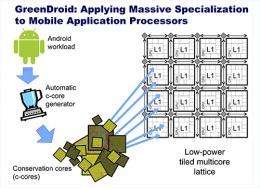
While chip makers can now make similar types of specialized processors by hand, the UC San Diego computer scientists developed a fully automated system. It generates blueprints for specialized processors, called conservation cores, from source code extracted from applications.

GreenDroid conservation cores use 11 times less energy per instruction than an aggressive mobile application processor. Accounting for code running outside the conservation core still results in an increase in efficiency of 7.5 times compared to an aggressive mobile application processor, according to the computer scientists’ HotChips presentation.

“Smartphones are a perfect match for our approach, since users spend most of their time running a core set of applications, and they demand long battery life. As mobile applications become more sophisticated, it’s going to be harder and harder to meet that challenge. Conservation cores offer a solution that exploits a resource that will soon be quite plentiful - dark silicon,” said Swanson.
Conservation cores also incorporate focused reconfigurability that allows them to adapt to small changes in the target application while still delivering efficiency gains.
Dark silicon to improve smartphone battery life
Enlarge

An overview of the GreenDroid project from computer scientists at UC San Diego.

Dark Silicon

This work is motivated by the growing problem of dark silicon, which refers to transistors on microprocessors that are forced to remain off most of the time because of power constraints.

“We don’t have enough power to use all the transistors at once - that is the ‘utilization wall,’” said UC San Diego computer science graduate student Nathan Goulding who presented the team’s GreenDroid chip at HotChips. Goulding led GreenDroid development, which is one part of the larger conservation core project.

“The utilization wall will change the way everyone builds processors,” the computer scientists reported in their HotChips talk.
If this utilization wall problem is not solved, more transistors on computer chips will not necessarily lead to improved performance or problem solving capacity in each new chip generation.

Automated Hardware Maker

As a real-world prototype, the computer scientists from the UC San Diego Jacobs School of Engineering used dark silicon to build specialized circuits for specific tasks frequently performed by popular smartphone applications such as Web browsers, email software and music players. The computer scientists asked ‘where does most of the computation happen?’

They took answers to this question, and fed the relevant code into their automated tool chain.

“A chip that does MP3 decoding…people can build specialized logic for this by hand, but it’s an enormous amount of effort and this doesn’t scale well. Our approach is automated,” said Goulding.

The computer scientists input pieces of code shared by multiple software applications for Android phones. The output at the end of the automated chain is a blueprint for specialized hardware. This specialized hardware will only execute some regions of the software code. The rest of the code, known as “cold code”, is executed by the phone’s general processor.

The computer scientists chose a smartphone for their chip prototype because mobile handsets are the new dominant computing platform. “Smartphones are going to be everywhere,” said Goulding, “We said to ourselves, ‘let’s make a prototype chip that saves energy on phones.’”

More information: GreenDroid: A Mobile Application Processor for Silicon’s Dark Future, Nathan Goulding, Jack Sampson, Ganesh Venkatesh, Saturnino Garcia, Joe Auricchio, Jonathan Babb,Michael Taylor, andSteven Swanson, Proceedings of HotChips, 2010.

Related work from the team: Conservation Cores: Reducing the Energy of Mature Computations, Ganesh Venkatesh, Jack Sampson, Nathan Goulding, Saturnino Garcia, Vladyslav Bryksin, Jose Lugo-Martinez,Steven Swanson, andMichael Bedford Taylor, ASPLOS '10: Proceeding of the 15th international conference on Architectural support for programming languages and operating systems, 2010.

Provided by University of California - San Diego (news : web)

4.6 /5 (10 votes)  

Filter


Move the slider to adjust rank threshold, so that you can hide some of the comments.


Display comments: newest first

Kedas
Sep 01, 2010

Rank: 3 / 5 (2)
"As mobile applications become more sophisticated, it’s going to be harder and harder to meet that challenge."

It is the other way around it is the speed of the processor that makes them decide to add more demanding applications.
If you use a faster CPU they just going to add something that brings it down again.
winthrom
Sep 01, 2010

Rank: 2.7 / 5 (3)
The "Microsoft Syndrome" is to make fatter code that does little more, or no more, than the leaner code it replaces, and call it a new release. Fat object oriented code compilers that generate easy to write and test code (fast to market) by "code hackers" in India and China will soon bog down smart phones also. Real software programmers (C code & assembler) are getting harder to find, and they are not cheap either. Mobile applications will follow the road pioneered by Microsoft on PCs. Soon, a smart phone will be powerful enough to be the brain in artificial life, a real andriod.
Parsec
Sep 01, 2010

Rank: 5 / 5 (5)
Real software programmers (C code & assembler)


omg, a religious zealot. Modern programming languages (like C++), modern optmizing compilers, and new programming techniques can make programs that are nearly as fast as hand-coded versions, with orders of magnitude more programmer productivity and far fewer bugs.

I speak from experience. I have programmed in at least 20 assemblers (3 of which I wrote myself), and in C for 10 years before switching to C++. I would rather have my eyebrows completely plucked with duct tape than go back.
Rank 4.6 /5 (10 votes)
Related Stories
Relevant PhysicsForums posts
  • Remote Internet voting security flaw?
    createdFeb 01, 2012
  • iPhone battery over time
    createdJan 30, 2012
  • Best alternate Tablet to an iPad for writing math or physics equations?
    createdJan 26, 2012
  • Sending SMS to a website
    createdJan 20, 2012
  • Need help with my technical fest!
    createdJan 19, 2012
  • Ubislate 7 upgrade to the world's cheapest tablet
    createdJan 06, 2012
  • More from Physics Forums - Computing & Technology

More news stories

Hackers intercept FBI, Scotland Yard call (Update)

(AP) -- Trading jokes and swapping leads, investigators from the FBI and Scotland Yard spent the conference call strategizing about how to bring down the hacking collective known as Anonymous, responsible ...

Technology / Internet

created 13 hours ago | popularity 5 / 5 (7) | comments 22

Japanese entrepreneurs aim for Silicon Valley

For an emerging generation of Japanese innovators, the dream isn't a job for life at a big company. They have new ambitions, and they're determined to go places. Especially Silicon Valley.

Technology / Business

created 10 hours ago | popularity 5 / 5 (1) | comments 1

A 'natural' solution for transportation

As the United States transitions away from a primarily petroleum-based transportation industry, a number of different alternative fuel sources—ethanol, biodiesel, electricity and hydrogen—have each ...

Technology / Energy & Green Tech

created 14 hours ago | popularity 3 / 5 (2) | comments 13

Hackers deface website of lawyers for US Marine

Members of the hacker group Anonymous defaced the website on Friday of the law firm that defended a US Marine who faced charges in connection with the 2005 killing of 24 Iraqi civilians.

Technology / Internet

created 7 hours ago | popularity 5 / 5 (2) | comments 2

TV executives crave viewers who watch 2 screens

Forget the small screen and the big screen. The hottest new thing in television is the "second screen" - the one on the tablet computer or cell phone that an increasing number of viewers keep an eye on while they're watching ...

Technology / Telecom

created 7 hours ago | popularity 1 / 5 (2) | comments 0


Amazon fungi found that eat polyurethane, even without oxygen

(PhysOrg.com) -- Until now polyurethane has been considered non-biodegradable, but a group of students from Yale University in the US has found fungi that will not only eat and digest it, they will do so even in the absence ...

Scientists chart high-precision map of Milky Way's magnetic fields

(PhysOrg.com) -- Scientists at the Naval Research Laboratory (NRL) are part of an international team that has pooled their radio observations into a database, producing the highest precision map to date of ...

Whole exome sequencing identifies cause of metabolic disease

Sequencing a patient's entire genome to discover the source of his or her disease is not routine – yet. But geneticists are getting close.

Hearing metaphors activates brain regions involved in sensory experience

When a friend tells you she had a rough day, do you feel sandpaper under your fingers? The brain may be replaying sensory experiences to help understand common metaphors, new research suggests.

Renowned physicist invents microscope that can peer at living brain cells

(PhysOrg.com) -- Ever since scientists began studying the brain, they’ve wanted to get a better look at what was going on. Researchers have poked and prodded and looked at dead cells under electron microscopes, ...

New kind of high-temperature photonic crystal could someday power everything from smartphones to spacecraft

A team of MIT researchers has developed a way of making a high-temperature version of a kind of materials called photonic crystals, using metals such as tungsten or tantalum. The new materials — which ...