Gentle bilby had 'killer' ancestor
September 1, 2010 By Bob Beale
Gentle bilby had 'killer' ancestor

Enlarge

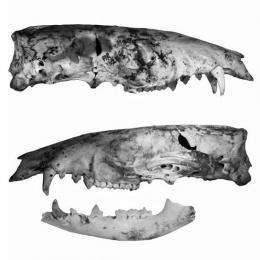
Exceptional fossil - 20 million years old

(PhysOrg.com) -- The gentle rabbit-like bilby - Australia's stand-in for the Easter bunny - had an ancient relative that was a far more fearsome little beast, a new study has found.

The gentle rabbit-like bilby - Australia's stand-in for the Easter bunny - had an ancient relative that was a far more fearsome little beast, a new study has found.

Although modern bilbies are mild-mannered creatures that eat mainly plants and insects, one 20 million years ago had the stout , muscular jaws and flesh-tearing teeth of a small but formidable predator, according to a paper to be in the .

The finding is based on an almost complete skull of the fossil marsupial, which has been named Galadi speciosus, discovered a team of University of New South Wales scientists at the Riversleigh World Heritage Area fossil site in northern Queensland.

"The preservation of the skull is exceptional - almost as good as for a modern animal - and this gives us a lot of information about Galadi’s anatomy, relationships and probable lifestyle,’ says Dr Kenny Travouillon, of the UNSW School of Biological, Earth and Environmental Sciences, who is lead author of the study.

"Features of the skull and teeth of Galadi show that it is a member of the same group of small marsupials including the modern bilby and bandicoots: they are found only in Australia and New Guinea and mostly weigh less than five kilograms."

Co-author Dr Robin Beck, from the American Museum of Natural History, points out that while Galadi probably weighed only about one kilogram, it appears to have been specialised to hunt for vertebrate prey.

"Compared to modern bandicoots, Galadi has a short snout and very robust skull, with big areas for the attachment of : it’s the pitbull of the bandicoot world," says Dr Beck.

"In terms of overall skull shape, it’s more like living carnivorous marsupials - such as quolls - which feed mainly on lizards, birds and , so we think Galadi probably had a similar diet."

Today, bilbies are found in Australia's western deserts, but Galadi and other members of its marsupial group appear to have been the dominant small predators in the rainforests that covered northern Australia 20 million years ago. Today, that niche is filled by a different marsupial group, the dasyurids, which include quolls, marsupial "mice" and the Tasmanian devil.

"We’re looking at Riversleigh and other Australian fossil sites to work out exactly when and why this replacement occurred," says Dr Yamila Gurovich, another UNSW co-author of the study.

Provided by University of New South Wales (news : web)


Rank 5 /5 (4 votes)
Related Stories
Relevant PhysicsForums posts
  • Mitosis
    created6 hours ago
  • Stem cell question.
    created7 hours ago
  • Protease cleavage
    created14 hours ago
  • Pertubance in a model
    created20 hours ago
  • Cancer drugs and Alzheimer's, Oh my!
    createdFeb 09, 2012
  • Squishing cells
    createdFeb 09, 2012
  • More from Physics Forums - Biology

More news stories

A frank discussion of the power law and linking correlation to causation

(PhysOrg.com) -- Michael Stumpf a mathematics professor at Imperial College in London, and Mason Porter a lecturer at Oxford have teamed together to write and publish a perspective piece in Science regarding the in ...

Other Sciences / Mathematics

created 20 hours ago | popularity 5 / 5 (3) | comments 8 | with audio podcast report

Employers feel no love for unscrupulous practice of 'service sweethearting'

A new study led by two Florida State University marketing professors finds that some frontline service employees who are rewarded for hikes in customer loyalty and satisfaction also may engage in "service ...

Other Sciences / Economics & Business

created 14 hours ago | popularity 4 / 5 (1) | comments 7

The question of life in the ancient world

There’s a general feeling that we don’t get the Greeks – ancient or modern. Many, including heads of state like Angela Merkel, visibly shake their head in exasperation, rightly or wrongly, at ...

Other Sciences / Archaeology & Fossils

created 20 hours ago | popularity 1.3 / 5 (3) | comments 4

Sonic Cradle lands spot in TED exhibition

A Simon Fraser University graduate student project that melds music, meditation and modern technology has landed a rare spot as an exhibit at TEDActive 2012 in Palm Springs, California this month.

Other Sciences / Other

created 16 hours ago | popularity not rated yet | comments 0

Do we no longer care about the collective good?

The Transformation of Solidarity, a book co-edited by University of Queensland sociologist Dr Mara Yerkes, tackles the subject of globalisation of national economies and societies where we put a high value ...

Other Sciences / Social Sciences

created Feb 06, 2012 | popularity 3.9 / 5 (8) | comments 39


Anonymous knocks CIA website offline (Update)

The website of the Central Intelligence Agency was inaccessible on Friday after the hacker group Anonymous claimed to have knocked it offline.

New error-correcting codes guarantee the fastest possible rate of data transmission

Error-correcting codes are one of the triumphs of the digital age. They’re a way of encoding information so that it can be transmitted across a communication channel — such as an optical fiber o ...

Humans may have helped the decline of African rainforests 3000 years ago

(PhysOrg.com) -- Large areas of rainforests in Central Africa mysteriously disappeared over three thousand years ago, to be replaced by savannas. The prevailing theory has been that the cause was a change ...

New power source discovered

(PhysOrg.com) -- Researchers at the Massachusetts Institute of Technology (MIT) and RMIT University have made a breakthrough in energy storage and power generation.

Small modular reactor design could be a 'SUPERSTAR'

(PhysOrg.com) -- Though most of today's nuclear reactors are cooled by water, we've long known that there are alternatives; in fact, the world's first nuclear-powered electricity in 1951 came from a reactor ...

The power of estrogen -- male snakes attract other males

A new study has shown that boosting the estrogen levels of male garter snakes causes them to secrete the same pheromones that females use to attract suitors, and turned the males into just about the sexiest ...