The superwind galaxy NGC 4666 (w/ Video)
September 1, 2010
The superwind galaxy NGC 4666

Enlarge

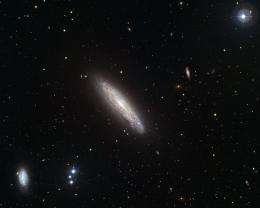
This visible light image, made with the Wide Field Imager on the MPG/ESO 2.2-meter telescope at the La Silla Observatory in Chile, shows the galaxy NGC 4666 in the center. It is a starburst galaxy, about 80 million light-years from Earth, in which particularly intense star formation is taking place. The starburst is thought to be caused by gravitational interactions with neighboring galaxies, including NGC 4668, visible to the lower left. A combination of supernova explosions and strong winds from massive stars in the starburst region drives a vast outflow of gas from the galaxy into space -- a so-called "superwind". NGC 4666 had previously been observed in X-rays by the ESA XMM-Newton space telescope, and these visible light observations were made to target background objects detected in the earlier X-ray images. This picture, which covers a field of 16 by 12 arcminutes, is a combination of twelve CCD frames, 67 megapixels each, taken through blue, green and red filters. Credit: ESO/J. Dietrich

(PhysOrg.com) -- The galaxy NGC 4666 takes pride of place at the centre of this new image, made in visible light with the Wide Field Imager on the MPG/ESO 2.2-meter telescope at the La Silla Observatory in Chile. NGC 4666 is a remarkable galaxy with very vigorous star formation and an unusual "superwind" of out-flowing gas. It had previously been observed in X-rays by the ESA XMM-Newton space telescope, and the image presented here was taken to allow further study of other objects detected in the earlier X-ray observations.

The prominent galaxy NGC 4666 in the centre of the picture is a starburst galaxy, about 80 million light-years from Earth, in which particularly intense star formation is taking place. The starburst is thought to be caused by gravitational interactions between NGC 4666 and its neighbouring , including NGC 4668, visible to the lower left. These interactions often spark vigorous star-formation in the galaxies involved.

A combination of supernova explosions and strong winds from massive stars in the starburst region drives a vast flow of gas from the galaxy into space — a so-called "superwind". The superwind is huge in scale, coming from the bright central region of the galaxy and extending for tens of thousands of light-years. As the superwind gas is very hot it emits radiation mostly as X-rays and in the radio part of the spectrum and cannot be seen in visible light images such as the one presented here.

This image was made as part of a follow-up to observations made with the ESA XMM-Newton in X-rays. NGC 4666 was the target of the original XMM-Newton observations, but thanks to the telescope's wide field-of-view many other X-ray sources were also seen in the background. One such serendipitous detection is a faint galaxy cluster seen close to the bottom edge of the image, right of centre. This cluster is much further away from us than NGC 4666, at a distance of about three billion light-years.

This video is not supported by your browser at this time.

In this zoom sequence we start with a view of part of the constellation of Virgo, far from the plane of the Milky Way and home to the Virgo cluster of galaxies. The brilliant double star Gamma Virginis appears at the lower right and we can faintly see the galaxy NGC 4666 above the centre of the picture. This apparently insignificant oval is in fact a starburst galaxy, about 80 million light-years from Earth, in which particularly intense star formation is taking place. The final part of the sequence shows the detailed Wide Field Imager view of the galaxy and its environment. Credit: ESO/J. Dietrich, Digitized Sky Survey 2. Acknowledgment: Davide De Martin. Music: John Dyson (from the album "Darklight")

In order to fully understand the nature of astronomical objects, researchers must study them at several wavelengths. This is because light of different wavelengths can tell us about different physical processes taking place. In this case the Wide Field Imager (WFI) observations were made in to further investigate these serendipitously detected X-ray objects — a good example of how astronomers using different telescopes work together to explore the Universe.

More information: Science paper: A&A 449, 837

Provided by ESO (news : web)

4.5 /5 (8 votes)  

Rank 4.5 /5 (8 votes)
Related Stories
Relevant PhysicsForums posts
  • Scale of the Universe
    created7 hours ago
  • Titan's lack of impact craters
    createdFeb 09, 2012
  • Real pictures of black hole eating a star?
    createdFeb 08, 2012
  • Hypothetical way to travel faster than light, but not technically exceed lightspeed
    createdFeb 06, 2012
  • How do scientists monitor the Sun's activity?
    createdFeb 05, 2012
  • Search patterns in observational studies
    createdFeb 05, 2012
  • More from Physics Forums - General Astronomy

More news stories

Humans may have helped the decline of African rainforests 3000 years ago

(PhysOrg.com) -- Large areas of rainforests in Central Africa mysteriously disappeared over three thousand years ago, to be replaced by savannas. The prevailing theory has been that the cause was a change ...

Space & Earth / Environment

created 18 hours ago | popularity 4.3 / 5 (11) | comments 12 | with audio podcast report

Could Venus be shifting gear?

(PhysOrg.com) -- ESA’s Venus Express spacecraft has discovered that our cloud-covered neighbour spins a little slower than previously measured. Peering through the dense atmosphere in the infrared, the ...

Space & Earth / Space Exploration

created 14 hours ago | popularity 5 / 5 (7) | comments 7 | with audio podcast

NASA budget will axe Mars deal with Europe: scientists

US President Barack Obama's budget proposal to be submitted next week for 2013 will cut NASA's budget by 20 percent and eliminate a major partnership with Europe on Mars exploration, scientists said Thursday.

Space & Earth / Space Exploration

created 17 hours ago | popularity 5 / 5 (2) | comments 18

Mars Science Laboratory computer issue resolved

(PhysOrg.com) -- Engineers have found the root cause of a computer reset that occurred two months ago on NASA's Mars Science Laboratory and have determined how to correct it.

Space & Earth / Space Exploration

created 15 hours ago | popularity 4.7 / 5 (6) | comments 3 | with audio podcast

NASA sees wide-eyed cyclone Jasmine

Cyclone Jasmine's eye has opened wider on NASA satellite imagery, as it moves through the Southern Pacific Ocean.

Space & Earth / Earth Sciences

created 6 hours ago | popularity 3.5 / 5 (2) | comments 1


Google users warned of threat to smartphone wallets

Users of Google smartphone wallets were being warned on Friday that there is a way to crack pass codes intended to thwart thieves from going on illicit shopping sprees.

Anonymous knocks CIA website offline (Update)

The website of the Central Intelligence Agency was inaccessible on Friday after the hacker group Anonymous claimed to have knocked it offline.

New error-correcting codes guarantee the fastest possible rate of data transmission

Error-correcting codes are one of the triumphs of the digital age. They’re a way of encoding information so that it can be transmitted across a communication channel — such as an optical fiber o ...

Complex wiring of the nervous system may rely on a just a handful of genes and proteins

Researchers at the Salk Institute have discovered a startling feature of early brain development that helps to explain how complex neuron wiring patterns are programmed using just a handful of critical genes. ...

New power source discovered

(PhysOrg.com) -- Researchers at the Massachusetts Institute of Technology (MIT) and RMIT University have made a breakthrough in energy storage and power generation.

The power of estrogen -- male snakes attract other males

A new study has shown that boosting the estrogen levels of male garter snakes causes them to secrete the same pheromones that females use to attract suitors, and turned the males into just about the sexiest ...