NIST researchers create 'quantum cats' made of light
September 1, 2010
NIST researchers create 'quantum cats' made of light

Enlarge

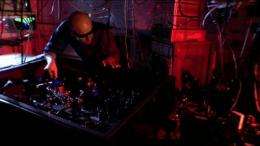
This is NIST research associate Thomas Gerrits at the laser table used to create "quantum cats" made of light. Credit: NIST

Researchers at the National Institute of Standards and Technology have created "quantum cats" made of photons (particles of light), boosting prospects for manipulating light in new ways to enhance precision measurements as well as computing and communications based on quantum physics.

The NIST experiments, described in a forthcoming paper,* repeatedly produced light pulses that each possessed two exactly opposite properties—specifically, opposite phases, as if the peaks of the were superimposed on the troughs. Physicists call this an optical Schrödinger's cat. NIST's quantum cat is the first to be made by detecting three photons at once and is one of the largest and most well-defined cat states ever made from light. (Larger cat states have been created in different systems by other research groups, including one at NIST.)

A "cat state" is a curiosity of the , where particles can exist in "superpositions" of two opposite properties simultaneously. Cat state is a reference to German physicist Erwin Schrödinger's famed 1935 theoretical notion of a cat that is both alive and dead simultaneously.

"This is a new state of light, predicted in for a long time," says NIST research associate Thomas Gerrits, lead author of the paper. "The technologies that enable us to get these really good results are ultrafast lasers, knowledge of the type of light needed to create the cat state, and photon detectors that can actually count individual photons."
NIST researchers create 'quantum cats' made of light
Enlarge

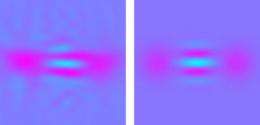
These colorized plots of electric field values indicate how closely the NIST "quantum cats" (left) compare with theoretical predictions for a cat state (right). The purple spots and alternating blue contrast regions in the center of the images indicate the light is in the appropriate quantum state. Credit: Gerrits/NIST

The NIST team created their optical cat state by using an ultrafast laser pulse to excite special crystals to create a form of light known as a squeezed vacuum, which contains only even numbers of photons. A specific number of photons were subtracted from the squeezed vacuum using a device called a beam splitter. The photons were identified with a NIST sensor that efficiently detects and counts individual photons (see "NIST Detector Counts Photons With 99 Percent Efficiency")

Depending on the number of subtracted , the remaining light is in a state that is a good approximation of a quantum cat says Gerrits—the best that can be achieved because nobody has been able to create a "real" one, by, for instance, the quantum equivalent to superimposing two weak laser beams with opposite phases.

More information: * T. Gerrits, S. Glancy, T. Clement , B. Calkins, A. Lita, A. Miller, A. Migdall, S.W. Nam, R. Mirin and E. Knill. Generation of optical coherent state superpositions by number-resolved photon subtraction from squeezed vacuum. Physical Review A. Forthcoming.

Provided by National Institute of Standards and Technology (news : web)

4.9 /5 (7 votes)  

Filter


Move the slider to adjust rank threshold, so that you can hide some of the comments.


Display comments: newest first

Xaero
Sep 01, 2010

Rank: 1.8 / 5 (4)
Actually Schrodinger cat though experiment was misinterpreted from its very beginning, because cat in the box will be always entangled with the box and poison in it - not just with observer. The life is nothing more, then the specially entangled state of organic molecules in space-time. The intermediate time of cat's life existence is the time, required for poison to kill the cat. It means, the life-time of "quantum cats" is principally limited by quantum decoherence (i.e. by vacuum noise, illustratively speaking) as well. This is why so fast lasers pulses are required for detection of this intermediate state of lightweight electrons. At the case of real cat such time would be significantly longer, accordingly.
Hesperos
Sep 01, 2010

Rank: 1.7 / 5 (3)
Did the cat die?


It depends.
Skeptic_Heretic
Sep 02, 2010

Rank: not rated yet
Actually Schrodinger cat though experiment was misinterpreted from its very beginning, because cat in the box will be always entangled with the box and poison in it - not just with observer.
There is no observer in the hypothetical of Schrodinger's Cat. The hypothetical merely explains superposition and quantum probability.
Hesperos
Sep 02, 2010

Rank: 1 / 5 (1)
I wonder if you feed them with quantum cat food made of quarks....
Xaero
Sep 02, 2010

Rank: 1 / 5 (2)
..there is no observer in the hypothetical of Schrodinger's Cat.
How can you know after then, that cat exists, it exists inside of box, in box with trigger and poison at the same moment?

You're assuming too much for observeless hypothesis. Without observer such cat could live outside of box safely and it could appear rather like green platypus... If you're sure, cat sits inside of box during whole experiment, you're expected to remain entangled with box via uninterrupted observation of it, and the cat remains entangled with internal walls of box.
Skeptic_Heretic
Sep 03, 2010

Rank: not rated yet
How can you know after then, that cat exists, it exists inside of box, in box with trigger and poison at the same moment?
That is exactly the point.
You're assuming too much for observeless hypothesis. Without observer such cat could live outside of box safely and it could appear rather like green platypus... If you're sure, cat sits inside of box during whole experiment, you're expected to remain entangled with box via uninterrupted observation of it, and the cat remains entangled with internal walls of box.
You put the cat there. Once you close the box there is no observer. If there is an observer there is no entanglement, no superposition, and the cat is always dead. Good job completely missing the point of the example.
Rank 4.9 /5 (7 votes)
Related Stories
Relevant PhysicsForums posts
  • Dark Energy question
    created1 hour ago
  • Wind Turbine Power
    created3 hours ago
  • Steam Table issues
    created5 hours ago
  • electrostatic induction in a conductor should be immpossible
    created9 hours ago
  • Help! Physics Momentum/Impulse problem!
    created11 hours ago
  • Gauss' law cubes, how to prove
    created13 hours ago
  • More from Physics Forums - General Physics

More news stories

Hovering not hard if you're top-heavy, researchers find

Top-heavy structures are more likely to maintain their balance while hovering in the air than are those that bear a lower center of gravity, researchers at New York University's Courant Institute of Mathematical Sciences ...

Physics / General Physics

created just added | popularity not rated yet | comments 0 | with audio podcast

SLAC, Stanford team focuses on high-energy electrons to treat cancer

Accelerator physicists at SLAC and cancer specialists from Stanford are working on a new technology that could dramatically reduce the time needed for cancer radiation treatments. The team ran an initial experiment ...

Physics / General Physics

created 3 hours ago | popularity not rated yet | comments 0

Measurements from high-energy collisions lead to better understanding of why meson particles disappear

For several years, physicists at the Relativistic Heavy Ion Collider (RHIC) at Brookhaven National Laboratory (BNL), USA, have studied an unusual state of matter called the quark–gluon plasma, which they ...

Physics / General Physics

created 3 hours ago | popularity not rated yet | comments 0

Quantum physicist explains $100K offer for proof scaled-up quantum computing is impossible

(PhysOrg.com) -- MIT researcher Scott Aaronson has certainly riled the physics community with his offer this past Friday, of $100,000 to anyone who can prove that scaled-up quantum computing is impossible. ...

Physics / Quantum Physics

created Feb 08, 2012 | popularity 4.1 / 5 (11) | comments 32 | with audio podcast weblog

Explained: Sigma

It's a question that arises with virtually every major new finding in science or medicine: What makes a result reliable enough to be taken seriously? The answer has to do with statistical significance -- but ...

Physics / General Physics

created Feb 09, 2012 | popularity 5 / 5 (14) | comments 26


New understanding of DNA repair could eventually lead to cancer therapy

A research group in the Faculty of Medicine & Dentistry at the University of Alberta is hoping its latest discovery could one day be used to develop new therapies that target certain types of cancers.

Zuckerberg's focus drives Facebook's ascent

When Mark Zuckerberg showed up to rent Judy Fusco's Los Altos, Calif., house in the fall of 2004, soon after he'd arrived in Silicon Valley, the landlord was immediately struck by his confidence.

Both maternal and paternal age linked to autism

Older maternal and paternal age are jointly associated with having a child with autism, according to a recently published study led by researchers at The University of Texas Health Science Center at Houston (UTHealth).

Night, weekend delivery OK for babies with birth defects

Weekday delivery is no better than night or weekend delivery for infants with birth defects, according to a new study presented today at The Pregnancy Meeting, the Society for Maternal-Fetal Medicine's annual conference. ...

Sonic Cradle lands spot in TED exhibition

A Simon Fraser University graduate student project that melds music, meditation and modern technology has landed a rare spot as an exhibit at TEDActive 2012 in Palm Springs, California this month.

Drug halts organ damage in inflammatory genetic disorder

A new study shows that Kineret (anakinra), a medication approved for the treatment of rheumatoid arthritis, is effective in stopping the progression of organ damage in people with neonatal-onset multisystem inflammatory disease ...