Researchers demonstrate new MEMS dynamic rheometer (w/ Video)
September 1, 2010
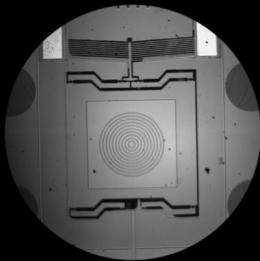
This is the NIST MEMS-based rheometer. The moving plate is controlled by resistance heating elements in the chevron-like structure at the top; expansion and contraction of the vanes causes the plate to move up and down. Central square where the sample would rest is approximately 500 micrometers across. Credit: Christopher/NIST
Researchers at the National Institute of Standards and Technology have demonstrated a microminiaturized device that can make complex viscosity measurements -- critical data for a wide variety of fields dealing with things that have to flow -- on sample sizes as small as a few nanoliters. Currently a table-top prototype, the NIST rheometer could be a particularly valuable tool for biotechnologists studying minute quantities of complex materials that must function in confined spaces.
Viscosity, elasticity and how materials flow when subject to a force is the subject of rheology, and the measurements tell a lot about a complicated material like a gel. Is it more like a liquid or a solid? By how much and under what conditions? The popular toy Silly Putty™ is a classic example of complex viscoelasticity, bouncing better than a rubber ball under a sharp, sudden force but slumping into a puddle when left alone.
One common way to make dynamic rheology measurements (how behavior changes with the speed or frequency of the applied force) is with a sizeable lab instrument that traps a test sample between a fixed plate and one that moves, and measures how much the thin layer of test material resists being deformed. Typical sample sizes are around a couple of milliliters, which doesn't sound like much, but, says polymer scientist Gordon Christopher, for some researchers it's a whole bunch.
"A lot of people in the biosciences are making very complex designer fluids based on proteins where you might make only 10 milliliters at a time. Polypeptide hydrogels for drug delivery or tissue replacement, for example," Christopher explains. "Their flow behaviors are very complicated and you really need to understand them, but in a traditional rheometer your sample for a single test is a large percentage of what you just spent two months making."
This video is not supported by your browser at this time.
This is the NIST MEMS-based rheometer. The moving plate is controlled by resistance heating elements in the chevron-like structure at the top; expansion and contraction of the vanes causes the plate to move up and down. Central square where the sample would rest is approximately 500 micrometers across. Credit: Christopher/NIST
Inspired by a talk by a NIST scientist working on the design of novel nano positioning microelectromechanical systems (MEMS), team leader Kalman Migler and his colleagues began a collaboration to build a MEMS device that duplicated a classic sliding-plate dynamic rheometer—but in a space about one-twentieth the size of a postage stamp. The sample size of the MEMS rheometer is about 5 nanoliters. "With our device, if you gave me a milliliter of sample, I could give you back hundreds of tests," Christopher says.Equally as important, he says, the MEMS rheometer inherently tests materials when they are confined in a very small space. For many biological applications where the material is meant to be used in a confined region like a blood vessel or the interior of a cell—or must be injected through a thin needle—understanding the flow characteristics of small amounts in a small space is more important than knowing how it behaves in bulk.
NIST's early prototype MEMS rheometers include only the core sliding plate mechanism on the MEMS chip, and rely on a microscope and high-speed cameras for the actual measurements. In a more polished version, according to the research team, the necessary sensors could be included on the chip and the entire instrument reduced to a handheld device for, e.g., quality control measurements on a plant floor.
The NIST MEMS dynamic rheometer is described in a new paper in Lab on a Chip.*
More information: * G.F. Christopher, J.M. Yoo, N. Dagalakis, S.D. Hudson and K.B. Migler. Development of aMEMS based dynamic rheometer. Lab Chip, 2010, Advance Article. DOI: 10.1039/C005065B
Provided by National Institute of Standards and Technology (news : web)
-
Three new standards for MEMS devices
Jul 16, 2004 |
not rated yet |
0
-
NIST develops test method for key micromechanical property
Jan 09, 2008 |
not rated yet |
0
-
Silly Putty probe yields non-silly results about time-dependent material properties
Jul 08, 2005 |
not rated yet |
0
-
'Micro-rack' measures cell mechanical properties
Mar 02, 2007 |
not rated yet |
0
-
Videos Extract Mechanical Properties of Liquid-Gel Interfaces
Jan 23, 2008 |
not rated yet |
0
-
Engineers build first sub-10-nm carbon nanotube transistor
Feb 01, 2012 |
4.9 / 5 (31) |
30
-
Something old, something new: Evolution and the structural divergence of duplicate genes
Jan 31, 2012 |
4.6 / 5 (7) |
1
-
The hidden nanoworld of ice crystals: Revealing the dynamic behavior of quasi-liquid layers
Jan 30, 2012 |
5 / 5 (3) |
1
-
Stock market network reveals investor clustering
Jan 27, 2012 |
3.9 / 5 (23) |
8
-
Of microchemistry and molecules: Electronic microfluidic device synthesizes biocompatible probes
Jan 26, 2012 |
5 / 5 (1) |
0
-
Stoichiometry
23 hours ago
-
Boiling and melting point of impure substances
Feb 10, 2012
-
Safe nitrogen compound to decompose a 500 deg C in a furnace?
Feb 09, 2012
-
[ask]electron inside drinking water
Feb 08, 2012
-
How to avoid formation of Lithium Chromate ???
Feb 08, 2012
-
how to choose a reduced or oxidated form in a redox
Feb 08, 2012
- More from Physics Forums - Chemistry
More news stories
Fool's gold may prove an unlikely alternative to overexploited catalytic materials
Catalytic materials, which lower the energy barriers for chemical reactions, are used in everything from the commercial production of chemicals to catalytic converters in car engines. However, with current catalytic materials ...
15 hours ago |
4.4 / 5 (8) |
5
|
Unpicking HIV’s invisibility cloak
Drug researchers hunting for alternative ways to treat human immunodeficiency virus (HIV) infections may soon have a novel targetits camouflage coat. HIV hides inside a cloak unusually rich in a sugar ...
15 hours ago |
5 / 5 (5) |
0
Hydrogen from acidic water: Researchers develop potential low cost alternative to platinum for splitting water
A technique for creating a new molecule that structurally and chemically replicates the active part of the widely used industrial catalyst molybdenite has been developed by researchers with the Lawrence Berkeley ...
Feb 09, 2012 |
4.8 / 5 (14) |
15
|
No entry without protein recycling: Researchers discover new coherence in enzyme transport
The group of Prof. Dr. Ralf Erdmann at the Ruhr-Universität Bochum, Germany, discovered a connection of peroxisomal protein import and receptor export. In the Journal of Biological Chemistry, they disclo ...
15 hours ago |
not rated yet |
0
Under the microscope #7
In this video Dr Ingrid Graz shows us a thin layer of gold on top of rubber. Cracks in the gold allow it to stretch and we can use this for stretchable electronics.
17 hours ago |
not rated yet |
0
Anonymous knocks CIA website offline (Update)
The website of the Central Intelligence Agency was inaccessible on Friday after the hacker group Anonymous claimed to have knocked it offline.
Google users warned of threat to smartphone wallets
Users of Google smartphone wallets were being warned on Friday that there is a way to crack pass codes intended to thwart thieves from going on illicit shopping sprees.
New error-correcting codes guarantee the fastest possible rate of data transmission
Error-correcting codes are one of the triumphs of the digital age. Theyre a way of encoding information so that it can be transmitted across a communication channel such as an optical fiber o ...
Humans may have helped the decline of African rainforests 3000 years ago
(PhysOrg.com) -- Large areas of rainforests in Central Africa mysteriously disappeared over three thousand years ago, to be replaced by savannas. The prevailing theory has been that the cause was a change ...
New power source discovered
(PhysOrg.com) -- Researchers at the Massachusetts Institute of Technology (MIT) and RMIT University have made a breakthrough in energy storage and power generation.
The power of estrogen -- male snakes attract other males
A new study has shown that boosting the estrogen levels of male garter snakes causes them to secrete the same pheromones that females use to attract suitors, and turned the males into just about the sexiest ...