The perfect nanocube: Precise control of size, shape and composition
September 1, 2010
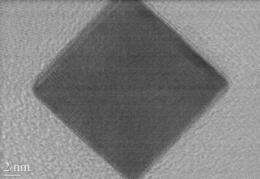
These electron microscope images show perfect-edged nanocubes produced in a one-step process created at NIST that allows careful control of the cubes’ size, shape and composition. Credit: NIST
(PhysOrg.com) -- With growing interest in using nanoparticles for everything from antibacterial socks to medical imaging to electronic devices, the need to understand the environmental, health and safety risks of these particles also grows. Researchers at the National Institute of Standards and Technology have developed a simple process for producing nanocrystals that will enable studies of certain physical and chemical properties that affect how nanoparticles interact with the world around them.
Because nanoparticles behave differently from bulk samples of the same material, new tests to understand how they affect biological systems must be developed. Toxicologists determine the hazards posed by nanoparticles by introducing them to a biological system and monitoring the effects, but they currently lack a set of control particles whose size, shape and composition have been carefully produced and characterized.
In a recent paper published in Angewandte Chemie,* NIST scientists describe a one-step process that allows them to control the size, shape and composition of gold-copper alloy nanocrystals to create perfect-edged nanocubes as small as 3.4 nanometers—just half the thickness of a cell wall and on the same size range as DNA.
The researchers combined and heated gold and copper precursors with other chemicals to produce highly crystalline, homogeneous, perfect nanocubes with abundant yield. To study the formation process, they removed samples at 1 hour, 1.5 hours, 5 hours, and 24 hours and found that just five hours were needed to produce perfectly cubic nanoparticles of uniform size. By adjusting the ratios of the chemicals in the original solution and the reaction time, they were able to precisely control the size, shape and composition of the nanocubes. This process is unique in allowing control of the ratio of copper to gold atoms within the nanocube to either 3:1 or 1:3.
"It's a simple process, and to the best of our knowledge is the first to use synthetic chemistry, or 'bottom up' technology, to produce gold-containing nanocubes below 5 nanometers. Anything less than 10 nanometers has been extremely challenging due to the mobile behavior of the gold atoms," says NIST physicist Angela R. Hight Walker, who wrote the paper with Yonglin Liu, a guest researcher at NIST.
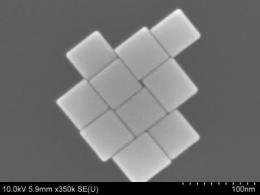
These electron microscope images show perfect-edged nanocubes produced in a one-step process created at NIST that allows careful control of the cubes' size, shape and composition. Credit: NIST
The NIST-developed process for creating such nanocubes will allow toxicologists to systematically alter one of the nanocubes' characteristics and observe how the change affects the biological response, if at all.This synthesis and the resulting high-quality nanocubes may have other applications in areas such as solar energy, says Liu. "Typically, we cannot make big batches of high-quality samples for testing; now we can."
The perfect-edged nanocubes are unique from other nanocubes in the literature, says Hight Walker. The sharp edges, as opposed to truncated or rounded edges, will enable different, more reactive chemistry that could be beneficial in applications such as catalysis—in which the nanocubes would be used to initiate or enhance a chemical reaction.
More information: * Y. Liu and A.R. Hight Walker. Monodisperse gold-copper bimetallic nanocubes: facile one-step synthesis with controllable size and composition. Angewandte Chemie. Posted online Aug. 16, 2010.
Provided by National Institute of Standards and Technology (news : web)
-
Shape matters in the case of cobalt nanoparticles
Jun 17, 2009 |
not rated yet |
0
-
NIST reference materials are 'gold standard' for bio-nanotech research
Jan 09, 2008 |
not rated yet |
0
-
Gold-palladium nanoparticles achieve greener, smarter production of hydrogen peroxide
Feb 19, 2009 |
not rated yet |
0
-
Researchers develop ultra-simple method for creating nanoscale gold coatings (w/ Video)
Jun 16, 2010 |
not rated yet |
0
-
Creating Highly Sought Magnetic Nanoparticles in One Step
May 02, 2008 |
not rated yet |
0
-
Engineers build first sub-10-nm carbon nanotube transistor
Feb 01, 2012 |
4.9 / 5 (30) |
30
-
Something old, something new: Evolution and the structural divergence of duplicate genes
Jan 31, 2012 |
4.6 / 5 (7) |
1
-
The hidden nanoworld of ice crystals: Revealing the dynamic behavior of quasi-liquid layers
Jan 30, 2012 |
5 / 5 (3) |
1
-
Stock market network reveals investor clustering
Jan 27, 2012 |
3.9 / 5 (23) |
8
-
Of microchemistry and molecules: Electronic microfluidic device synthesizes biocompatible probes
Jan 26, 2012 |
5 / 5 (1) |
0
-
polymer nanocomposites
5 hours ago
-
Corrosion Tests on Magnesium
18 hours ago
-
polyethylene copper nanocomposite
Feb 09, 2012
-
Output of xrd analysis
Feb 08, 2012
-
Transport phenomena problem based on problems 18.B11 and 19B.6 from Bird, stewart, lw
Feb 06, 2012
-
Help with material selection - Car Piston
Feb 05, 2012
- More from Physics Forums - Materials & Chemical Engineering
More news stories
'Dark plasmons' transmit energy
Microscopic channels of gold nanoparticles have the ability to transmit electromagnetic energy that starts as light and propagates via "dark plasmons," according to researchers at Rice University.
14 hours ago |
5 / 5 (5) |
0
|
Nanotube therapy takes aim at breast cancer stem cells
Wake Forest Baptist Medical Center researchers have again proven that injecting multiwalled carbon nanotubes (MWCNTs) into tumors and heating them with a quick, 30-second laser treatment can kill them.
Nanotechnology / Bio & Medicine
19 hours ago |
5 / 5 (1) |
0
|
New kind of solar cell could capture significantly more energy than current cells
New solar cells could increase the maximum efficiency of solar panels by over 25%, according to scientists from the University of Cambridge.
Feb 08, 2012 |
4.5 / 5 (11) |
14
|
New technology platform for molecule-based electronics
Researchers at the Nano-Science Center at the University of Copenhagen have developed a new nano-technology platform for the development of molecule-based electronic components using the wonder material graphene. At the same ...
Nanotechnology / Nanomaterials
21 hours ago |
5 / 5 (2) |
0
Nanoshell whispering galleries improve thin solar panels
Visitors to Statuary Hall in the U.S. Capitol Building may have experienced a curious acoustic feature that allows a person to whisper softly at one side of the cavernous, half-domed room and for another on ...
Nanotechnology / Nanomaterials
Feb 07, 2012 |
4.3 / 5 (6) |
6
|
New error-correcting codes guarantee the fastest possible rate of data transmission
Error-correcting codes are one of the triumphs of the digital age. Theyre a way of encoding information so that it can be transmitted across a communication channel such as an optical fiber o ...
High school students test best with 7 hours' rest
(Medical Xpress) -- Whether or not you know any high school students that actually get nine hours of sleep each night, thats what federal guidelines currently prescribe.
Soccer -- the link between managers and captains
Soccer managers regard their captains as an extension of themselves, according to new research from Northumbria University, which could explain why Fabio Capello quit as England manager following the FA row ...
Using economic evaluations for drug reimbursement decisions - what have we achieved?
Researchers at the University of York perform evaluations of the clinical and cost-effectiveness of drugs for the National Institute for Health and Clinical Excellence (NICE).
Increasing healthy food options makes economic sense
If there is an obvious truth one can learn from perusing the various dining options on Lehighs sprawling Asa Packer campusfrom the University Center and Rathbone Hall to the sorority and fraternity houses on the ...
Humans may have helped the decline of African rainforests 3000 years ago
(PhysOrg.com) -- Large areas of rainforests in Central Africa mysteriously disappeared over three thousand years ago, to be replaced by savannas. The prevailing theory has been that the cause was a change ...
