Sensor measures yoctonewton forces fast
September 1, 2010
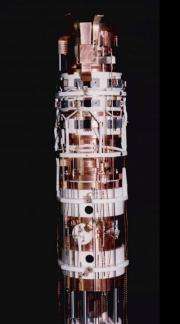
The NIST force sensor is a crystal of ions (charged atoms) trapped inside the upper region of the copper cylinder. A laser beam directed upward through the trap cools the ions. A force is applied in the form of an oscillating electric field, and a detector (not shown) measures the light reflected off the ions. Credit: Bollinger/NIST
(PhysOrg.com) -- Physicists at the National Institute of Standards and Technology have used a small crystal of ions (electrically charged atoms) to detect forces at the scale of yoctonewtons. Measurements of slight forces—one yoctonewton is equivalent to the weight of a single copper atom on Earth -- can be useful in force microscopy, nanoscale science, and tests of fundamental physics theories.
A newton is already a small unit: roughly the force of Earth's gravity on a small apple. A yoctonewton is one septillionth of a newton (yocto means 23 zeros after the decimal place, or 0.000000000000000000000001).
Measurements of vanishingly small forces typically are made with tiny mechanical oscillators, which vibrate like guitar strings. The new NIST sensor, described in Nature Nanotechnology,* is even more exotic—a flat crystal of about 60 beryllium ions trapped inside a vacuum chamber by electromagnetic fields and cooled to 500 millionths of a degree above absolute zero with an ultraviolet laser. The apparatus was developed over the past 15 years for experiments related to ion plasmas and quantum computing. In this case, it was used to measure yoctonewton-scale forces from an applied electric field. In particular, the experiment showed that it was possible to measure about 390 yoctonewtons in just one second of measurement time, a rapid speed that indicates the technique's high sensitivity. Sensitivity is an asset for practical applications.
The previous force measurement record with this level of sensitivity was achieved by another NIST physicist who measured forces 1,000 times larger, or 500 zeptonewtons (0.0000000000000000005 newtons) in one second of measurement time using a mechanical oscillator.** Previous NIST research indicated that a single trapped ion could sense forces at yoctonewton scales but did not make calibrated measurements. ***
The ion sensor described in Nature Nanotechnology works by examining how an applied force affects ion motion, based on changes in laser light reflected off the ions. A small oscillating electric field applied to the crystal causes the ions to rock back and forth; as the ions rock, the intensity of the reflected laser light wobbles in sync with the ion motion. A change in the amount of reflected laser light due to the force is detectable, providing a measure of the ions' induced motion using a principle similar to the one at work in a police officer's radar gun. The technique is highly sensitive because of the low mass of the ions, strong response of charged particles to external electric fields, and ability to detect nanometer-scale changes in ion motion.
More information: * M.J. Biercuk, H. Uys, J.P. Britton, A.P. VanDevender and J. J. Bollinger. Ultrasensitive force and displacement detection using trapped ions. Nature Nanotechnology. Posted online Aug. 22, 2010.
** J.D. Teufel, T. Donner, M.A. Castellanos-Beltran, J.W. Harlow and K.W. Lehnert. Nanomechanical motion measured with an imprecision below that at the standard quantum limit. Nature Nanotechnology 4, 820.
*** See "NIST Develops Novel Ion Trap for Sensing Force and Light"
Provided by National Institute of Standards and Technology (news : web)
-
Scientists record yoctonewton forces
Apr 14, 2010 |
not rated yet |
0
-
Scientists develop novel ion trap for sensing force and light
Jul 01, 2009 |
not rated yet |
0
-
A Quantum Mechanical 'Tune Up' for Better Measurement
Jun 05, 2004 |
not rated yet |
0
-
X marks the spot: Ions coldly go through NIST trap junction
Apr 08, 2009 |
not rated yet |
0
-
'Quantum Logic Clock' Based on Aluminum Ion is Now World's Most Precise Clock (w/ Video)
Feb 04, 2010 |
not rated yet |
0
-
Engineers build first sub-10-nm carbon nanotube transistor
Feb 01, 2012 |
4.9 / 5 (30) |
30
-
Something old, something new: Evolution and the structural divergence of duplicate genes
Jan 31, 2012 |
4.6 / 5 (7) |
1
-
The hidden nanoworld of ice crystals: Revealing the dynamic behavior of quasi-liquid layers
Jan 30, 2012 |
5 / 5 (3) |
1
-
Stock market network reveals investor clustering
Jan 27, 2012 |
3.9 / 5 (23) |
8
-
Of microchemistry and molecules: Electronic microfluidic device synthesizes biocompatible probes
Jan 26, 2012 |
5 / 5 (1) |
0
-
Wind Turbine Power
1 hour ago
-
Steam Table issues
3 hours ago
-
electrostatic induction in a conductor should be immpossible
7 hours ago
-
Help! Physics Momentum/Impulse problem!
10 hours ago
-
Gauss' law cubes, how to prove
11 hours ago
-
what is significance of torque
13 hours ago
- More from Physics Forums - General Physics
More news stories
What lies beneath: Mapping hidden nanostructures
The ability to diagnose and predict the properties of materials is vital, particularly in the expanding field of nanotechnology. Electron and atom-probe microscopy can categorize atoms in thin sheets of material, ...
1 hour ago |
not rated yet |
0
'Dark plasmons' transmit energy
Microscopic channels of gold nanoparticles have the ability to transmit electromagnetic energy that starts as light and propagates via "dark plasmons," according to researchers at Rice University.
17 hours ago |
5 / 5 (5) |
0
|
Nanotube therapy takes aim at breast cancer stem cells
Wake Forest Baptist Medical Center researchers have again proven that injecting multiwalled carbon nanotubes (MWCNTs) into tumors and heating them with a quick, 30-second laser treatment can kill them.
Nanotechnology / Bio & Medicine
22 hours ago |
5 / 5 (1) |
0
|
New kind of solar cell could capture significantly more energy than current cells
New solar cells could increase the maximum efficiency of solar panels by over 25%, according to scientists from the University of Cambridge.
Feb 08, 2012 |
4.5 / 5 (11) |
14
|
Nanoshell whispering galleries improve thin solar panels
Visitors to Statuary Hall in the U.S. Capitol Building may have experienced a curious acoustic feature that allows a person to whisper softly at one side of the cavernous, half-domed room and for another on ...
Nanotechnology / Nanomaterials
Feb 07, 2012 |
4.3 / 5 (6) |
6
|
Fool's gold may prove an unlikely alternative to overexploited catalytic materials
Catalytic materials, which lower the energy barriers for chemical reactions, are used in everything from the commercial production of chemicals to catalytic converters in car engines. However, with current catalytic materials ...
Curry spice component may help slow prostate tumor growth
Curcumin, an active component of the Indian curry spice turmeric, may help slow down tumor growth in castration-resistant prostate cancer patients on androgen deprivation therapy (ADT), a study from researchers ...
Netflix light on flicks as viewers soak up TV shows
Like most fresh faces that arrive in Hollywood, Netflix wanted to be a movie star. But now it's learning what many in Tinseltown have known for decades: Movies are sexy, but the real money is in television.
To avoid early labor and delivery, weight and diet changes not the answer
One of the strongest known risk factors for spontaneous or unexpected preterm birth any birth that occurs before the 37th week of pregnancy, most often without a known cause is already having had one. For women ...
Arthritic knees, but not hips, have robust repair response
Researchers at Duke University Medical Center used new tools they developed to analyze knees and hips and discovered that osteoarthritic knee joints are in a constant state of repair, while hip joints are not.
Sony's Hirai refuses to abandon dire TV business
Struggling Japanese entertainment giant Sony will not abandon its cash-bleeding television business, its incoming CEO says, but he acknowledges tough decisions lie ahead including over redundancies.