NASA and NOAA's newest GOES satellite ready for action
September 1, 2010
NASA and NOAA's newest GOES satellite ready for action

Enlarge

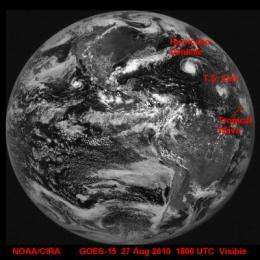
This visible full-disk image of the Earth was captured by GOES-15 on Aug. 27, 2010, at 1800 UTC (2 p.m. EDT). At that time Hurricane Danielle, Tropical Storm Earl and a tropical wave were occurring in the Atlantic Ocean basin. Credit: NOAA/CIRA

NASA and NOAA's latest Geostationary Operational Environmental Satellite, GOES-15, has successfully completed five months of on-orbit testing and has been accepted into service. The satellite has demonstrated operational readiness of its subsystems, spacecraft instruments and communications services. GOES-15 is the third and final spacecraft in the GOES N-P Series of geostationary environmental weather satellites.

The GOES fleet help NOAA forecasters track life-threatening weather and that can impact the satellite-based electronics and communications industry. During the checkout period, GOES-15 delivered high-resolution images from space, including the first visible and of Earth taken by its imager instrument, and the first image of the sun taken by its solar X-ray imager instrument.

"NASA is ecstatic that we were able to deliver on our promise to provide NOAA and this Nation with three geosynchronous weather satellites," said Andre Dress, GOES Deputy Project Manager at NASA's Goddard Space Flight Center, Greenbelt, Md. "From the very beginning, we set the bar high and we have attained all our goals. It is something that NASA and its contractors (Boeing Space & Intelligence Systems, Lockheed Martin, ITT and United Launch Alliance) can be very proud of."

NOAA operates GOES-13 in the east and GOES-11 in the west -- both provide weather observations covering more than 50 percent of the Earth's surface. The GOES-15 spacecraft, designed and built by Boeing Space and Intelligence Systems, will be placed in an on-orbit storage location at 105 degrees west longitude should one of the operational GOES satellites degrade or exhaust their fuel. It will share a parking space with GOES-14, currently in the same storage orbit. Both satellites can be made operational within 24 hours to replace an older satellite.

"With more than 35 million Americans living in hurricane-prone areas, we need the reliable, accurate data GOES provide," said Gary Davis, director of the Office of Systems Development at NOAA's Satellite and Information Service.

Provided by NASA's Goddard Space Flight Center (news : web)


Rank not rated yet
Related Stories
Relevant PhysicsForums posts
  • Scale of the Universe
    created3 hours ago
  • Titan's lack of impact craters
    createdFeb 09, 2012
  • Real pictures of black hole eating a star?
    createdFeb 08, 2012
  • Hypothetical way to travel faster than light, but not technically exceed lightspeed
    createdFeb 06, 2012
  • How do scientists monitor the Sun's activity?
    createdFeb 05, 2012
  • Search patterns in observational studies
    createdFeb 05, 2012
  • More from Physics Forums - General Astronomy

More news stories

NASA sees wide-eyed cyclone Jasmine

Cyclone Jasmine's eye has opened wider on NASA satellite imagery, as it moves through the Southern Pacific Ocean.

Space & Earth / Earth Sciences

created 3 hours ago | popularity not rated yet | comments 1

NASA sees Giovanna reach cyclone strength, threaten Madagascar

Tropical Storm 12S built up steam and became a cyclone on February 10, 2012 as NASA's Terra satellite passed overhead. Residents of east-central Madagascar should prepare for this cyclone to make landfall ...

Space & Earth / Earth Sciences

created 3 hours ago | popularity not rated yet | comments 0

Humans may have helped the decline of African rainforests 3000 years ago

(PhysOrg.com) -- Large areas of rainforests in Central Africa mysteriously disappeared over three thousand years ago, to be replaced by savannas. The prevailing theory has been that the cause was a change ...

Space & Earth / Environment

created 15 hours ago | popularity 4.2 / 5 (9) | comments 10 | with audio podcast report

Could Venus be shifting gear?

(PhysOrg.com) -- ESA’s Venus Express spacecraft has discovered that our cloud-covered neighbour spins a little slower than previously measured. Peering through the dense atmosphere in the infrared, the ...

Space & Earth / Space Exploration

created 11 hours ago | popularity 5 / 5 (7) | comments 7 | with audio podcast

Mars Science Laboratory computer issue resolved

(PhysOrg.com) -- Engineers have found the root cause of a computer reset that occurred two months ago on NASA's Mars Science Laboratory and have determined how to correct it.

Space & Earth / Space Exploration

created 12 hours ago | popularity 4.7 / 5 (6) | comments 3 | with audio podcast


Google users warned of threat to smartphone wallets

Users of Google smartphone wallets were being warned on Friday that there is a way to crack pass codes intended to thwart thieves from going on illicit shopping sprees.

Anonymous knocks CIA website offline (Update)

The website of the Central Intelligence Agency was inaccessible on Friday after the hacker group Anonymous claimed to have knocked it offline.

Complex wiring of the nervous system may rely on a just a handful of genes and proteins

Researchers at the Salk Institute have discovered a startling feature of early brain development that helps to explain how complex neuron wiring patterns are programmed using just a handful of critical genes. ...

New error-correcting codes guarantee the fastest possible rate of data transmission

Error-correcting codes are one of the triumphs of the digital age. They’re a way of encoding information so that it can be transmitted across a communication channel — such as an optical fiber o ...

Putting the squeeze on planets outside our solar system

(PhysOrg.com) -- Using high-powered lasers, scientists at Lawrence Livermore National Laboratory and collaborators discovered that molten magnesium silicate undergoes a phase change in the liquid state, abruptly ...

The power of estrogen -- male snakes attract other males

A new study has shown that boosting the estrogen levels of male garter snakes causes them to secrete the same pheromones that females use to attract suitors, and turned the males into just about the sexiest ...