Hurricane warnings posted on US East Coast, NASA sees Earl's heavy rainfall
September 1, 2010
Hurricane warnings posted on US East Coast, NASA sees Earl's heavy rainfall

Enlarge

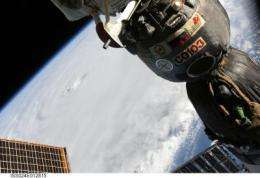
ISS024-E-012815 (30 Aug. 2010) -- Photographed by an Expedition 24 crew member on the International Space Station, this is an oblique view that shows the eye (just left of center) of Hurricane Earl (at this time a category 4 but later downgraded to a category 3), centered just north of the Virgin Islands near 19.3 north latitude and 64.7 west longitude packing 115-kilometer winds. A Russian Soyuz vehicle is docked to the station (foreground). The photo was taken with a digital still camera using a 55mm lens. Credit: NASA Johnson Space Center

NASA's Tropical Rainfall Measuring Mission, or TRMM satellite looked at the rate rain was falling in Hurricane Earl yesterday, and it was intense.

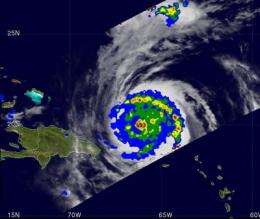
The TRMM satellite passed close to Hurricane Earl's position early on August 31 at 0439 UTC (12:39 a.m. EDT) collecting data used in the TRMM (TMI) rainfall analysis. At that time, TRMM observed a band of rain drenching Puerto Rico as it spiraled into the powerful hurricane. At the time Earl had become a powerful category four hurricane with wind speeds of about 115 knots (~132 mph). Very heavy rainfall of over 50 mm/hr (2 inches) clearly defined the location of Earl's eye wall. TRMM is managed by NASA and the Japanese Space Agency.

Another NASA satellite analyzed Hurricane Earl's cloud temperatures and thunderstorms. High, cold tops indicate powerful storms. NASA's Atmospheric Infrared Sounder (AIRS) instrument flies aboard the Aqua satellite and captured an of Hurricane Earl today, Sept. 1 at 06:53 UTC (2:53 a.m. EDT). It showed high, powerful thunderstorms circle the center providing the heat engine for the hurricane. Earl's eye was not visible in the image, possibly because it was going through eyewall replacement, which usually occurs in major hurricanes.

On September 1 at 1500 UTC (11 a.m. EDT), Earl was a Category 3 hurricane with near 125 mph. Earl's center was located about 725 miles south-southeast of Cape Hatteras, N.C. near 25.1 North and 72.1 West. It is moving to the northwest near 17 mph, and had a minimum central pressure of 943 millibars.

Earl is a large storm, with tropical storm-force winds extending out from the center to 200 miles, and hurricane-force-winds extending out 90 miles from the center. The extent of hurricane-force winds has increased since yesterday.
Hurricane warnings posted on US East Coast, NASA sees Earl's heavy rainfall
Enlarge

NASA's TRMM satellite captured very heavy rainfall (red) of over 50 mm/hr (2 inches) in Earl on Aug. 31 that clearly defined the location of Earl's eye wall. Credit: NASA/SSAI, Hal Pierce

A Hurricane warning is in effect from Bogue Inlet,N.C. to the N.C./V.A. border, including Pamlico and Albemarle Sounds. That means that hurricane conditions expected within 36 hours. A Hurricane watch has been posted from the North Carolina/Virginia border to Cape Henlopen, Delaware. That means conditions expected within 48 hours. Tropical storm warning is in effect from Cape Fear, N.C. to west of Bogue Inlet, N.C. and San Salvador Island, Central Bahamas. That means Tropical storm conditions expected within 36 hours.

What can be expected? A storm surge of 3 to 5 feet above normal tidal levels expected in the warning area, with large and destructive waves. Large swells should affect the Bahamas and southeastern U.S. today. In terms of rainfall, the Bahamas and extreme eastern North Carolina, including Outer Banks, can expect 1 to 2 inches, locally up to 4 inches of rain.

Earl is expected to maintain intensity for the next few days, as it moves northwest, then north.

Provided by NASA's Goddard Space Flight Center (news : web)


Rank 5 /5 (1 vote)
Relevant PhysicsForums posts
  • Wind Waves in Reservoir ~ Wind run-up and Wind set-up
    createdFeb 08, 2012
  • Balance of oxygen in the atmosphere
    createdFeb 01, 2012
  • The case for a methanol-based economy
    createdJan 30, 2012
  • Weather in a rotating cylinder
    createdJan 25, 2012
  • Importance of difference between SVP over ice and water?
    createdJan 19, 2012
  • Ozone and atmosphere sampling
    createdJan 16, 2012
  • More from Physics Forums - Earth

More news stories

NASA's TRMM satellite sees Cyclone Jasmine in 3-D

Data from NASA's TRMM satellite was used to create a 3-Dimensional look at Cyclone Jasmine, currently moving through the South Pacific Ocean.

Space & Earth / Earth Sciences

created 46 minutes ago | popularity not rated yet | comments 0

Deconstructing a mystery: What caused Snowmaggedon?

In the quiet after the storms, streets and cars had all but disappeared under piles of snow. The U.S. Postal Service suspended service for the first time in 30 years. Snow plows struggled to push the evidence ...

Space & Earth / Earth Sciences

created 2 hours ago | popularity 5 / 5 (1) | comments 0 | with audio podcast

New views show old NASA Mars landers

(PhysOrg.com) -- The High Resolution Imaging Science Experiment (HiRISE) camera on NASA's Mars Reconnaissance Orbiter recorded a scene on Jan. 29, 2012, that includes the first color image from orbit showing ...

Space & Earth / Space Exploration

created 10 hours ago | popularity 4.9 / 5 (7) | comments 4 | with audio podcast

Tidal forces could squeeze out planetary water

Alien planets might experience tidal forces powerful enough to remove all their water, leaving behind hot, dry worlds like Venus, researchers said.

Space & Earth / Space Exploration

created 8 hours ago | popularity 5 / 5 (1) | comments 1 | with audio podcast

Black holes and star formation

(PhysOrg.com) -- It has long been recognized that galaxy mergers or even close interactions can play a vital role in shaping the morphology of galaxies. One way they can do so, it is thought, is by triggering ...

Space & Earth / Astronomy

created 9 hours ago | popularity 4 / 5 (4) | comments 2 | with audio podcast


'Dark plasmons' transmit energy

Microscopic channels of gold nanoparticles have the ability to transmit electromagnetic energy that starts as light and propagates via "dark plasmons," according to researchers at Rice University.

Cell biologists describes mechanism by which some people may be more susceptible to colon cancer

An international research team led by cell biologists at the University of California, Riverside has uncovered a new insight into colon cancer, the third leading cause of cancer-related deaths in the United ...

New method makes culture of complex tissue possible in any lab

Scientists at the University of California, San Diego have developed a new method for making scaffolds for culturing tissue in three-dimensional arrangements that mimic those in the body. This advance, published online in ...

Anyone can learn to be more inventive, cognitive researcher says

There will always be a wild and unpredictable quality to creativity and invention, says Anthony McCaffrey, a cognitive psychology researcher at the University of Massachusetts Amherst, because an "Aha moment" is rare and ...

New integrated building model may improve fish farming operations

Today's "locavore" movement with its emphasis on eating more locally-produced food is a natural fit for fruits and vegetables in nearly every region, but few entrepreneurs have dared to apply the concept to ...

FBI file: Steve Jobs was considered for govt post

(AP) -- FBI background interviews of some people who knew Apple co-founder Steve Jobs reveal a man driven by power and alienating some of the people who worked with him.