Northern Lights in the classroom
September 1, 2010
Northern Lights in the classroom

Enlarge

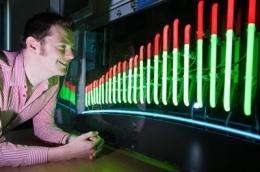
Dr Jim Wild with the "Aurora in a box"

A new model created by Lancaster University space scientist Dr Jim Wild is bringing the experience of the Northern Lights into the classroom.

The “Aurora in a box” which recreates the physics involved in the creation of the or Aurora Borealis, will be used to demonstrate how electrically charged particles in the atmosphere create the spectacle seen at the earth’s poles.

Dr Wild, a Physicist studying the space environment and the links between the Sun, the Earth and other planets, was awarded a grant from Research Councils UK to create theoutreach tool to explain the research to non-specialist audiences.

“The science of the aurora is basically the same as that of a neon lamp, like any found in shops and advertising displays”.

“I really like the idea that something really familiar, and something that seems so magical, are exactly the same physics”

Auroras are linked to the , a flow of ions and electrons continuously flowing outward from the Sun. The Earth's magnetic field traps these particles, most of which travel toward the poles where they are accelerated towards the Earth. Collisions between these particles, and atmospheric atoms and molecules, causes energy releases in the form of streams or arches of coloured light.

The “Aurora in a box” consists of glass tubes full of gas through which electrons move, causing the gas to fluoresce exactly as it does at the Earth’s poles.

Dr Wild uses the model to help him explain his research to children in schools, at university events and at national science events such as National Science and Engineering Week’s Big Bang event in Manchester last year.

Research into what causes auroras has many implications.

“For a start it’s just really interesting science, but it also has very practical uses,” says Dr Wild.

“We use a lot of technology in space, like communications and positioning satellites, and those satellites are sometimes outside the protection of the Earth’s magnetic field. They’re therefore more vulnerable to changes in space weather and can be damaged or have their services disrupted. Being able to predict this would be very useful.”

Provided by Lancaster University


Rank 4 /5 (1 vote)
Relevant PhysicsForums posts

More news stories

A frank discussion of the power law and linking correlation to causation

(PhysOrg.com) -- Michael Stumpf a mathematics professor at Imperial College in London, and Mason Porter a lecturer at Oxford have teamed together to write and publish a perspective piece in Science regarding the in ...

Other Sciences / Mathematics

created 20 hours ago | popularity 5 / 5 (3) | comments 8 | with audio podcast report

Employers feel no love for unscrupulous practice of 'service sweethearting'

A new study led by two Florida State University marketing professors finds that some frontline service employees who are rewarded for hikes in customer loyalty and satisfaction also may engage in "service ...

Other Sciences / Economics & Business

created 14 hours ago | popularity 4 / 5 (1) | comments 7

The question of life in the ancient world

There’s a general feeling that we don’t get the Greeks – ancient or modern. Many, including heads of state like Angela Merkel, visibly shake their head in exasperation, rightly or wrongly, at ...

Other Sciences / Archaeology & Fossils

created 19 hours ago | popularity 1.3 / 5 (3) | comments 4

Sonic Cradle lands spot in TED exhibition

A Simon Fraser University graduate student project that melds music, meditation and modern technology has landed a rare spot as an exhibit at TEDActive 2012 in Palm Springs, California this month.

Other Sciences / Other

created 16 hours ago | popularity not rated yet | comments 0

Do we no longer care about the collective good?

The Transformation of Solidarity, a book co-edited by University of Queensland sociologist Dr Mara Yerkes, tackles the subject of globalisation of national economies and societies where we put a high value ...

Other Sciences / Social Sciences

created Feb 06, 2012 | popularity 3.9 / 5 (8) | comments 39


Anonymous knocks CIA website offline (Update)

The website of the Central Intelligence Agency was inaccessible on Friday after the hacker group Anonymous claimed to have knocked it offline.

New error-correcting codes guarantee the fastest possible rate of data transmission

Error-correcting codes are one of the triumphs of the digital age. They’re a way of encoding information so that it can be transmitted across a communication channel — such as an optical fiber o ...

Humans may have helped the decline of African rainforests 3000 years ago

(PhysOrg.com) -- Large areas of rainforests in Central Africa mysteriously disappeared over three thousand years ago, to be replaced by savannas. The prevailing theory has been that the cause was a change ...

New power source discovered

(PhysOrg.com) -- Researchers at the Massachusetts Institute of Technology (MIT) and RMIT University have made a breakthrough in energy storage and power generation.

Small modular reactor design could be a 'SUPERSTAR'

(PhysOrg.com) -- Though most of today's nuclear reactors are cooled by water, we've long known that there are alternatives; in fact, the world's first nuclear-powered electricity in 1951 came from a reactor ...

Google users warned of threat to smartphone wallets

Users of Google smartphone wallets were being warned on Friday that there is a way to crack pass codes intended to thwart thieves from going on illicit shopping sprees.