Global Hawk drone aircraft flies over Frank on the GRIP hurricane mission
September 1, 2010 by Rob Gutro
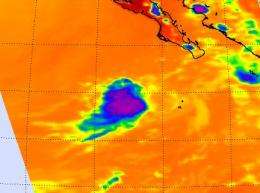
This infrared image of Frank was taken from NASA's AIRS instrument that flies on the Aqua satellite. It was taken on August 27 at 4:53 p.m. EDT, and showed that Frank had reduced in size, and the only strong convection was limited to the center of the storm (purple). Credit: NASA JPL, Ed Olsen
NASA's 2010 hurricane experiment is in full swing as the tropics have heated up. NASA's Global Hawk unmanned aircraft was sent out over this past weekend to conduct measurements on then Tropical Storm Frank in the eastern Pacific Ocean, the first ever high-altitude flyover of a tropical cyclone with a UAS (unmanned aircraft system).
NASA's Genesis and Rapid Intensification Processes (GRIP) experiment is a NASA Earth science field mission that's happening now out of Fort Lauderdale, Fla., Southern California and Houston, Texas.
The GRIP campaign consists of three aircraft, 15 instruments and NASA satellites to better understand how tropical storms form and develop into major hurricanes.
At the pre-dawn hour of 5:50 a.m. PDT, Saturday, Aug. 28 the Global Hawk took off autonomously from the runway in the desert at Edwards Air Force Base, Calif. and spiraled over the air base to gain high altitude before heading west to the Pacific Ocean. An hour before the takeoff and after a pre-flight briefing, a group of about 20 scientists, engineers, pilots, and technical and aircraft support personnel were at their assigned stations in a specially designed operations room at the NASA Dryden Flight Research Center at Edwards, already monitoring all aspects of the jet's mechanical, electrical, communications, and scientific instrument status. They were prepared to staff, conduct, and monitor this flight for up to 18 hours.
The purpose of the flight was to test the Global Hawk’s capability to overfly the weather conditions that could be expected within a tropical cyclone, and test and evaluate the retrieval of data collected from several sophisticated remote-sensing instruments, including a radar and profilers, and its transmission back to the ground station. The target was a low-pressure system in the Eastern Pacific basin, just southwest of the Baja California peninsula in Mexico that was Hurricane Frank a couple of days before.
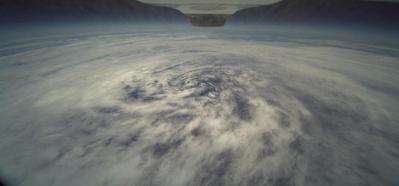
This photo of Tropical Storm Frank was taken from the HDVis camera on the underside of the Global Hawk aircraft on Saturday, Aug. 28, at 5:07 pm EDT as the aircraft approached Frank for the second time. The Global Hawk captured this photo from an altitude of 60,000 ft. (about 11.4 miles) Credit: NASA/NOAA
The camera on the underside of the Global Hawk provided several photographs of Tropical Storm Frank. As the Global Hawk approached Frank for the second time, flying at an altitude of 60,000 ft., the camera captured one photo on Saturday, Aug. 28 at 5:07 p.m. EDT that showed bands of thunderstorms around Frank's center.
At the time of the image, Frank's maximum sustained winds were near 55 knots (62 mph). Frank was located about 290 miles south-southwest of Cabo San Lucas, Mexico and churning in the waters of the eastern Pacific Ocean. Its center was near 19.3 North latitude and 112.2 West longitude. Frank was moving northwest at 6 mph (5 knots) at that time. Frank was weakening due to wind shear.
By Sunday, Aug. 29, 2010 at 10:51 p.m. EDT, Frank had become a remnant low pressure system. The remnant low had an elongated low level circulation with winds to 25 knots (29 mph) in the western quadrant. The winds continued to decrease overnight into Monday. On Monday, Aug. 30 at 5:26 a.m. EDT the National Hurricane Center noted that Frank's remnants were centered near 21 North and 11 West and Frank was dissipating.
-
NASA satellites see Tropical Storm Frank powering back up near Mexico
Aug 24, 2010 |
not rated yet |
0
-
NASA infrared imagery sees landfalling Jimena, weak Kevin and pyrocumulus clouds
Sep 01, 2009 |
not rated yet |
0
-
NASA's Aqua and Terra satellites view Tropical Storms Blas and Celia
Jun 21, 2010 |
not rated yet |
0
-
GOES-11 sees tropical cyclones fizzling and forming in the Eastern Pacific
Aug 13, 2009 |
not rated yet |
0
-
Once a depression, 6E now a remnant, NASA imagery shows little strength left
Jul 16, 2010 |
not rated yet |
0
-
Engineers build first sub-10-nm carbon nanotube transistor
Feb 01, 2012 |
4.9 / 5 (31) |
30
-
Something old, something new: Evolution and the structural divergence of duplicate genes
Jan 31, 2012 |
4.6 / 5 (7) |
1
-
The hidden nanoworld of ice crystals: Revealing the dynamic behavior of quasi-liquid layers
Jan 30, 2012 |
5 / 5 (3) |
1
-
Stock market network reveals investor clustering
Jan 27, 2012 |
3.9 / 5 (23) |
8
-
Of microchemistry and molecules: Electronic microfluidic device synthesizes biocompatible probes
Jan 26, 2012 |
5 / 5 (1) |
0
-
Discrepancy between oxygen and carbon-dioxide levels
16 hours ago
-
where gems are found in the world
19 hours ago
-
Wind Waves in Reservoir ~ Wind run-up and Wind set-up
Feb 08, 2012
-
Balance of oxygen in the atmosphere
Feb 01, 2012
-
The case for a methanol-based economy
Jan 30, 2012
-
Weather in a rotating cylinder
Jan 25, 2012
- More from Physics Forums - Earth
More news stories
Could Venus be shifting gear?
(PhysOrg.com) -- ESAs Venus Express spacecraft has discovered that our cloud-covered neighbour spins a little slower than previously measured. Peering through the dense atmosphere in the infrared, the ...
Space & Earth / Space Exploration
5 hours ago |
5 / 5 (5) |
7
|
Humans may have helped the decline of African rainforests 3000 years ago
(PhysOrg.com) -- Large areas of rainforests in Central Africa mysteriously disappeared over three thousand years ago, to be replaced by savannas. The prevailing theory has been that the cause was a change ...
Mars Science Laboratory computer issue resolved
(PhysOrg.com) -- Engineers have found the root cause of a computer reset that occurred two months ago on NASA's Mars Science Laboratory and have determined how to correct it.
Space & Earth / Space Exploration
6 hours ago |
5 / 5 (5) |
3
|
Clam fields found at deep, low-temperature Mariana vents
(PhysOrg.com) -- Scientists have marveled at the unusual life forms thriving at high temperature hydrothermal vents of the deep ocean.
Space & Earth / Earth Sciences
5 hours ago |
not rated yet |
0
|
Two new moons for Jupiter
Advances in technology have lead to the discovery of new planets outside of our Solar System, and now even new moons in our own backyard.
Space & Earth / Space Exploration
5 hours ago |
not rated yet |
2
Putting the squeeze on planets outside our solar system
(PhysOrg.com) -- Using high-powered lasers, scientists at Lawrence Livermore National Laboratory and collaborators discovered that molten magnesium silicate undergoes a phase change in the liquid state, abruptly ...
Employers feel no love for unscrupulous practice of 'service sweethearting'
A new study led by two Florida State University marketing professors finds that some frontline service employees who are rewarded for hikes in customer loyalty and satisfaction also may engage in "service ...
US issues guidelines to avoid heparin contamination
Four years after US drug-maker Baxter International's blood thinner heparin was contaminated in China, causing dozens of deaths, US regulators on Friday issued draft guidelines for safe production.
Expat French get Internet vote for first time
French citizens will for the first time this year be able to vote in a parliamentary election over the Internet, an experiment that could be extended to other elections if successful.
"Twisted Metal" gamers get shot at real gunplay
Fans of "Twisted Metal" will get to welcome a long-awaited sequel of the car-battle videogame with a real-world bang by blasting an ice cream truck to bits with a machine gun.
The power of estrogen -- male snakes attract other males
A new study has shown that boosting the estrogen levels of male garter snakes causes them to secrete the same pheromones that females use to attract suitors, and turned the males into just about the sexiest ...
