Kids with sports concussions need time out
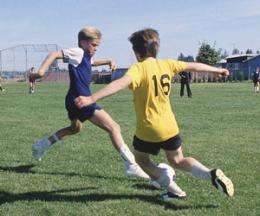
Between 1997-2007, the number of emergency room visits for concussions doubled in children ages 8-13 who play organized sports. Part of the reason is greater awareness, according to Mark E. Halstead, MD, assistant professor of orthopaedic surgery and of pediatrics and director of Washington University in St. Louis’ Sports Concussion Program.
“I think, overall, there probably aren’t many more concussions,” Halstead says. “What we’re really seeing is more attention. People are seeking more medical attention because that’s what we’re recommending.”
Halstead is first author on a report with new guidelines for managing sports-related concussions. The recommendations give advice to both parents and physicians and appear in the September issue of Pediatrics.
Young athletes are especially vulnerable because their brains are still developing and may be more susceptible to the effects of a concussion, according to Halstead. As recently as 10 years ago, a child with a low-grade concussion may have been allowed to return to action as soon as 15 minutes after symptoms had subsided, he says.
Now, Halstead's team recommends that no athlete be allowed back into competition the same day. In some cases, he says, it may be weeks or even months before it’s safe to go back on the playing field. At the very least, he recommends — and now laws in many states require — that young athletes be evaluated and cleared by a doctor before returning to competition.
Common signs and symptoms of a concussion include headache (by far the most common symptom), dizziness or memory or concentration problems, in which many athletes will describe feeling “foggy.” Some also may feel sick to their stomachs or have issues with balance.
“If someone has taken a blow to the head, and they’re feeling some of those symptoms, parents and coaches need to assume that the player has suffered a concussion,” Halstead says. “We always tell people to err on the side of caution.”
That’s particularly important in younger children. Although concussions are more common among older athletes due to more violent collisions involving bigger bodies at higher speeds, concussions have the potential to be much more dangerous in younger athletes whose brains are still growing and developing.
“There is a problem called ‘second impact syndrome’ that affects children but is not seen in older athletes,” Halstead says. “If a child returns to competition too soon and suffers another head injury, they can develop dramatic swelling in the brain and even die following that second injury. That syndrome is unique to the pediatric population. We’ve never seen it happen in a professional athlete.”
To avoid those devastating consequences, Halstead says it’s never appropriate to allow young athletes to return to action the same day an injury is sustained. In fact, he says athletes should not return to physical activity of any kind until they are symptom-free. And in some cases, in addition to resting from physical activity, young athletes may need what he calls “brain rest,” including temporarily refraining from school work, video games, television and reading.
“All of those activities can aggravate symptoms, so we want them to refrain from those things in order to heal better,” he says. “Once they are OK when at rest, we can allow them to slowly begin physical activity, while paying close attention to ensure that symptoms don’t return.”
These are the first concussion guidelines published for athletes younger than high-school age. Previous guidelines used in older athletes defined concussions in stages, as either grade 1, 2 or 3. The length of rehabilitation was determined by the grade of the concussion.
These new recommendations, Halstead says, urge doctors to avoid that kind of “cookie cutter” approach and to allow individuals back into competition only after they feel better and symptoms have subsided. Verifying that, however, requires cooperation from the patient.
“That’s the trouble with a concussion as opposed to a knee injury,” Halstead says. “When a kid hurts a knee, he or she goes limping off the field and can’t put weight on the leg. With a head injury, a lot of times we’re relying on the athlete to tell us that he or she is having problems. We want kids and coaches to know the signs and symptoms. That way, if there’s any question, they can be evaluated. Especially in children, concussions aren’t something to ‘monkey around’ with.”
More information: Halstead ME, Walter KD and the Council on Sports Medicine and Fitness, Clinical Report Sport-Related Concussion in Children and Adolescents. Pediatrics vol. 126 (3) pp 597-611 Sept. 2010 (published online Aug. 30, 2010. DOI: 10.1542/peds.2010-2005)


