Metal-mining bacteria are green chemists
September 2, 2010
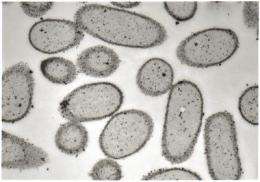
Bacterial cells that can accumulate high quantities of precious metals are an efficient and green alternative to traditional recycling methods. Here, E. coli cells are surrounded by nanoparticles of palladium and gold (black deposits). Credit: Kevin Deplanche
Microbes could soon be used to convert metallic wastes into high-value catalysts for generating clean energy, say scientists writing in the September issue of Microbiology.
Researchers from the School of Biosciences at the University of Birmingham have discovered the mechanisms that allow the common soil bacterium Desulfovibrio desulfuricans to recover the precious metal palladium from industrial waste sources.
Palladium is one of the platinum group metals (PGMs) which are among the most precious resources on earth. They possess a wide variety of applications, due to their exceptional chemical properties. PGMs are routinely used in many catalytic systems and are the active elements of autocatalytic converters that reduce greenhouse gas emissions.
Dr Kevin Deplanche who led the study explained why new ways of recovering PGMs are needed. "These metals are a finite resource and this is reflected in their high market value," he said. "Over the last 10 years, demand has consistently outstripped supply and so research into alternative ways of recovering palladium from secondary sources is paramount to ensuring future availability of this resource."
Previous work in the team's lab showed that Desulfovibrio desulfuricans was able to reduce palladium in industrial wastes into metallic nanoparticles with biocatalytic activity. Now, the precise molecules involved in the reduction process have been identified. Hydrogenase enzymes located on the surface membrane of the bacterium carry out the reduction of palladium, which results in the accumulation of catalytic nanoparticles. The bacterial cells coated with palladium nanoparticles are known as 'BioPd."
The group believes that BioPd has great potential to be used for generating clean energy. "Research in our group has shown that BioPd is an excellent catalyst for the treatment of persistent pollutants, such as chromium, that is used in the paint industry. BioPd could even be used in a proton exchange fuel cell to make clean electricity from hydrogen," said Dr Deplanche. "Our ultimate aim is to develop a one-step technology that allows for the conversion of metallic wastes into high value catalysts for green chemistry and clean energy generation," he said.
Provided by Society for General Microbiology
-
Today's waste, tomorrow's fuel
Jul 03, 2007 |
not rated yet |
0
-
Chemists create more efficient palladium fuel cell catalysts
Mar 19, 2009 |
not rated yet |
0
-
Chemists Develop Easier Way To Find Platinum, Other Rare Metals
Sep 25, 2007 |
not rated yet |
0
-
Bacteria-based nanoclusters
Aug 18, 2006 |
not rated yet |
0
-
Platinum nanocatalyst could aid drugmakers
Aug 31, 2009 |
not rated yet |
0
-
Engineers build first sub-10-nm carbon nanotube transistor
Feb 01, 2012 |
4.9 / 5 (30) |
30
-
Something old, something new: Evolution and the structural divergence of duplicate genes
Jan 31, 2012 |
4.6 / 5 (7) |
1
-
The hidden nanoworld of ice crystals: Revealing the dynamic behavior of quasi-liquid layers
Jan 30, 2012 |
5 / 5 (3) |
1
-
Stock market network reveals investor clustering
Jan 27, 2012 |
3.9 / 5 (23) |
8
-
Of microchemistry and molecules: Electronic microfluidic device synthesizes biocompatible probes
Jan 26, 2012 |
5 / 5 (1) |
0
-
Cancer drugs and Alzheimer's, Oh my!
5 hours ago
-
Squishing cells
6 hours ago
-
Any books/articles for evolutionary stable strategy models in humans?
17 hours ago
-
Science behind the bore feeling?
23 hours ago
-
Homo Sapien vs. Chimpanzee - Divergence Timeline
Feb 09, 2012
-
a single mRNA strand is attached to sevaral ribosomes?
Feb 08, 2012
- More from Physics Forums - Biology
More news stories
Fighting crimes against biodiversity: How to catch a killer weed
Invasive species which have the potential to destroy biodiversity and influence global change could be tracked and controlled in the same way as wanted criminals, according to new research from Queen Mary, University of London.
41 minutes ago |
not rated yet |
0
Ultraviolet protection molecule in plants yields its secrets
Lying around in the sun all day is hazardous not just for humans but also for plants, which have no means of escape. Ultraviolet (UV) radiation from the sun can damage proteins and DNA inside cells, leading ...
14 hours ago |
5 / 5 (5) |
0
|
Deadly bird parasite evolves at exceptionally fast rate
A new study of a devastating bird disease that spread from poultry to house finches in the mid-1990s reveals that the bacteria responsible for the disease evolves at an exceptionally fast rate. What's more, ...
12 hours ago |
5 / 5 (2) |
0
|
Decoding the molecular machine behind E. coli and cholera
Scientists from Queen Mary, University of London have discovered the workings behind some of the bacteria that kill hundreds of thousands every year, possibly paving the way for new antibiotics that could treat infections ...
12 hours ago |
not rated yet |
0
|
Deciding to go left or right: Researchers use device to determine that lower animals can navigate too
For decades, scientists have associated binary decision making opting to go left or right with higher-ranking animals, including humans. A team of Harvard researchers, however, is rewriting that ...
20 hours ago |
not rated yet |
2
|
Humans may have helped the decline of African rainforests 3000 years ago
(PhysOrg.com) -- Large areas of rainforests in Central Africa mysteriously disappeared over three thousand years ago, to be replaced by savannas. The prevailing theory has been that the cause was a change ...
Japan scientist makes 'Avatar' robot
A Japanese-developed robot that mimics the movements of its human controller is bringing the Hollywood blockbuster "Avatar" one step closer to reality.
Metastatic breast cancer hitches a free ride from the immune system
Inflammatory breast cancer (IBC) is the most lethal form of breast cancer . It spreads easily through the lymphatic and blood vessels, forming metastasis which can lead to multi-organ failure. New research published in BioMed ...
A novel method for simultaneously measuring blood pressure and arterial stiffness
Arterial stiffness due to is a major contributor to cardiovascular disease but is very difficult to measure. It also can influence blood pressure readings since these rely on the time taken for arteries to return to normal ...
India's global pharmacy role threatened by EU pact
(AP) -- Efforts by India and the European Union to strengthen trade are threatening India's ability to deliver lifesaving medicines to the world's poorest, analysts say as the two sides push through protracted ...
US video game sales fall 34 percent in January
(AP) -- U.S. retail sales of video game hardware, software and accessories fell 34 percent in January from a year earlier to $751 million due to the lack of new game titles, according to market researcher NPD Group.
Sep 02, 2010
Rank: not rated yet
By Larry O'Hanlon
Wed Sep 1, 2010 08:39 AM ET http://news.disco...=rssnws1
Sep 06, 2010
Rank: not rated yet