Thanks to high-tech, storm track easier to predict
September 2, 2010 By SETH BORENSTEIN , AP Science Writer
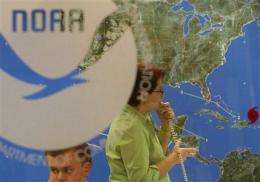
Gladys Rubio answers phone calls, at the National Hurricane Center in Miami, Wednesday, Sept. 1, 2010 as powerful Hurricane Earl wheeled toward the East Coast, driving the first tourists Wednesday from North Carolina vacation islands and threatening damaging winds and waves up the Atlantic seaboard over Labor Day weekend.(AP Photo/J Pat Carter)
(AP) -- Sophisticated computer models that replaced instinct with cold, hard math have helped forecasters predict where a storm like Hurricane Earl is going about twice as accurately as 20 years ago.
And last year, they proved it: The three-day forecast was as accurate as the here-it-comes, one-day warning used to be in the 1980s. In the 2009 hurricane season, the one-day forecast predicting where a storm would hit was off by only 53 miles on average.
But Earl is the type of storm - big and in a tricky location - that can defy expectations. Its predicted track shows the eye passing just off the East Coast, dancing so close to shore that a slight wobble could turn that miss into a mess.
Even if the eye remains offshore, high winds that extend 200 miles from the center could reach inland.
A small shift could "bring the center of Earl directly in contact with the Outer Banks, hence the need for the (hurricane) warning," National Hurricane Center Director Bill Read said Wednesday.
East Coast storms can be more predictable than those in the Gulf of Mexico because they don't usually make the sharp twists and turns taken by some gulf storms.
Still, MIT meteorology professor Kerry Emanuel called Earl "a forecasting nightmare in a way."
That's why Read and others emphasize that the forecast isn't a precise projection of Earl's movements. It's a line surrounded by a "cone of uncertainty."
About one out of three times, the eye of the storm will move out of the cone, said Timothy Schott, tropical cyclone program leader for the National Weather Service in Silver Spring, Md.
"We're very confident about the track. We're confident about the intensity," Read said.
But because of uncertainties, the track can't be narrowed to "a skinny line on a map," he said. "That's why we have errors."
However, those errors are nothing compared with what they used to be.
When Max Mayfield joined the hurricane center in 1972, forecasters had some computer models, but their calculations were based more on history, not the physics of the current atmosphere.
Mostly forecasters used their knowledge and plain old "feel," said Mayfield, who later became the center's director and is now retired.
In 1972, the average two-day forecast was off by about 450 miles; last year it was 81 miles. The margin of error used to be so big that when a storm hit the Leeward Islands - far to the southeast of the U.S. - forecasters started alerts for Florida and up the East Coast, Mayfield said.
He credits the improved forecasts to better observations of storms and improved computer models.
"We have a lot more confidence in the models than we used to," Mayfield said.
Many - if not most - of the models now look at the shifting dynamics of the atmosphere to see what forces are guiding a hurricane. That type of calculation takes faster computers, which are now more readily available.
Hurricanes avoid high-pressure systems - which almost act like brick walls - and follow low pressure troughs, which act like bowling alley gutters guiding storms. The models essentially predict where the walls and gutters will be.
In some ways, those computer models have gotten so reliable that hurricane specialists half-jokingly grouse that they will soon become messengers instead of forecasters, said Hugh Willoughby, a professor at Florida International University and former head of the weather service's hurricane research division.
There are also far more computer models churning data and making predictions, said MIT's Emanuel. That makes a consensus more likely, he said.
But the weather service's Schott said that's only half the story. Despite years of research, forecasters still have not significantly improved their forecasts on storm intensity. They aren't certain why storms suddenly get weaker or stronger.
That's why planes and drones are continuously flown into Earl for more information, especially about the way energy is exchanged between the ocean and the storm itself, Schott said.
"While we pride ourselves that the track forecast is getting better and better, we remain humbled by the uncertainties of the science we don't yet understand," Schott said. "This is not an algebra question where there's only one right answer."
More information: National Hurricane Center: http://www.nhc.noaa.gov
©2010 The Associated Press. All rights reserved. This material may not be published, broadcast, rewritten or redistributed.
-
Busy Atlantic storm season predicted
Aug 02, 2005 |
not rated yet |
0
-
East Coast most likely hurricane target
May 16, 2006 |
not rated yet |
0
-
Tropical storms can quickly turn deadly
Apr 02, 2008 |
not rated yet |
0
-
Meteorologists revise hurricane forecast
Aug 03, 2006 |
not rated yet |
0
-
GOES-13 catches 3 tropical cyclones thrashing through the Atlantic
Aug 31, 2010 |
not rated yet |
0
-
Engineers build first sub-10-nm carbon nanotube transistor
Feb 01, 2012 |
4.9 / 5 (31) |
30
-
Something old, something new: Evolution and the structural divergence of duplicate genes
Jan 31, 2012 |
4.6 / 5 (7) |
1
-
The hidden nanoworld of ice crystals: Revealing the dynamic behavior of quasi-liquid layers
Jan 30, 2012 |
5 / 5 (3) |
1
-
Stock market network reveals investor clustering
Jan 27, 2012 |
3.9 / 5 (23) |
8
-
Of microchemistry and molecules: Electronic microfluidic device synthesizes biocompatible probes
Jan 26, 2012 |
5 / 5 (1) |
0
-
Discrepancy between oxygen and carbon-dioxide levels
Feb 09, 2012
-
where gems are found in the world
Feb 09, 2012
-
Wind Waves in Reservoir ~ Wind run-up and Wind set-up
Feb 08, 2012
-
Balance of oxygen in the atmosphere
Feb 01, 2012
-
The case for a methanol-based economy
Jan 30, 2012
-
Weather in a rotating cylinder
Jan 25, 2012
- More from Physics Forums - Earth
More news stories
NASA budget will axe Mars deal with Europe: scientists
US President Barack Obama's budget proposal to be submitted next week for 2013 will cut NASA's budget by 20 percent and eliminate a major partnership with Europe on Mars exploration, scientists said Thursday.
Space & Earth / Space Exploration
23 hours ago |
5 / 5 (2) |
21
Could Venus be shifting gear?
(PhysOrg.com) -- ESAs Venus Express spacecraft has discovered that our cloud-covered neighbour spins a little slower than previously measured. Peering through the dense atmosphere in the infrared, the ...
Space & Earth / Space Exploration
20 hours ago |
5 / 5 (7) |
8
|
Mars Science Laboratory computer issue resolved
(PhysOrg.com) -- Engineers have found the root cause of a computer reset that occurred two months ago on NASA's Mars Science Laboratory and have determined how to correct it.
Space & Earth / Space Exploration
21 hours ago |
4.7 / 5 (6) |
4
|
Two new moons for Jupiter
Advances in technology have lead to the discovery of new planets outside of our Solar System, and now even new moons in our own backyard.
Space & Earth / Space Exploration
20 hours ago |
4 / 5 (1) |
7
NASA sees wide-eyed cyclone Jasmine
Cyclone Jasmine's eye has opened wider on NASA satellite imagery, as it moves through the Southern Pacific Ocean.
Space & Earth / Earth Sciences
12 hours ago |
3.5 / 5 (2) |
2
Anonymous knocks CIA website offline (Update)
The website of the Central Intelligence Agency was inaccessible on Friday after the hacker group Anonymous claimed to have knocked it offline.
New error-correcting codes guarantee the fastest possible rate of data transmission
Error-correcting codes are one of the triumphs of the digital age. Theyre a way of encoding information so that it can be transmitted across a communication channel such as an optical fiber o ...
Small modular reactor design could be a 'SUPERSTAR'
(PhysOrg.com) -- Though most of today's nuclear reactors are cooled by water, we've long known that there are alternatives; in fact, the world's first nuclear-powered electricity in 1951 came from a reactor ...
New power source discovered
(PhysOrg.com) -- Researchers at the Massachusetts Institute of Technology (MIT) and RMIT University have made a breakthrough in energy storage and power generation.
The power of estrogen -- male snakes attract other males
A new study has shown that boosting the estrogen levels of male garter snakes causes them to secrete the same pheromones that females use to attract suitors, and turned the males into just about the sexiest ...
Advanced power-grid model finds low-cost, low-carbon future in West
(PhysOrg.com) -- The least expensive way for the Western U.S. to reduce greenhouse gas emissions enough to help prevent the worst consequences of global warming is to replace coal with renewable and other ...