Start-up company aims to harness the full potential of producing electricity from waste heat
September 2, 2010 by Lisa Zyga
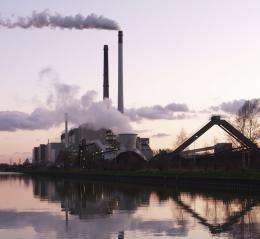
A coal power plant in Datteln, Germany, that transforms chemical energy into 36%-48% electricity and the remaining 52%-64% into waste heat. Image credit: Arnold Paul. Wikimedia Commons.
(PhysOrg.com) -- Matt Scullin co-founded Alphabet Energy just one year ago, but already the CEO has ambitions of turning the San Francisco-based start-up company into the "Intel of waste heat." By harnessing the waste heat emitted by power plants, industrial furnaces, and cars, Alphabet Energy envisions that it could provide inexpensive electricity to the US grid by recycling waste heat on a much larger scale than currently exists.
Currently, more than two-thirds of the fuel used to generate power in the United States is lost as heat, according to a 2008 report from the Oak Ridge National Laboratory. The goal of cogeneration technology is to convert this waste heat into electric and thermal power. Although the idea has been around for more than a century, the US produces only about 9% of its power from cogeneration systems. In comparison, many European countries use cogeneration systems for a significantly larger portion of their electricity production, with Denmark producing more than 50% of its power using waste heat recovery systems. In the US, the Department of Energy has a goal for recycled waste heat to account for 20% of US electricity production by 2030.
Alphabet Energy's strength lies in its recent development of a thermoelectric chip that can be inserted into a wide variety of exhaust flues, engines, or other heat-producing devices to convert the waste heat into electricity. As heat essentially pushes electrons through the material, the device can be connected to the grid to feed in the electricity in real time. As the company explains, the device's key advantage is the novel material - a relatively abundant, low-cost material that has been modified by researchers at the Lawrence Berkeley National Laboratory to lower its thermal conductivity and increase its electricity output using a smaller amount of heat. Another advantage is that the thermoelectric chip is produced using similar methods used for producing the microchips used in electronic devices, which should lower production costs.
These improvements may allow Alphabet Energy to lower the cost of installing the system to less than half that of current systems, to under $1 per watt. At this cost, and depending on the properties of the heat generation system, the system could deliver a payback time of two to four years. In addition, since electricity generated from waste heat is 100% clean energy, Alphabet estimates that its technology will be able to offset more than 500 million tonnes of carbon annually.
Alphabet Energy plans on performing a pilot test at an industrial facility next year, and may start commercialization in 2012. One of the challenges the company faces is that waste heat is one of the few power sources that the US government does not currently subsidize. However, recently a bipartisan group of lawmakers led by Democratic Representative Paul Tonko of New York have introduced a bill that would offer a 30% tax credit for installing waste heat recovery systems in industrial environments.
Alphabet Energy estimates that the technology for waste heat recovery systems could comprise a $200 billion global market. Other US companies are also working on waste heat recovery techniques, from small start-ups to corporations including General Motors and General Electric. Besides heat from factories and power plants, future systems could also harness the heat from laptop computers and cell phones, although that technology is still in development.
More information: Alphabet Energy
via: National Geographic
© 2010 PhysOrg.com
-
A greener way to power cars
Feb 20, 2008 |
not rated yet |
0
-
Physicist addresses international forum on thermoelectric energy
Oct 03, 2007 |
not rated yet |
0
-
Energy-efficient water purification
Jan 14, 2009 |
not rated yet |
0
-
Breakthrough made in energy efficiency, use of waste heat
Apr 01, 2009 |
not rated yet |
0
-
The future of electricity may be found in environmentally-friendly, thermoelectric cells
Oct 14, 2009 |
not rated yet |
0
-
Engineers build first sub-10-nm carbon nanotube transistor
Feb 01, 2012 |
4.9 / 5 (29) |
30
-
Something old, something new: Evolution and the structural divergence of duplicate genes
Jan 31, 2012 |
4.6 / 5 (7) |
1
-
The hidden nanoworld of ice crystals: Revealing the dynamic behavior of quasi-liquid layers
Jan 30, 2012 |
5 / 5 (3) |
1
-
Stock market network reveals investor clustering
Jan 27, 2012 |
3.9 / 5 (23) |
8
-
Of microchemistry and molecules: Electronic microfluidic device synthesizes biocompatible probes
Jan 26, 2012 |
5 / 5 (1) |
0
-
feed hold button on CNC lathe
4 hours ago
-
Mechanics of Solids ( Final exam question) plz help!
6 hours ago
-
RFAC in Fortran
9 hours ago
-
dynamics 2/32
15 hours ago
-
dynamics
15 hours ago
-
Vibration Absorbtion Problem
20 hours ago
- More from Physics Forums - General Engineering
More news stories
Facebook sees slowing growth
Few experts were surprised when Facebook disclosed in its recent IPO filing that its user growth had slowed in the U.S. and Canada. But a deeper look at Facebook's user numbers shows its growth is also slowing ...
24 minutes ago |
not rated yet |
0
NFC aid for the visually and hearing impaired
As the proportion of senior citizens grows, their special needs are gaining momentum. Human eyesight, for example, weakens with age. VTT Technical Research Centre of Finland has been developing new NFC-based applications ...
45 minutes ago |
not rated yet |
0
Soraa LED light may dim 50-watt halogen rivals
(PhysOrg.com) -- Soraa, a Fremont, California company founded in 2008, this week launched its first product, a light that uses LEDS (light emitting diodes). The "Soraa LED MR16 lamp" is the "perfect" replacement ...
Google launches Chrome browser for Android smartphones
With more and more people connecting to the Internet through a phone or a tablet instead of a PC, Google Inc. is bringing its fast-growing browser, Chrome, to the newest Android-powered mobile devices.
1 hour ago |
5 / 5 (2) |
0
Oracle to pay $1.9B for Taleo, extends SAP rivalry
(AP) -- Oracle Corp. is escalating its rivalry with German business-software maker SAP AG and plans to pay $1.9 billion for Taleo Corp., a company that helps businesses hire and manage their employees.
1 hour ago |
not rated yet |
0
Apple to debut 'iPad 3' in March: report
Apple will unveil a new version of its market-ruling iPad table computer in March, according to a report in Dow Jones-owned technology blog All Things D.
Can indigenous insects be used against the light brown apple moth?
The light brown apple moth (LBAM), Epiphyas postvittana (Walker), an invasive insect from Australia, was found in California in 2006. The LBAM feeds on apples, pears, stonefruits, citrus, grapes, berries and many other plants ...
Physics research suggests new pathways for cancer progression
Observing that certain cancer cells may exhibit greater flexibility than normal cells, some scientists believe that this capability promotes rapid tumor growth. Now computer simulations developed by Boston University Biomedical ...
NASA sees Tropical Cyclone Jasmine over Vanuatu and New Caledonia
NASA's Aqua satellite passed over Tropical Cyclone Jasmine on Feb. 8, 2012 as it was passing between Vanuatu and New Caledonia. NASA imagery showed Jasmine had a 20 nautical mile-wide eye.
Physically abused children report higher levels of psychosomatic symptoms
Children who display multiple psychosomatic symptoms, such as regular aches and pains and sleep and appetite problems, are more than twice as likely to be experiencing physical abuse at home than children who do not display ...
New technology platform for molecule-based electronics
Researchers at the Nano-Science Center at the University of Copenhagen have developed a new nano-technology platform for the development of molecule-based electronic components using the wonder material graphene. At the same ...
Sep 02, 2010
Rank: 5 / 5 (8)
Sep 02, 2010
Rank: 3.8 / 5 (5)
heat recovery is great, but this isn't the best way to do it. That cooler water previously mentioned could be used as preheated water, but most of this is alrady covered in the stack.. Plus, the build up of soot on the devices will make them highly ineffective.
Combustion Turbines should be made illegal unless they are combined cycle, using the wasted combustion heat to turn a second steam turbine doubling output. This should be a much higher priority.
Just go nuclear guys. Notice thier website tells you nothing of their device, ponzi scheme.
Sep 02, 2010
Rank: 4.3 / 5 (4)
Hand out nuclear power plant permits so fast you have trouble printing them to keep up, because that is the ONLY realistic way your going to fix those problems in the foreseeable future.
Sep 02, 2010
Rank: 4.5 / 5 (4)
http://www.kryoth...l?tid=47
Sep 02, 2010
Rank: 4.8 / 5 (4)
Sep 02, 2010
Rank: 5 / 5 (5)
Sep 02, 2010
Rank: 1.7 / 5 (9)
To Modernmystic: Your post makes no sense. It MAY make sense in Europe because I do not really know how much of their energy comes from where. In the US, oil (which is the only real resource which fuels those ninnies) only makes up about 10% of our generation capacity and that is likely to drop in the future anyway.
To GSwift7: I thought the exact same thing when I saw "biggest challenge is no subsidies" if your technology were so bloody good then you wouldn't need them. Private investors would be throwing money at you. It clearly must not be very good.
Sep 02, 2010
Rank: 1.3 / 5 (6)
First of all 10% of our generation capacity is a LOT of money to be giving fanatics. Are you REALLY that thick?
Secondly we're going to run out of coal and oil at some point. I don't believe in global warming, and I totally agree with you that nature has no intrinsic value whatsoever, but we've been a fire culture for about a million years...it's time to move on. Moreover with the continued advance of civilization we're going to be needing more and more energy, fission, and in the long run fusion are the only two viable options at the moment.
Sep 02, 2010
Rank: 4.4 / 5 (7)
Am I missing some implied meaning behind this statement?
Is clean, potable water in any way unnatural? Naturally drinkable water economically dominates over the costs of desalination and distillation, doesn't it?
Your arguement is equal to saying that education has no intrisic value becuae it is nearly impossible to analyze the cost/benefit for every individual in society, weigh that agaisnt the high-school education level vs. earnings of someone like Michael Jackson.
The free market also allows one to step into a booth in Mexico City and pay to get a dose of clean air.
It would be an easier argument to make that human life has no intrinsic value as most of us consume resources and create toxic waste more often that we create anything with added value.
Human life and everything on this planet has some intrinsic value as it all comes from nature.
Nature's value IS intrinsic and immeasurable.
"My two cents."
Sep 02, 2010
Rank: 2 / 5 (6)
Sep 02, 2010
Rank: 5 / 5 (4)
Sep 02, 2010
Rank: 2 / 5 (3)
Drinkable water has value to human beings and is therefore valuable in that sense, otherwise it's just a more pure form of H2O...nothing more or less.
Sep 02, 2010
Rank: 2.3 / 5 (4)
I agree, were you making some kind of point?
It takes time to build nuclear reactors...and how do you know it will all be "natural and gradual"? Are you psychic?
The market is notorious for spinning on a dime and waiting till the last minute. Have you been on a desert island the past couple of years?
You go right ahead and assume things will go smooth when the last drop of oil is taken out of the ground. Meanwhile the grown ups will plan for the future...mkay.
Sep 02, 2010
Rank: 4.7 / 5 (3)
The supply of coal and oil on the other hand is a function of natural processes and human engineering. Proven reserves (not yet being mined) of coal in the US will last us for at least another century. Oil might start slowing down earlier, but its not like the oil is going to be there on Tuesday and be all gone on Wednesday. It doesnt take a psychic to understand natural resource supply.
We will NEVER take the last drop of oil, it will never DISAPPEAR, it will just become more expensive then alternatives. And we will have a pretty good idea of when that will happen before it does. When it does happen, a crap tonne of private money will flow into the next cheapest energy source, and the economy will march on.
Quit with the fearmongering.
Sep 02, 2010
Rank: 5 / 5 (1)
WHAT material????
Sep 02, 2010
Rank: 5 / 5 (1)
Sep 03, 2010
Rank: not rated yet
Sep 03, 2010
Rank: not rated yet
What they are trying to say is that any energy recovered from the waste heat is clean energy in the sense that you are using heat that would otherwise be wasted,even though the coal/oil/gas producing the heat is dirty energy.
Sep 14, 2010
Rank: 5 / 5 (25)
A+