Eclectic enzymes: Easily modified building blocks for drug design
September 2, 2010
Eclectic enzymes: Easily modified building blocks for drug design

(PhysOrg.com) -- In the pursuit of biologically active compounds, it is often necessary to be able to control the stereochemistry at predefined positions in a molecular skeleton. The search for ways to prepare chiral building blocks with known configuration that also show structural differentiation is important.

Italian scientists working with Elisabetta Brenna have developed a technique to separate individual stereoisomers of building blocks that can be easily integrated into biologically active molecules. As the scientists from Politecnico di Milano, Milano, Italy, report in the , their technique relies on the use of enzymes.

The specific activity of a biologically relevant molecule is often dependent on its stereochemistry (i.e., the spatial arrangement of its atoms). However, most compounds showing have complex structures, making their synthesis difficult. Moreover, compounds with differing stereochemistries can show different activities. Thus, it is sometimes desirable to prepare a range of compounds with the same structural backbone, but having different spatial arrangements of their atoms. The use of configurationally defined building blocks is attractive, but a method to obtain all the stereoisomers of a given building block is thus required.

Brenna and her colleagues have developed a method that allows a mixture of isomers to be differentiated, and it depends on the use of the enzyme lipase PS. The resolution of the stereoisomers relies on the preferential reaction of the enzyme with only one , thereby creating a product mixture containing the desired compound and a mixture of the unreacted isomers. The desired product can be easily separated from the unreacted mixture, which can then be resubjected to the enzyme to undergo further . In this way, a wide range of building blocks with differing and known stereochemistries can be prepared.

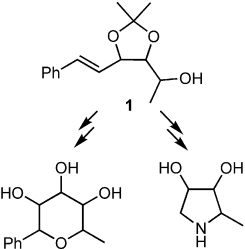
The authors then showed the applicability of their method by incorporating their configurationally defined building blocks into biologically active compounds. Using simple and straightforward organic chemistry transformations, the authors were able to embed their building blocks into two classes of compounds that are of biological interest. Importantly, scientists can now easily examine the biological activities of all the different stereoisomers of a given compound. Thus, the Italian team is well on their way to helping scientists screen a diverse range of potential drugs that may lead to the treatment, cure, prevention, or diagnosis of diseases.

More information: Elisabetta Brenna, et al., Oxygenated Stereotriads with Definite Absolute Configuration by Lipase-Mediated Kinetic Resolution: De Novo Synthesis of Imino Sugars and 6-Deoxy-C-glycosides, European Journal of Organic Chemistry, 2010, No. 23, 4468-4475, http://dx.doi.org/ … oc.201000558

Provided by Wiley (news : web)


Rank 5 /5 (1 vote)
Relevant PhysicsForums posts
  • Safe nitrogen compound to decompose a 500 deg C in a furnace?
    created8 hours ago
  • [ask]electron inside drinking water
    createdFeb 08, 2012
  • How to avoid formation of Lithium Chromate ???
    createdFeb 08, 2012
  • how to choose a reduced or oxidated form in a redox
    createdFeb 08, 2012
  • Mesomeric effect in acids.
    createdFeb 08, 2012
  • Looking for a safe endothermic chemical reaction
    createdFeb 07, 2012
  • More from Physics Forums - Chemistry

More news stories

Hydrogen from acidic water: Researchers develop potential low cost alternative to platinum for splitting water

A technique for creating a new molecule that structurally and chemically replicates the active part of the widely used industrial catalyst molybdenite has been developed by researchers with the Lawrence Berkeley ...

Chemistry / Materials Science

created 11 hours ago | popularity 5 / 5 (10) | comments 11 | with audio podcast

Flexible paper robots

(PhysOrg.com) -- These inexpensive robots can stretch, bend and twist under control, and lift objects up to 120 times their own weight. Being soft, they can apply gentle and even pressure, and adapt to varied ...

Chemistry / Materials Science

created 9 hours ago | popularity 5 / 5 (5) | comments 2 | with audio podcast

New method makes culture of complex tissue possible in any lab

Scientists at the University of California, San Diego have developed a new method for making scaffolds for culturing tissue in three-dimensional arrangements that mimic those in the body. This advance, published online in ...

Chemistry / Biochemistry

created 8 hours ago | popularity 5 / 5 (4) | comments 0 | with audio podcast

Engineers find inspiration for new materials in Piranha-proof armor

(PhysOrg.com) -- It’s a matchup worthy of a late-night cable movie: put a school of starving piranha and a 300-pound fish together, and who comes out the winner?

Chemistry / Materials Science

created 17 hours ago | popularity 4.3 / 5 (3) | comments 2 | with audio podcast

Materials that shrink when heated

One common reason that people with fillings experience toothache is that their fillings expand at a different rate to the original tooth when, for example, drinking a hot drink. Contrary to intuition, however, ...

Chemistry / Materials Science

created 10 hours ago | popularity 5 / 5 (2) | comments 1


'Dark plasmons' transmit energy

Microscopic channels of gold nanoparticles have the ability to transmit electromagnetic energy that starts as light and propagates via "dark plasmons," according to researchers at Rice University.

FDA-approved drug rapidly clears amyloid from the brain, reverses Alzheimer's symptoms in mice

Neuroscientists at Case Western Reserve University School of Medicine have made a dramatic breakthrough in their efforts to find a cure for Alzheimer's disease. The researchers' findings, published in the journal Science, show t ...

Ultraviolet protection molecule in plants yields its secrets

Lying around in the sun all day is hazardous not just for humans but also for plants, which have no means of escape. Ultraviolet (UV) radiation from the sun can damage proteins and DNA inside cells, leading ...

Anyone can learn to be more inventive, cognitive researcher says

There will always be a wild and unpredictable quality to creativity and invention, says Anthony McCaffrey, a cognitive psychology researcher at the University of Massachusetts Amherst, because an "Aha moment" is rare and ...

Soraa LED light may dim 50-watt halogen rivals

(PhysOrg.com) -- Soraa, a Fremont, California company founded in 2008, this week launched its first product, a light that uses LEDS (light emitting diodes). The "Soraa LED MR16 lamp" is the "perfect" replacement ...

Cell biologists describes mechanism by which some people may be more susceptible to colon cancer

An international research team led by cell biologists at the University of California, Riverside has uncovered a new insight into colon cancer, the third leading cause of cancer-related deaths in the United ...