Cornell leads fight against invasive emerald ash borer
September 2, 2010 By Molly Cronin
Cornell leads fight against invasive emerald ash borer

Enlarge

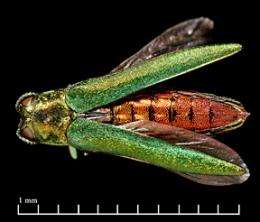
Emerald ash borer. Image: Kent Loeffler/Cornell

Cornell University is leading efforts to manage outbreak populations of the emerald ash borer (EAB), a beetle that has the potential to devastate ash trees in the Northeast. The new invasive species is already in Steuben and Ulster counties. The pest first showed up in western New York last August in the Cattaraugus County town of Randolph.

"I knew it would be a matter of time until we would find the EAB at other sites in New York," said John Vandenberg, research entomologist with the U.S. Department of Agriculture Agricultural Research Service and adjunct professor of entomology, who discovered the EAB in New York state last summer. "What we discovered in Randolph last year were some rather heavily infested ash trees." He hopes, he added, that the new detections have been discovered early enough to prevent disastrous infestations.

Vandenberg, along with Mark Whitmore, a Cornell forest entomologist, and Melissa Fierke of the State University of New York College of Environmental Science and Forestry are working extensively with Cornell Cooperative Extension offices throughout New York to raise public awareness about the EAB to minimize the ecological, social and economic impacts of the destructive pest.

While the bright green beetles cause no direct harm to humans, they can kill a North American ash tree in two to three years. The beetles threaten the Northeast's hardwood forests and are a major potential liability to communities, says Whitmore, because removing dead or infested trees costs $2,000 to $3,000 per tree. "Every penny we spend now will be paid back many times over in cost saving," he said, recommending that communities conduct an urban tree inventory and begin to lay out realistic plans for the eventual arrival of the EAB.

To keep the EAB from spreading, the team has been strategically killing and removing infested ash trees to decrease the EAB population and use for research.

With expected emergency funding from the Farm Bill, the team is considering identifying potential high-risk areas and perhaps importing several natural predator species of Chinese parasitic wasps if research proves them effective, said Vandenberg. "Meanwhile, we would have time to look for additional natural enemies, develop ash resistance or find other measures," he said.

Losing ash trees would not only mean major losses to lumber companies, said Tom Gerow of Wagner Lumber in Owego, N.Y., but a massive loss of ash trees would cause overharvest of other tree species and a failure of forests to replenish the lost valuable species. "Ash trees represent 10 percent of New York forests," said Gerow. "The 'void' will most likely be filled by plant species that reduce the environmental and societal benefits that forests have to offer."

The EAB, a native of Asia, is believed to have made its way to the United States through wooden shipping crates. Since first detected in North America in 2002 near Detroit and southern Ontario, the EAB has since spread, likely via infested ash firewood, to 13 states and two Canadian provinces, killing hundreds of millions of . To discourage such spread of invasive species, New York enacted firewood regulations in May 2009, which prohibits the transport of untreated firewood beyond 50 miles. Consumers should only use firewood from local sources and never move firewood from dying trees.

Provided by Cornell University (news : web)

Filter


Move the slider to adjust rank threshold, so that you can hide some of the comments.


Display comments: newest first

gunslingor1
Sep 02, 2010

Rank: not rated yet
More scientific mombo jombo. Invassive species are great, just more curropt scientists trying to keep their jobs.

I'll keep using this rediculous standard arguement on every scientific article.
Rank not rated yet
Related Stories
Relevant PhysicsForums posts
  • Stem cell question.
    created1 hour ago
  • Protease cleavage
    created7 hours ago
  • Pertubance in a model
    created14 hours ago
  • Cancer drugs and Alzheimer's, Oh my!
    created22 hours ago
  • Squishing cells
    created22 hours ago
  • Any books/articles for evolutionary stable strategy models in humans?
    createdFeb 09, 2012
  • More from Physics Forums - Biology

More news stories

The power of estrogen -- male snakes attract other males

A new study has shown that boosting the estrogen levels of male garter snakes causes them to secrete the same pheromones that females use to attract suitors, and turned the males into just about the sexiest ...

Biology / Plants & Animals

created 12 hours ago | popularity 4.8 / 5 (5) | comments 0 | with audio podcast

Grass to gas: Researchers' genome map speeds biofuel development

Researchers at the University of Georgia have taken a major step in the ongoing effort to find sources of cleaner, renewable energy by mapping the genomes of two originator cells of Miscanthus x giganteus, a large perenn ...

Biology / Biotechnology

created 9 hours ago | popularity 3.8 / 5 (5) | comments 0 | with audio podcast

Experts reveal how plants don't get sunburn

(PhysOrg.com) -- Experts at the University of Glasgow have discovered how plants survive the harmful rays of the sun.

Biology / Cell & Microbiology

created 12 hours ago | popularity 4.7 / 5 (3) | comments 0 | with audio podcast

Miami battling invasion of giant African snails

No one knows how they got there. But an invasion of African giant snails has southern Florida in a panic over potential crop damage, disease and general yuckiness surrounding the slimy gastropods.

Biology / Ecology

created 16 hours ago | popularity 4 / 5 (1) | comments 4

Protein libraries in a snap

(PhysOrg.com) -- A Rice University undergraduate will depart with not only a degree but also a possible patent for his invention of an efficient way to create protein libraries, an important component of biomolecular ...

Biology / Cell & Microbiology

created 15 hours ago | popularity 4.8 / 5 (4) | comments 0 | with audio podcast


Google users warned of threat to smartphone wallets

Users of Google smartphone wallets were being warned on Friday that there is a way to crack pass codes intended to thwart thieves from going on illicit shopping sprees.

Anonymous knocks CIA website offline (Update)

The website of the Central Intelligence Agency was inaccessible on Friday after the hacker group Anonymous claimed to have knocked it offline.

Complex wiring of the nervous system may rely on a just a handful of genes and proteins

Researchers at the Salk Institute have discovered a startling feature of early brain development that helps to explain how complex neuron wiring patterns are programmed using just a handful of critical genes. ...

New error-correcting codes guarantee the fastest possible rate of data transmission

Error-correcting codes are one of the triumphs of the digital age. They’re a way of encoding information so that it can be transmitted across a communication channel — such as an optical fiber o ...

Humans may have helped the decline of African rainforests 3000 years ago

(PhysOrg.com) -- Large areas of rainforests in Central Africa mysteriously disappeared over three thousand years ago, to be replaced by savannas. The prevailing theory has been that the cause was a change ...

Putting the squeeze on planets outside our solar system

(PhysOrg.com) -- Using high-powered lasers, scientists at Lawrence Livermore National Laboratory and collaborators discovered that molten magnesium silicate undergoes a phase change in the liquid state, abruptly ...