Cluster turns the invisible into the visible
September 2, 2010
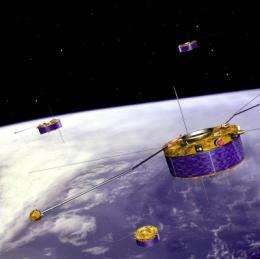
An artist's impression of the Cluster quartet. Credits: ESA
(PhysOrg.com) -- Cluster has spent a decade revealing previously hidden interactions between the Sun and Earth. Its studies have uncovered secrets of aurora, solar storms, and given us insight into fundamental processes that occur across the Universe. And there is more work to do.
The aurora, those dancing lights in the polar skies, are but the visible manifestation of an invisible battle taking place above our heads. Supersonic particles from the Sun collide with our planet’s magnetic field every day. Most are deflected away but some are trapped by Earth’s magnetism and accelerated to collide with the atmosphere, creating the aurora, the planet’s radiation belts and from time to time large magnetic storms worldwide.
In its decade studying this activity, Cluster has discovered giant magnetic whirlpools injecting new particles into Earth’s field, huge ‘holes’ in the uppermost atmosphere of Earth that create black regions in the visible aurora, and magnetic dead spots called nulls that form just as the magnetic landscape of space is about to snap into a new configuration.
“Cluster has shown us a previously hidden world of new details,” says Philippe Escoubet, ESA Cluster Mission Manager. As well as understanding the aurora, Cluster has a practical side: it unveils the environment that spacecraft such as navigation and communications satellites are expected to work in. Solar particles can damage spacecraft electronics, sometimes critically, so Cluster’s characterisation of this danger can lead to more robust satellite design.
There is a global science community working on Cluster. Every other day, a science team somewhere in the world has a paper accepted for publication that relies on Cluster data. The Cluster Active Archive already possesses more than 1000 users worldwide, ensuring that the science results will continue even after the mission itself comes to an end.
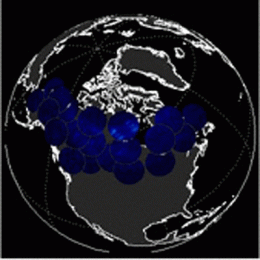
(Click 'Enlarge' for animated version) Auroral brightnening due to substorms over Canada. Cluster data has helped provide scientists with a new view of magnetospheric processes, challenging existing theories about magnetic substorms that cause aurorae and perturbations in GPS signals. Credits: Canadian Space Agency/ University of Calgary
Ten years is a long time in the severe condition of space. The four Cluster spacecraft are all showing their age and the operations team face a daily challenge to keep the fleet operational. Perhaps the biggest task is to make sure the power keep flowing.The solar panels no longer generate as much electricity as they did, and the batteries onboard are gradually breaking down in a dramatic way: a series of minor explosions. The batteries are made of non-magnetic silver-cadmium to avoid interfering with Cluster’s instruments. But over time, such batteries generate oxyhydrogen, an explosive gas. To date seven batteries have cracked across the four spacecraft, two of which were more like small explosions. Ground controllers saw the spacecraft lurch each time this happened. From twenty batteries, just nine remain. Yet new, creative scenarios for operations mean the spacecraft remain almost fully functional despite the loss of battery power.
And there is a lot still to be done. Recently, Cluster’s approach to Earth was lowered from 19 000 km to just several hundred kilometres. This will sweep Cluster through the regions responsible for the final acceleration of auroral particles, giving scientists an unparalleled view of this behaviour.
Whilst Cluster is firmly in orbit around the Earth, its science is fundamental to our understanding of the most distant realms of the Universe.
“We are doing astrophysics close to home,” says David Southwood, ESA Director of Science and Robotic Exploration, “Beyond the solar system is an enormous Universe, filled with uncountable stars. The spaces in between them are full of magnetic fields. Other missions study the objects - the islands in the universal ocean - but Cluster studies the very ocean itself.”
Cluster is expected to operate until 2012. A mission extension is under review to extend its operations to 2014.
-
Cluster spacecraft reach greatest separation at fifth anniversary
Jul 14, 2005 |
not rated yet |
0
-
ESA’s Cluster flies through Earth’s electrical switch
May 19, 2006 |
not rated yet |
0
-
Cluster takes first look at acceleration processes driving aurora
Apr 13, 2010 |
not rated yet |
0
-
Scientists weather a space storm to find its origin
Aug 02, 2005 |
not rated yet |
0
-
A decade of studying the Earth's magnetic shield, in 3-D
Aug 31, 2010 |
not rated yet |
0
-
Engineers build first sub-10-nm carbon nanotube transistor
Feb 01, 2012 |
4.9 / 5 (30) |
30
-
Something old, something new: Evolution and the structural divergence of duplicate genes
Jan 31, 2012 |
4.6 / 5 (7) |
1
-
The hidden nanoworld of ice crystals: Revealing the dynamic behavior of quasi-liquid layers
Jan 30, 2012 |
5 / 5 (3) |
1
-
Stock market network reveals investor clustering
Jan 27, 2012 |
3.9 / 5 (23) |
8
-
Of microchemistry and molecules: Electronic microfluidic device synthesizes biocompatible probes
Jan 26, 2012 |
5 / 5 (1) |
0
-
Titan's lack of impact craters
18 hours ago
-
Real pictures of black hole eating a star?
Feb 08, 2012
-
Hypothetical way to travel faster than light, but not technically exceed lightspeed
Feb 06, 2012
-
How do scientists monitor the Sun's activity?
Feb 05, 2012
-
Search patterns in observational studies
Feb 05, 2012
-
Derivation of Pogson's law
Feb 03, 2012
- More from Physics Forums - General Astronomy
More news stories
Humans may have helped the decline of African rainforests 3000 years ago
(PhysOrg.com) -- Large areas of rainforests in Central Africa mysteriously disappeared over three thousand years ago, to be replaced by savannas. The prevailing theory has been that the cause was a change ...
New views show old NASA Mars landers
(PhysOrg.com) -- The High Resolution Imaging Science Experiment (HiRISE) camera on NASA's Mars Reconnaissance Orbiter recorded a scene on Jan. 29, 2012, that includes the first color image from orbit showing ...
Space & Earth / Space Exploration
21 hours ago |
4.9 / 5 (7) |
9
|
Black holes and star formation
(PhysOrg.com) -- It has long been recognized that galaxy mergers or even close interactions can play a vital role in shaping the morphology of galaxies. One way they can do so, it is thought, is by triggering ...
20 hours ago |
4.1 / 5 (7) |
5
|
Deconstructing a mystery: What caused Snowmaggedon?
In the quiet after the storms, streets and cars had all but disappeared under piles of snow. The U.S. Postal Service suspended service for the first time in 30 years. Snow plows struggled to push the evidence ...
Space & Earth / Earth Sciences
13 hours ago |
4.7 / 5 (3) |
1
|
Ocean microbe communities changing, but long-term environmental impact is unclear
As oceans warm due to climate change, water layers will mix less and affect the microbes and plankton that pump carbon out of the atmosphere but researchers say it's still unclear whether these processes ...
Space & Earth / Earth Sciences
15 hours ago |
5 / 5 (2) |
2
|
Japan scientist makes 'Avatar' robot
A Japanese-developed robot that mimics the movements of its human controller is bringing the Hollywood blockbuster "Avatar" one step closer to reality.
Fighting crimes against biodiversity: How to catch a killer weed
Invasive species which have the potential to destroy biodiversity and influence global change could be tracked and controlled in the same way as wanted criminals, according to new research from Queen Mary, University of London.
Metastatic breast cancer hitches a free ride from the immune system
Inflammatory breast cancer (IBC) is the most lethal form of breast cancer . It spreads easily through the lymphatic and blood vessels, forming metastasis which can lead to multi-organ failure. New research published in BioMed ...
A novel method for simultaneously measuring blood pressure and arterial stiffness
Arterial stiffness due to is a major contributor to cardiovascular disease but is very difficult to measure. It also can influence blood pressure readings since these rely on the time taken for arteries to return to normal ...
India's global pharmacy role threatened by EU pact
(AP) -- Efforts by India and the European Union to strengthen trade are threatening India's ability to deliver lifesaving medicines to the world's poorest, analysts say as the two sides push through protracted ...
US video game sales fall 34 percent in January
(AP) -- U.S. retail sales of video game hardware, software and accessories fell 34 percent in January from a year earlier to $751 million due to the lack of new game titles, according to market researcher NPD Group.

Sep 04, 2010
Rank: 1 / 5 (1)
Plasmas and Electromagnetic fields hold the keys for next century. ESA cluster mission is helping this perspective change to reality
The missions must continue to monitor and Esa hopes to go -Solar orbiter Phase as early as possible in view of Cosmic Alignment.
The scienceof Cosmology Vedas interlinks help in this direction.
Vidyardhi Nanduri