Microrobots: Miniature auto differential helps tiny aerial robots stay aloft
September 2, 2010
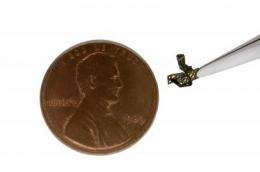
Engineers at Harvard University are developing minuscule aerial robots that could someday be used to probe environmental hazards, forest fires, and other places too perilous for people. Credit: Pratheev S. Sreetharan/Harvard University
Engineers at Harvard University have created a millionth-scale automobile differential to govern the flight of minuscule aerial robots that could someday be used to probe environmental hazards, forest fires, and other places too perilous for people.
Their new approach is the first to passively balance the aerodynamic forces encountered by these miniature flying devices, letting their wings flap asymmetrically in response to gusts of wind, wing damage, and other real-world impediments.
"The drivetrain for an aerial microrobot shares many characteristics with a two-wheel-drive automobile," says lead author Pratheev S. Sreetharan, a graduate student in Harvard's School of Engineering and Applied Sciences. "Both deliver power from a single source to a pair of wheels or wings. But our PARITy differential generates torques up to 10 million times smaller than in a car, is 5 millimeters long, and weighs about one-hundredth of a gram -- a millionth the mass of an automobile differential."
High-performance aerial microrobots, such as those the Harvard scientists describe in the Journal of Mechanical Design, could ultimately be used to investigate areas deemed too dangerous for people. Scientists at institutions including the University of California, Berkeley, University of Delaware, University of Tokyo, and Delft University of Technology in the Netherlands are exploring aerial microrobots as cheap, disposable tools that might someday be deployed in search and rescue operations, agriculture, environmental monitoring, and exploration of hazardous environments.

Engineers at Harvard University are developing minuscule aerial robots that could someday be used to probe environmental hazards, forest fires, and other places too perilous for people. Credit: Pratheev S. Sreetharan/Harvard University
To fly successfully through unpredictable environments, aerial microrobots -- like insects, nature's nimblest fliers -- have to negotiate conditions that change second-by-second. Insects usually accomplish this by flapping their wings in unison, a process whose kinematic and aerodynamic basis remains poorly understood.Sreetharan and his co-author, Harvard engineering professor Robert J. Wood, recognized that an aerial microrobot based on an insect need not contain complex electronic feedback loops to precisely control wing position.
"We're not interested so much in the position of the wings as the torque they generate," says Wood, an associate professor of electrical engineering at Harvard. "Our design uses 'mechanical intelligence' to determine the correct wing speed and amplitude to balance the other forces affecting the robot. It can slow down or speed up automatically to correct imbalances."
Sreetharan and Wood found that even when a significant part of an aerial microrobot's wing was removed, the self-correction engendered by their PARITy (Passive Aeromechanical Regulation of Imbalanced Torques) drivetrain allowed the device to remain balanced in flight. Smaller wings simply flapped harder to keep up with the torque generated by an intact wing, reaching speeds of up to 6,600 beats per minute.
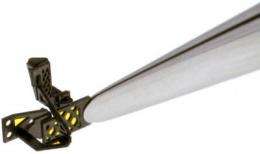
Engineers at Harvard University are developing minuscule aerial robots that could someday be used to probe environmental hazards, forest fires, and other places too perilous for people. Credit: Pratheev S. Sreetharan/Harvard University
The Harvard engineers say their passive approach to regulating the forces generated in flight is preferable to a more active approach involving electronic sensors and computation, which would add weight and complexity to devices intended to remain as small as lightweight as possible. Current-generation aerial microrobots are about the size and weight of many insects, and even make a similar buzzing sound when flying."We suspect that similar passive mechanisms exist in nature, in actual insects," Sreetharan says. "We take our inspiration from biology, and from the elegant simplicity that has evolved in so many natural systems."
-
Micro flying robots can fly more effectively than flies
Aug 01, 2009 |
not rated yet |
0
-
Staying the course: Fruit flies employ stabilizer reflex to recover from midflight stumbles
Mar 01, 2010 |
not rated yet |
0
-
Flies Don't Think Much Of Turning (w/ Video)
Apr 02, 2010 |
not rated yet |
0
-
Artificial butterfly in flight and filmed (w/ Video)
May 20, 2010 |
not rated yet |
0
-
Secrets of insect flight revealed
Sep 17, 2009 |
not rated yet |
0
-
Engineers build first sub-10-nm carbon nanotube transistor
Feb 01, 2012 |
4.9 / 5 (30) |
30
-
Something old, something new: Evolution and the structural divergence of duplicate genes
Jan 31, 2012 |
4.6 / 5 (7) |
1
-
The hidden nanoworld of ice crystals: Revealing the dynamic behavior of quasi-liquid layers
Jan 30, 2012 |
5 / 5 (3) |
1
-
Stock market network reveals investor clustering
Jan 27, 2012 |
3.9 / 5 (23) |
8
-
Of microchemistry and molecules: Electronic microfluidic device synthesizes biocompatible probes
Jan 26, 2012 |
5 / 5 (1) |
0
-
Empirical data regarding shower heads and water
5 hours ago
-
feed hold button on CNC lathe
Feb 09, 2012
-
RFAC in Fortran
Feb 09, 2012
-
dynamics 2/32
Feb 08, 2012
-
dynamics
Feb 08, 2012
-
Vibration Absorbtion Problem
Feb 08, 2012
- More from Physics Forums - General Engineering
More news stories
US video game sales fall 34 percent in January
(AP) -- U.S. retail sales of video game hardware, software and accessories fell 34 percent in January from a year earlier to $751 million due to the lack of new game titles, according to market researcher NPD Group.
2 hours ago |
not rated yet |
0
Zynga partners with toy maker Hasbro
Old school toy maker Hasbro and online social game star Zynga on Thursday announced a partnership to mesh the Internet firm's hits with real-world products.
1 hour ago |
not rated yet |
0
Samsung can continue selling Galaxy tabs in Germany: court
South Korea's Samsung Electronics can continue to sell its Galaxy Tab 10.1N tablet computer in Germany, a German court ruled Thursday, rejecting a bid by arch-rival Apple to have them banned.
23 hours ago |
4 / 5 (4) |
3
Digital photos could put kids at risk
A study published in the International Journal of Electronic Security and Digital Forensics this month suggests that parents and carers could be putting children at risk if they upload digital photos that are automatically "geota ...
19 hours ago |
5 / 5 (1) |
3
Google launches Chrome browser for Android smartphones
With more and more people connecting to the Internet through a phone or a tablet instead of a PC, Google Inc. is bringing its fast-growing browser, Chrome, to the newest Android-powered mobile devices.
22 hours ago |
5 / 5 (5) |
0
Protein libraries in a snap
(PhysOrg.com) -- A Rice University undergraduate will depart with not only a degree but also a possible patent for his invention of an efficient way to create protein libraries, an important component of biomolecular ...
Breastfeeding protects against asthma up to six years of age
(Medical Xpress) -- Research by the University of Otago in Christchurch and Wellington has shown that breastfeeding of infants has a clear protective effect against children developing asthma or wheezing up to six years of ...
Study finds stress hormones fluctuate with mood during pregnancy
(Medical Xpress) -- While pregnant, women pay particular attention to factors such as diet and exercise to ensure their babies are born healthy and develop normally. New research from the University of Calgarys Faculty ...
Humans may have helped the decline of African rainforests 3000 years ago
(PhysOrg.com) -- Large areas of rainforests in Central Africa mysteriously disappeared over three thousand years ago, to be replaced by savannas. The prevailing theory has been that the cause was a change ...
Japan scientist makes 'Avatar' robot
A Japanese-developed robot that mimics the movements of its human controller is bringing the Hollywood blockbuster "Avatar" one step closer to reality.
Miami battling invasion of giant African snails
No one knows how they got there. But an invasion of African giant snails has southern Florida in a panic over potential crop damage, disease and general yuckiness surrounding the slimy gastropods.


Sep 02, 2010
Rank: not rated yet
Right... call me cynic...
Sep 02, 2010
Rank: not rated yet
Sep 02, 2010
Rank: not rated yet
Whenever you see robots being made primarily for "search and rescue", the truth is closer to "search and destroy". Not to say that these new fantastic devises could not be used for humanitarian and environmental purposes, it's just that these uses fall at the bottom of the list - except for media propaganda (such as here) where they rise to the top.
Sep 02, 2010
Rank: not rated yet
I'd start writing the scifi movie script right now if the movie industry wasn't so messed up.
Sep 02, 2010
Rank: not rated yet
I think that movie was made already - the newer release of The Day The Earth Stood Still.
Sep 05, 2010
Rank: not rated yet