Canadian to command space station in 2013
September 2, 2010
Canadian Astronaut Chris Hadfield

Enlarge

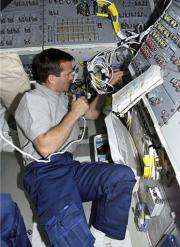
Canadian Astronaut Chris Hadfield checks out equipment on the space shuttle Endeavour in 2001. Hadfield in 2013 will become the first Canadian to command the International Space Station (ISS), the Canadian Space Agency announced Thursday.

Astronaut Chris Hadfield in 2013 will become the first Canadian to command the International Space Station (ISS), the Canadian Space Agency announced Thursday.

Hadfield, 51, will rocket on his third trip into space aboard a in December 2012 and assume command of the station during the second part of a six-month mission.

Over the first four months, as an ISS flight engineer, Hadfield will carry out scientific experiments, robotics tasks and technology demonstrations, the said in a statement.

As well, the veteran space-walker may be called upon to step out into space to perform tasks around the station.

As ISS commander, Hadfield will be responsible for the crew's safety, ISS ongoing operations, maintenance and equipment, while ensuring that scientific experiments are carried out.

He may also be called on to perform assembly and maintenance tasks on the ISS, and to grapple and berth spacecraft to the station using the robotic Canadarm-2.

Hadfield was, in 2001, the first Canadian to perform a and in 1995 became the only Canadian to board the Russian space station Mir.

Construction of the ISS started in 1998 and now orbits the Earth from a distance of 350 kilometers, circling the planet every 90 minutes at a speed of 28,000 kilometers per hour.

(c) 2010 AFP


Rank 5 /5 (2 votes)
Related Stories
Relevant PhysicsForums posts
  • Titan's lack of impact craters
    created15 hours ago
  • Real pictures of black hole eating a star?
    createdFeb 08, 2012
  • Hypothetical way to travel faster than light, but not technically exceed lightspeed
    createdFeb 06, 2012
  • How do scientists monitor the Sun's activity?
    createdFeb 05, 2012
  • Search patterns in observational studies
    createdFeb 05, 2012
  • Derivation of Pogson's law
    createdFeb 03, 2012
  • More from Physics Forums - General Astronomy

More news stories

Deconstructing a mystery: What caused Snowmaggedon?

In the quiet after the storms, streets and cars had all but disappeared under piles of snow. The U.S. Postal Service suspended service for the first time in 30 years. Snow plows struggled to push the evidence ...

Space & Earth / Earth Sciences

created 10 hours ago | popularity 4.7 / 5 (3) | comments 1 | with audio podcast

New views show old NASA Mars landers

(PhysOrg.com) -- The High Resolution Imaging Science Experiment (HiRISE) camera on NASA's Mars Reconnaissance Orbiter recorded a scene on Jan. 29, 2012, that includes the first color image from orbit showing ...

Space & Earth / Space Exploration

created 18 hours ago | popularity 4.9 / 5 (7) | comments 7 | with audio podcast

Ocean microbe communities changing, but long-term environmental impact is unclear

As oceans warm due to climate change, water layers will mix less and affect the microbes and plankton that pump carbon out of the atmosphere – but researchers say it's still unclear whether these processes ...

Space & Earth / Earth Sciences

created 12 hours ago | popularity 5 / 5 (2) | comments 2 | with audio podcast

Researchers create 3-D laser maps that show how earthquake changes landscape

Geologists have a new tool to study how earthquakes change the landscape down to a few inches, and it's giving them insight into how earthquake faults behave. In the Feb. 10 issue of the journal Science, a team ...

Space & Earth / Earth Sciences

created 12 hours ago | popularity 5 / 5 (4) | comments 0 | with audio podcast

Black holes and star formation

(PhysOrg.com) -- It has long been recognized that galaxy mergers or even close interactions can play a vital role in shaping the morphology of galaxies. One way they can do so, it is thought, is by triggering ...

Space & Earth / Astronomy

created 17 hours ago | popularity 4.1 / 5 (7) | comments 5 | with audio podcast


'Dark plasmons' transmit energy

Microscopic channels of gold nanoparticles have the ability to transmit electromagnetic energy that starts as light and propagates via "dark plasmons," according to researchers at Rice University.

FDA-approved drug rapidly clears amyloid from the brain, reverses Alzheimer's symptoms in mice

Neuroscientists at Case Western Reserve University School of Medicine have made a dramatic breakthrough in their efforts to find a cure for Alzheimer's disease. The researchers' findings, published in the journal Science, show t ...

Hydrogen from acidic water: Researchers develop potential low cost alternative to platinum for splitting water

A technique for creating a new molecule that structurally and chemically replicates the active part of the widely used industrial catalyst molybdenite has been developed by researchers with the Lawrence Berkeley ...

Ultraviolet protection molecule in plants yields its secrets

Lying around in the sun all day is hazardous not just for humans but also for plants, which have no means of escape. Ultraviolet (UV) radiation from the sun can damage proteins and DNA inside cells, leading ...

Anyone can learn to be more inventive, cognitive researcher says

There will always be a wild and unpredictable quality to creativity and invention, says Anthony McCaffrey, a cognitive psychology researcher at the University of Massachusetts Amherst, because an "Aha moment" is rare and ...

Soraa LED light may dim 50-watt halogen rivals

(PhysOrg.com) -- Soraa, a Fremont, California company founded in 2008, this week launched its first product, a light that uses LEDS (light emitting diodes). The "Soraa LED MR16 lamp" is the "perfect" replacement ...