Brainy worms: Evolution of the cerebral cortex
September 2, 2010
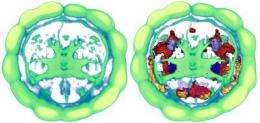
A virtual Platynereis brain (left), created by averaging microscopy images of the brains of 36 different individuals, onto which scientists mapped gene activity (right). Perspective shows the brain as viewed from inside a Platynereis larvae, at 48 hours’ old. Credit: EMBL/R.Tomer
(PhysOrg.com) -- Our cerebral cortex, or pallium, is a big part of what makes us human: art, literature and science would not exist had this most fascinating part of our brain not emerged in some less intelligent ancestor in prehistoric times. But when did this occur and what were these ancestors?
Unexpectedly, scientists at the European Molecular Biology Laboratory (EMBL) in Heidelberg, Germany, have now discovered a true counterpart of the cerebral cortex in an invertebrate, a marine worm. Their findings are published today in Cell, and give an idea of what the most ancient higher brain centres looked like, and what our distant ancestors used them for.
It has long been clear that, in evolutionary terms, we share our pallium with other vertebrates, but beyond that was mystery. This is because even invertebrates that are clearly related to us - such as the fish-like amphioxus - appear to have no similar brain structures, nothing that points to a shared evolutionary past. But EMBL scientists have now found brain structures related to the vertebrate pallium in a very distant cousin - the marine ragworm Platynereis dumerilii, a relative of the earthworm - which last shared an ancestor with us around 600 million years ago.
"Two stunning conclusions emerge from this finding", explains Detlev Arendt, who headed the study: "First, the pallium is much older than anyone would have assumed, probably as old as higher animals themselves. Second, we learn that it came out of 'the blue' - as an adaptation to early marine life in Precambrian oceans."
To uncover the evolutionary origins of our brain, EMBL scientist Raju Tomer, who designed and conducted the work, took an unprecedentedly deep look at the regions of Platynereis dumerilii's brain responsible for processing olfactory information - the mushroom-bodies. He developed a new technique, called cellular profiling by image registration (PrImR), which is the first to enable scientists to investigate a large number of genes in a compact brain and determine which are turned on simultaneously. This technique enabled Tomer to determine each cell's molecular fingerprint, defining cell types according to the genes they express, rather than just based on their shape and location as was done before.
"Comparing the molecular fingerprints of the developing ragworms' mushroom-bodies to existing information on the vertebrate pallium," Arendt says, " it became clear that they are too similar to be of independent origin and must share a common evolutionary precursor."
This ancestral structure was likely a group of densely packed cells, which received and processed information about smell and directly controlled locomotion. It may have enabled our ancestors crawling over the sea floor to identify food sources, move towards them, and integrate previous experiences into some sort of learning.
"Most people thought that invertebrate mushroom-bodies and vertebrate pallium had arisen independently during the course of evolution, but we have proven this was most probably not the case," says Tomer. Arendt concludes: "The evolutionary history of our cerebral cortex has to be rewritten."
More information: Tomer, R., Denes, A., Tessmar-Raible, K., & Arendt, D. Cellular resolution expression profiling reveals common origin of annelid mushroom bodies and vertebrate pallium. Cell, 26 August 2010.
Provided by European Molecular Biology Laboratory (news : web)
-
MicroRNA: A glimpse into the past
Feb 01, 2010 |
not rated yet |
0
-
The beginnings of the thinking brain
Jun 28, 2006 |
not rated yet |
0
-
Scientists uncover key developmental mechanisms of the amygdala
Jan 13, 2009 |
not rated yet |
0
-
The Worm That Turned Evolutionary Key
Nov 20, 2009 |
not rated yet |
0
-
Discovery of 'creator' gene for cerebral cortex points to potential stem cell treatments
Jan 17, 2008 |
not rated yet |
0
-
Engineers build first sub-10-nm carbon nanotube transistor
Feb 01, 2012 |
4.9 / 5 (31) |
30
-
Something old, something new: Evolution and the structural divergence of duplicate genes
Jan 31, 2012 |
4.6 / 5 (7) |
1
-
The hidden nanoworld of ice crystals: Revealing the dynamic behavior of quasi-liquid layers
Jan 30, 2012 |
5 / 5 (3) |
1
-
Stock market network reveals investor clustering
Jan 27, 2012 |
3.9 / 5 (23) |
8
-
Of microchemistry and molecules: Electronic microfluidic device synthesizes biocompatible probes
Jan 26, 2012 |
5 / 5 (1) |
0
-
Protease cleavage
5 hours ago
-
Pertubance in a model
12 hours ago
-
Cancer drugs and Alzheimer's, Oh my!
20 hours ago
-
Squishing cells
21 hours ago
-
Any books/articles for evolutionary stable strategy models in humans?
Feb 09, 2012
-
Science behind the bore feeling?
Feb 09, 2012
- More from Physics Forums - Biology
More news stories
The power of estrogen -- male snakes attract other males
A new study has shown that boosting the estrogen levels of male garter snakes causes them to secrete the same pheromones that females use to attract suitors, and turned the males into just about the sexiest ...
10 hours ago |
4.8 / 5 (5) |
0
|
Grass to gas: Researchers' genome map speeds biofuel development
Researchers at the University of Georgia have taken a major step in the ongoing effort to find sources of cleaner, renewable energy by mapping the genomes of two originator cells of Miscanthus x giganteus, a large perenn ...
7 hours ago |
3.7 / 5 (3) |
0
|
Experts reveal how plants don't get sunburn
(PhysOrg.com) -- Experts at the University of Glasgow have discovered how plants survive the harmful rays of the sun.
10 hours ago |
5 / 5 (2) |
0
|
Protein libraries in a snap
(PhysOrg.com) -- A Rice University undergraduate will depart with not only a degree but also a possible patent for his invention of an efficient way to create protein libraries, an important component of biomolecular ...
13 hours ago |
5 / 5 (2) |
0
|
Miami battling invasion of giant African snails
No one knows how they got there. But an invasion of African giant snails has southern Florida in a panic over potential crop damage, disease and general yuckiness surrounding the slimy gastropods.
14 hours ago |
4 / 5 (1) |
4
Google users warned of threat to smartphone wallets
Users of Google smartphone wallets were being warned on Friday that there is a way to crack pass codes intended to thwart thieves from going on illicit shopping sprees.
Anonymous knocks CIA website offline (Update)
The website of the Central Intelligence Agency was inaccessible on Friday after the hacker group Anonymous claimed to have knocked it offline.
Complex wiring of the nervous system may rely on a just a handful of genes and proteins
Researchers at the Salk Institute have discovered a startling feature of early brain development that helps to explain how complex neuron wiring patterns are programmed using just a handful of critical genes. ...
NASA sees wide-eyed cyclone Jasmine
Cyclone Jasmine's eye has opened wider on NASA satellite imagery, as it moves through the Southern Pacific Ocean.
Putting the squeeze on planets outside our solar system
(PhysOrg.com) -- Using high-powered lasers, scientists at Lawrence Livermore National Laboratory and collaborators discovered that molten magnesium silicate undergoes a phase change in the liquid state, abruptly ...
NASA sees Giovanna reach cyclone strength, threaten Madagascar
Tropical Storm 12S built up steam and became a cyclone on February 10, 2012 as NASA's Terra satellite passed overhead. Residents of east-central Madagascar should prepare for this cyclone to make landfall ...