Water in Earth's mantle key to survival of oldest continents
September 2, 2010
Water in Earth's mantle key to survival of oldest continents

Enlarge

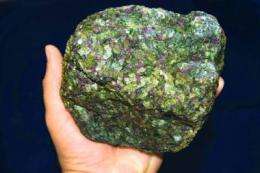
This is an image of a sample of cratonic mantle root from Kimberley, South Africa. The rock consists of dark green olivine, whitish-green enstatite, emerald green diopside and purple garnet. Credit: Credit: David R. Bell / ASU

Earth today is one of the most active planets in the Solar System, and was probably even more so during the early stages of its life. Thanks to the plate tectonics that continue to shape our planet's surface, remnants of crust from Earth's formative years are rare, but not impossible to find. A paper published in Nature Sept. 2 examines how some ancient rocks have resisted being recycled into Earth's convecting interior.

Throughout the world there exist regions of ancient crust, referred to as cratons, which have resisted being recycled into the interior of our tectonically dynamic planet. These geologic anomalies appear to have withstood major deformation thanks to the presence of roots. A mantle root is a portion of Earth's mantle that lies beneath the craton, extending like the root of a tooth into the rest of the underlying mantle.

Just like a tooth, the mantle root of a craton is compositionally different from the normal mantle into which it protrudes. It is also colder, causing it to be more rigid. These roots were formed in ancient melting events and are intrinsically more buoyant than the surrounding mantle. The melting removed much of the calcium, aluminum, and iron that would normally form dense minerals. Thus, these roots act as rafts bobbing on a vigorously convecting mantle, on which old fragments of may bask in comparative safety.

However, geophysical calculations have suggested that this buoyancy is not enough to stop destruction of the mantle roots. According to these calculations, the hotter temperatures that are widely thought to have existed in Earth's mantle about 2.5 to 3 billion years ago should have warmed and softened up the base of these roots sufficiently to allow them to be gradually eroded from below, leading to their eventual destruction as they were entrained, piece by piece, into the convecting mantle. A stronger viscosity contrast between the root and the underlying mantle is required to ensure preservation.

In the Sept. 2 issue of Nature, Anne Peslier, an ESCG-Jacobs Technology scientist working at NASA-Johnson Space Center and her colleagues David Bell from Arizona State University and Alan Woodland and Marina Lazarov from the University of Frankfurt, published measurements of the trace water content of rocks from the deepest part of a mantle root that offer an explanation for this mystery.

"It has long been suspected, but not proven, that cratonic mantle roots are dryer than convecting upper mantle," explains Bell, an associate research scientist in the School of Earth and Space Exploration and the department of chemistry and biochemistry in ASU's College of Liberal Arts and Sciences. "The presence of very small quantities of water is known to weaken rocks and minerals. During partial melting, such as that experienced by the mantle roots, water - like calcium, aluminum and iron - is also removed."
Water in Earth's mantle key to survival of oldest continents
Enlarge

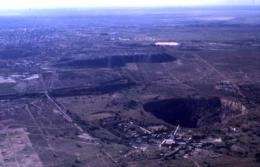
This is an aerial view of diamond mining at Kimberley, South Africa. The hole remaining after removal of kimberlite is shown in right foreground while waste dumps from which samples in this study were collected are in the center of the picture. Credit: Credit: David R. Bell / ASU

The researchers used samples found in diamond mines of Southern Africa, where the ancient crust of the Kaapvaal craton was pierced about 100 million years ago by gas-charged magmas called kimberlites. These magmas were generated at depths of about 125 miles (200 kilometers) beneath the mantle root and ascended rapidly (in a matter of hours) through the Earth via deep fractures, bringing with them pieces of the rocks traversed, including diamonds. After erupting explosively at the surface, the magmas solidified into the pipe-like bodies of kimberlite rock that were subsequently mined for their diamonds.

The mantle rocks analyzed by the team were transported from a range of depths down to 125 miles (200 km) below the surface, where they had resided since their formation around 3 billion years ago. The samples of rock called peridotite are composed mainly of the mineral olivine, with minor quantities of pyroxenes and garnet. Olivine is, because if its abundance, the mineral believed to control the rheological properties of peridotite.

What Peslier and colleagues found is that beyond a depth of about 112 miles (180 km), the water content of olivines begins to decline with depth, so that the olivine in peridotite samples from the very base of the cratonic mantle root contained hardly any water. That makes these olivines very hard to deform or break up, and may generate the strong contrast with that geophysical models of craton root stability require.

Why the bottom of the mantle root has dry olivines is still a matter of speculation. One possibility, suggested by Woodland, is that reducing conditions thought to prevail at these depths would ensure that fluids would be rich in methane instead of water. Bell suggests that melts generated in the asthenosphere, such as those eventually giving rise to kimberlite eruptions, may scavenge any water present while passing through the base of the cratonic root and transport it into the overlying shallower mantle.

These results reiterate the belief shared by many scientists that knowing how much water is present deep in terrestrial planets and moons, like Earth, Mars or the Moon, is important to understanding their dynamics and evolutionary history.

Provided by Arizona State University (news : web)

4.8 /5 (6 votes)  

Filter


Move the slider to adjust rank threshold, so that you can hide some of the comments.


Display comments: newest first

Shootist
Sep 03, 2010

Rank: not rated yet
No mention in the article that the Kimberley Diamond mine is located within the confines of a 300-500km impact crater (Reitz Ring)?

No mention in the the article that the ancient crusts may have been uplifted and exposed to the surface by this putative impact event?

Such would certainly change their hypothesis.

http://www.scienc...chtype=a
Nik_2213
Sep 05, 2010

Rank: not rated yet
Uh, possibly because there's scant literature on the Reitz ring. Makes for alternate hypothesis, of course, that an ancient impact prompted upwelling etc that spawned kimberlite pipes...
Rank 4.8 /5 (6 votes)
Relevant PhysicsForums posts
  • Discrepancy between oxygen and carbon-dioxide levels
    created13 hours ago
  • where gems are found in the world
    created16 hours ago
  • Wind Waves in Reservoir ~ Wind run-up and Wind set-up
    createdFeb 08, 2012
  • Balance of oxygen in the atmosphere
    createdFeb 01, 2012
  • The case for a methanol-based economy
    createdJan 30, 2012
  • Weather in a rotating cylinder
    createdJan 25, 2012
  • More from Physics Forums - Earth

More news stories

Domestic consumption main contributor to Africa's growing e-waste

West Africa faces a rising tide of e-waste generated by domestic consumption of new and used electrical and electronic equipment, according to a new United Nations report. Domestic consumption makes up the majority (up to ...

Space & Earth / Environment

created 50 minutes ago | popularity not rated yet | comments 0

Humans may have helped the decline of African rainforests 3000 years ago

(PhysOrg.com) -- Large areas of rainforests in Central Africa mysteriously disappeared over three thousand years ago, to be replaced by savannas. The prevailing theory has been that the cause was a change ...

Space & Earth / Environment

created 5 hours ago | popularity 5 / 5 (3) | comments 4 | with audio podcast report

Could Venus be shifting gear?

(PhysOrg.com) -- ESA’s Venus Express spacecraft has discovered that our cloud-covered neighbour spins a little slower than previously measured. Peering through the dense atmosphere in the infrared, the ...

Space & Earth / Space Exploration

created 1 hour ago | popularity 5 / 5 (3) | comments 4 | with audio podcast

Clam fields found at deep, low-temperature Mariana vents

(PhysOrg.com) -- Scientists have marveled at the unusual life forms thriving at high temperature hydrothermal vents of the deep ocean.

Space & Earth / Earth Sciences

created 2 hours ago | popularity not rated yet | comments 0 | with audio podcast

Mars Science Laboratory computer issue resolved

(PhysOrg.com) -- Engineers have found the root cause of a computer reset that occurred two months ago on NASA's Mars Science Laboratory and have determined how to correct it.

Space & Earth / Space Exploration

created 2 hours ago | popularity 5 / 5 (4) | comments 2 | with audio podcast


Fool's gold may prove an unlikely alternative to overexploited catalytic materials

Catalytic materials, which lower the energy barriers for chemical reactions, are used in everything from the commercial production of chemicals to catalytic converters in car engines. However, with current catalytic materials ...

Curry spice component may help slow prostate tumor growth

Curcumin, an active component of the Indian curry spice turmeric, may help slow down tumor growth in castration-resistant prostate cancer patients on androgen deprivation therapy (ADT), a study from researchers ...

What lies beneath: Mapping hidden nanostructures

The ability to diagnose and predict the properties of materials is vital, particularly in the expanding field of nanotechnology. Electron and atom-probe microscopy can categorize atoms in thin sheets of material, ...

Netflix light on flicks as viewers soak up TV shows

Like most fresh faces that arrive in Hollywood, Netflix wanted to be a movie star. But now it's learning what many in Tinseltown have known for decades: Movies are sexy, but the real money is in television.

To avoid early labor and delivery, weight and diet changes not the answer

One of the strongest known risk factors for spontaneous or unexpected preterm birth – any birth that occurs before the 37th week of pregnancy, most often without a known cause – is already having had one. For women ...

Arthritic knees, but not hips, have robust repair response

Researchers at Duke University Medical Center used new tools they developed to analyze knees and hips and discovered that osteoarthritic knee joints are in a constant state of repair, while hip joints are not.