Hubble observations of supernova reveal composition of 'star guts' pouring out
September 2, 2010
Hubble observations of supernova reveal composition of 'star guts' pouring out

Enlarge

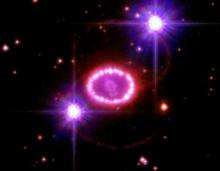
A team of astronomers led by the University of Colorado at Boulder is charting the interactions between Supernova 1987A and a glowing gas ring encircling the supernova remnant known as the "String of Pearls." Credit: NASA

Observations made with NASA's newly refurbished Hubble Space Telescope of a nearby supernova are allowing astronomers to measure the velocity and composition of "star guts" being ejected into space following the explosion, according to a new study led by the University of Colorado at Boulder.

The team detected significant brightening of the emissions from Supernova 1987A, which were consistent with some theoretical predictions about how supernovae interact with their immediate galactic environment. Discovered in 1987, Supernova 1987A is the closest to Earth to be detected since 1604 and resides in the nearby , a adjacent to our own Milky Way Galaxy.

The team observed the supernova in optical, ultraviolet and near-infrared light, charting the interplay between the and the famous "String of Pearls," a glowing ring 6 trillion miles in diameter encircling the supernova remnant that has been energized by X-rays. The gas ring likely was shed some 20,000 years before the supernova exploded, and rushing out from the remnant have been brightening some 30 to 40 pearl-like "hot spots" in the ring -- objects that likely will grow and merge together in the coming years to form a continuous, glowing circle.

"The new observations allow us to accurately measure the velocity and composition of the ejected 'star guts,' which tell us about the deposition of energy and heavy elements into the ," said CU-Boulder Research Associate Kevin France of the Center for Astrophysics and Space Astronomy, lead study author. "The new observations not only tell us what elements are being recycled into the Large Magellanic Cloud, but how it changes its environment on human time scales."

A paper on the subject was published in the Sept. 2 issue of Science. The international study involved study co-authors from 15 other universities and institutes and included CU-Boulder Richard McCray, the Science paper's second author.

In addition to ejecting massive amounts of hydrogen, 1987A has spewed helium, oxygen, nitrogen and rarer heavy elements like sulfur, silicon and iron. Supernovae are responsible for a large fraction of biologically important elements, including oxygen, carbon and iron found in plants and animals on Earth today, he said. The iron in a person's blood, for example, is believed to have been made by supernovae explosions.

Hubble is the only observatory in the world that can observe the brightening of the String of Pearls in ultraviolet light, said France. Most of the data for the study was gathered by the Space Telescope Imaging Spectrograph, or STIS, which was installed on Hubble in 1997 and was one of the workhorse instruments before its power supply failed in 2004. A faulty circuit board on STIS was replaced by astronauts on the final Hubble repair mission in May 2009.

The team compared STIS observations in January 2010 with Hubble observations made over the past 15 years on 1987A's evolution. STIS has provided the team with detailed images of the exploding star, as well as spectrographic data -- essentially wavelengths of light broken down into colors like a prism that produce unique fingerprints of gaseous matter. The results revealed temperatures, chemical composition, density and motion of 1987A and its surrounding environment, said France.

Since the supernova is roughly 163,000 light-years away, the explosion occurred in roughly 161,000 B.C., said France. One light year is about 6 trillion miles.

"To see a supernova go off in our backyard and to watch its evolution and interactions with the environment in human time scales is unprecedented," he said. "The massive stars that produce explosions like Supernova 1987A are like rock stars -- they live fast, flashy lives and die young."

France said the energy input from supernovae regulates the physical state and the long-term evolution of galaxies like the . Many astronomers believe a supernova explosion near our forming sun some 4 to 5 billion years ago is responsible for a significant fraction of radioactive elements in our solar system today, he said.

"In the big picture, we are seeing the effect a supernova can have in the surrounding galaxy, including how the energy deposited by these stellar explosions changes the dynamics and chemistry of the environment," said France. "We can use this new data to understand how supernova processes regulate the evolution of ."

Some of the upcoming Hubble observations of 1987A will be made with the Cosmic Origins Spectrograph, a $70 million instrument designed by a team at CU-Boulder's Center for Astrophysics and Space Astronomy that was installed on Hubble during the 2009 servicing mission. The instrument is designed to help scientists better understand the "cosmic web" of material permeating the cosmos by gathering information from UV light from distant objects, allowing scientists to look back in time and space and reconstruct the condition and evolution of the early universe.

France became a member of the Cosmic Origins Spectrograph science team in 2007 and has been using data gathered by instrument to study topics ranging from the chemistry of the early universe about 2.5 billion years after the Big Bang occurred roughly 13.7 billion years ago, to the evaporation of the atmosphere around a planet that is orbiting another star. "COS has been extremely productive in the early phases of its mission and has great scientific breadth," said France.

Provided by University of Colorado at Boulder (news : web)

4.6 /5 (17 votes)  

Filter


Move the slider to adjust rank threshold, so that you can hide some of the comments.


Display comments: newest first

FredJose
Sep 02, 2010

Rank: 1 / 5 (2)
The article mentions elements like iron and sulfur but does not go on to mention whether any other heavier elements were detected. So one can assume : NONE. What I'm getting at is - where does the elements like gold, lead, silver etc. come from? Surely we should have detected such elements from the result of this supernova explosion - according to current theory?

Since the supernova is roughly 163,000 light-years away, the explosion occurred in roughly 161,000 B.C., said France. One light year is about 6 trillion miles

This assumes a linear expansion/travel time. It would be neglecting time dilation effects due to gravity.

But then the Big Bang strangely does not have or allow for any "centre" from which one could induce a gravity time dilation effect, hence one is essentially stuck with having to assume a linear time for light to travel in. Peculiar that.
Wonder why Dr Hawkins saw fit to introduce such a curve?
YouAreRight
Sep 02, 2010

Rank: 4.8 / 5 (6)
Apparently elements heaver than Iron cannot be formed in a stars normal fusion process. Iron is so stable that there is not enough energy to fuse it into larger elements. All of the heavier elements are created in the extreme neutron flux of a supernova, when Iron and other elements are bombarded by neutrons. So the quantity of elements heavier than Iron created naturally is very small, maybe very hard to detect.
omatumr
Sep 02, 2010

Rank: 1 / 5 (2)
Are iron meteorites "star guts" from the exploding star that gave birth to the Solar System?

That would explain why the seven stable molybdenum isotopes (Mo-92, Mo-94, Mo-95, Mo-96, Mo-97, Mo-98 and Mo-100) in iron meteorites have not been throughly mixed since they were produced by stellar nuclear reactions.

"Strange" Mo was first reported in iron meteorites by Qi-Lu [Doctoral Dissertation (1991) University of Tokyo] and subsequently confirmed by several others, including Q.Z. Yin et al. [Nature 415 (2002) 881-883] at Harvard.

With kind regards,
Oliver K. Manuel
Former NASA Principal
Investigator for Apollo
ShotmanMaslo
Sep 03, 2010

Rank: 5 / 5 (2)


This assumes a linear expansion/travel time. It would be neglecting time dilation effects due to gravity.


There are no substantial relativistic effects during a supernova explosion, so nothing is neglected.

gwrede
Sep 03, 2010

Rank: 1 / 5 (1)
The gas ring likely was shed some 20,000 years before the supernova exploded, and shock waves rushing out from the remnant have been brightening some 30 to 40 pearl-like "hot spots" in the ring -- objects that likely will grow and merge together in the coming years to form a continuous, glowing circle.
Pearls of that size (1/5 of the distance to the star) can't originate from the explosion. Instead, they must have formed later. And now their internal gravitation is beginning to help in keeping the beads separate.

There should be some specific influence that makes the beads smooth out into a ring against their internal gravity, but nothing is suggested. Such an influence could be tangential velocity, as in Saturn's rings, but since the gas originated from a point outward (at the scale of the ring, anyway), there can't be any significant tangential momentum.

Merely having seen smooth rings elsewhere doesn't give the right to predict a smooth-out, off-hand.

gwrede
Sep 03, 2010

Rank: not rated yet
Pearls of that size (1/5 of the distance to the star) can't originate from the explosion.
What I meant was, the beads are a result of unevennes in the initial outburst, and then they've gradually coalesced by gravity. So they've formed [i]after[/i] the explosion.
yyz
Sep 03, 2010

Rank: 5 / 5 (1)
"There should be some specific influence that makes the beads smooth out into a ring against their internal gravity, but nothing is suggested"

As the article pointed out, these 'beads' are seen as hotspots, regions where ejecta from the 1987 event are just now encountering an older, pre-existing ring of matter tossed off ~20,000 years ago. More ejecta from the supernova will light up new hotspots that will gradually merge to form a uniform, brightly emitting ring. The hotspot phenomena was predicted and the first hotspot was seen in 1995. A short clip of observations of the ring 'lighting up' over time can be found here: http://www.youtub...embedded

The accompanying paper also has a good description of what is being seen (Esp. Fig 2): http://hubblesite.../pdf.pdf

Btw, the diameter of the ring is 1.34 light years, for scale.
yyz
Sep 03, 2010

Rank: 5 / 5 (1)
Interest in SN 1987A led to renewed studies in trying to figure out just what precursors to supernovae look like. While precursor stars may vary in type, archival plates of SN 1987A (before the blast event) showed it was so-called luminous blue variable(LBV) star. And one remarkable LBV, Sher 25 in the open cluster NGC 3603, looks strikingly similar to the SN 1987A we see today: http://gismal.fil...2010.jpg

Note the bluish ring that appears around Sher 25...similar to that seen in SN 1987A. A 1997 paper looked into the similarities of the two objects and concluded that Sher 25 may be a future supernova candidate: http://arxiv.org/...38v1.pdf

One can only wonder how bright Sher 25 may appears in our skies when it erupts. Its' parent star cluster, NGC 3603, is much closer to earth than SN 1987A, which is located in the Large Magellanic Cloud.
omatumr
Sep 03, 2010

Rank: 2 / 5 (4)
Dr. D. D. Sabu and I were delighted to see the asymmetric explosion of Supernova 1987, fragmenting in the manner we had suggested in 1975 for the birth of the Solar System ["Elemental and isotopic inhomogeneities in noble gases: The case for local synthesis of the chemical elements", Transactions Missouri Academy Sciences 9, 104-122 (1975)]: www.omatumr.com/Origin.htm

With kind regards,
Oliver K. Manuel
Former NASA Principal
Investigator for Apollo

Rank 4.6 /5 (17 votes)
Related Stories
Relevant PhysicsForums posts
  • Titan's lack of impact craters
    created13 hours ago
  • Real pictures of black hole eating a star?
    createdFeb 08, 2012
  • Hypothetical way to travel faster than light, but not technically exceed lightspeed
    createdFeb 06, 2012
  • How do scientists monitor the Sun's activity?
    createdFeb 05, 2012
  • Search patterns in observational studies
    createdFeb 05, 2012
  • Derivation of Pogson's law
    createdFeb 03, 2012
  • More from Physics Forums - General Astronomy

More news stories

Deconstructing a mystery: What caused Snowmaggedon?

In the quiet after the storms, streets and cars had all but disappeared under piles of snow. The U.S. Postal Service suspended service for the first time in 30 years. Snow plows struggled to push the evidence ...

Space & Earth / Earth Sciences

created 9 hours ago | popularity 4.7 / 5 (3) | comments 1 | with audio podcast

New views show old NASA Mars landers

(PhysOrg.com) -- The High Resolution Imaging Science Experiment (HiRISE) camera on NASA's Mars Reconnaissance Orbiter recorded a scene on Jan. 29, 2012, that includes the first color image from orbit showing ...

Space & Earth / Space Exploration

created 17 hours ago | popularity 4.9 / 5 (7) | comments 7 | with audio podcast

Researchers create 3-D laser maps that show how earthquake changes landscape

Geologists have a new tool to study how earthquakes change the landscape down to a few inches, and it's giving them insight into how earthquake faults behave. In the Feb. 10 issue of the journal Science, a team ...

Space & Earth / Earth Sciences

created 11 hours ago | popularity 5 / 5 (4) | comments 0 | with audio podcast

Ocean microbe communities changing, but long-term environmental impact is unclear

As oceans warm due to climate change, water layers will mix less and affect the microbes and plankton that pump carbon out of the atmosphere – but researchers say it's still unclear whether these processes ...

Space & Earth / Earth Sciences

created 11 hours ago | popularity 5 / 5 (2) | comments 2 | with audio podcast

Black holes and star formation

(PhysOrg.com) -- It has long been recognized that galaxy mergers or even close interactions can play a vital role in shaping the morphology of galaxies. One way they can do so, it is thought, is by triggering ...

Space & Earth / Astronomy

created 16 hours ago | popularity 4 / 5 (6) | comments 3 | with audio podcast


'Dark plasmons' transmit energy

Microscopic channels of gold nanoparticles have the ability to transmit electromagnetic energy that starts as light and propagates via "dark plasmons," according to researchers at Rice University.

FDA-approved drug rapidly clears amyloid from the brain, reverses Alzheimer's symptoms in mice

Neuroscientists at Case Western Reserve University School of Medicine have made a dramatic breakthrough in their efforts to find a cure for Alzheimer's disease. The researchers' findings, published in the journal Science, show t ...

Hydrogen from acidic water: Researchers develop potential low cost alternative to platinum for splitting water

A technique for creating a new molecule that structurally and chemically replicates the active part of the widely used industrial catalyst molybdenite has been developed by researchers with the Lawrence Berkeley ...

Ultraviolet protection molecule in plants yields its secrets

Lying around in the sun all day is hazardous not just for humans but also for plants, which have no means of escape. Ultraviolet (UV) radiation from the sun can damage proteins and DNA inside cells, leading ...

Anyone can learn to be more inventive, cognitive researcher says

There will always be a wild and unpredictable quality to creativity and invention, says Anthony McCaffrey, a cognitive psychology researcher at the University of Massachusetts Amherst, because an "Aha moment" is rare and ...

New method makes culture of complex tissue possible in any lab

Scientists at the University of California, San Diego have developed a new method for making scaffolds for culturing tissue in three-dimensional arrangements that mimic those in the body. This advance, published online in ...