Researchers map spread of invasive reed in Great Lakes basin
September 2, 2010 By Jennifer Donovan
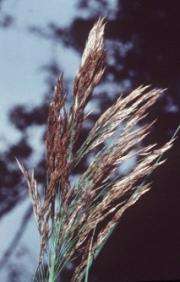
Phragmites australis, the common reed, is invading Great Lakes wetlands and beaches. Robert H. Mohlenbrock @ USDA-NRCS PLANTS Database / USDA SCS. 1989
Phragmites australis is an uncommon term for an increasingly common sight in the wetlands and along the beaches of the Great Lakes. It’s the scientific name for the common reed, a fast-growing perennial wetland grass. An immigrant from Europe, it’s an exotic species that has a reputation for taking over any wetland real estate it visits.
Phragmites is a formidable foe. It roots easily, digs in deep and shoots runners along the ground in every direction, sprouting new plants all along the way. The reed grows tall—as high as 15 feet—and has stalks that can slice like a well-sharpened knife. It provides no food for birds and no shelter for wildlife. In fact, it threatens their very existence.
Until now, no one has done a comprehensive map showing where Phragmites is established and where it is spreading in the Great Lakes basins. The Michigan Tech Research Institute (MTRI), based in Ann Arbor, Mich., has taken on that job. To do the work, the institute has received a $580,000 federal grant from the US Fish and Wildlife Service and the US Geological Survey, funded by the US Environmental Protection Agency’s $475 million Great Lakes Restoration Initiative.
MTRI’s goal is to map the likely extent of Phragmites in each Great Lakes coastal basin—the land occupied by a lake, its shoreline and the areas near shore that drain into the lake—by 2011.
“MTRI was asked to do this work because our federal sponsors know that we are experts in using satellites to collect radar data,” said Colin Brooks, research scientist and environmental science lab manager at MTRI. Principal investigator on the research is Laura Bourgeau-Chavez, also a MTRI research scientist.
Bourgeau-Chavez, Brooks and their team are attacking the Phragmites mapping challenge two ways: high-tech and low-tech.
High-tech is MTRI’s middle name. The research center specializes in remote-sensor and information-technology development and its application to national security and infrastructure problems, as well as to earth sciences and environmental processes.
In the case of Phragmites, MTRI scientists are using Synthetic Aperture Radar (SAR), which employs satellite imagery as the primary remote sensing data source for mapping. Data from three dates during the growing season will be collected and analyzed.
“It provides unique information about wetlands,” explained Brooks. “Radar can measure the structure and biomass of wetlands, which shows us where the Phragmites areas are and how thickly they have infested an area. More traditional methods can’t do that.”
The low-tech—but equally important—aspect of the project involves deploying three field teams of two undergraduate or graduate students each out across the wetlands and along the beaches of the Great Lakes, including three Michigan Tech students. The teams are collecting samples of vegetation and measuring water conditions at nearly 400 sites throughout the Great Lakes basin.
The data MTRI collects will be combined with data from other sources including Ducks Unlimited, The Watershed Center - Grand Traverse Bay, the Michigan Department of Natural Resources and Environment and the Great Lakes Indian Fish and Wildlife Commission. The resulting database will map existing Phragmites growth and help map the potential spread of the invasive plant for each lake basin.
-
Counting frogs: Why monitoring our amphibian populations is important
Mar 23, 2010 |
not rated yet |
0
-
Great Lakes compact languishes
Apr 07, 2008 |
not rated yet |
0
-
New ballast treatment could protect Great Lakes fish
Jun 04, 2008 |
not rated yet |
0
-
No new federal funding for Great Lakes
Nov 18, 2005 |
not rated yet |
0
-
Changing climate likely to make 'super weed' even more powerful
Jun 03, 2009 |
not rated yet |
0
-
Engineers build first sub-10-nm carbon nanotube transistor
Feb 01, 2012 |
4.9 / 5 (31) |
30
-
Something old, something new: Evolution and the structural divergence of duplicate genes
Jan 31, 2012 |
4.6 / 5 (7) |
1
-
The hidden nanoworld of ice crystals: Revealing the dynamic behavior of quasi-liquid layers
Jan 30, 2012 |
5 / 5 (3) |
1
-
Stock market network reveals investor clustering
Jan 27, 2012 |
3.9 / 5 (23) |
8
-
Of microchemistry and molecules: Electronic microfluidic device synthesizes biocompatible probes
Jan 26, 2012 |
5 / 5 (1) |
0
-
Discrepancy between oxygen and carbon-dioxide levels
17 hours ago
-
where gems are found in the world
20 hours ago
-
Wind Waves in Reservoir ~ Wind run-up and Wind set-up
Feb 08, 2012
-
Balance of oxygen in the atmosphere
Feb 01, 2012
-
The case for a methanol-based economy
Jan 30, 2012
-
Weather in a rotating cylinder
Jan 25, 2012
- More from Physics Forums - Earth
More news stories
Could Venus be shifting gear?
(PhysOrg.com) -- ESAs Venus Express spacecraft has discovered that our cloud-covered neighbour spins a little slower than previously measured. Peering through the dense atmosphere in the infrared, the ...
Space & Earth / Space Exploration
5 hours ago |
5 / 5 (5) |
7
|
Humans may have helped the decline of African rainforests 3000 years ago
(PhysOrg.com) -- Large areas of rainforests in Central Africa mysteriously disappeared over three thousand years ago, to be replaced by savannas. The prevailing theory has been that the cause was a change ...
Mars Science Laboratory computer issue resolved
(PhysOrg.com) -- Engineers have found the root cause of a computer reset that occurred two months ago on NASA's Mars Science Laboratory and have determined how to correct it.
Space & Earth / Space Exploration
6 hours ago |
5 / 5 (5) |
3
|
Clam fields found at deep, low-temperature Mariana vents
(PhysOrg.com) -- Scientists have marveled at the unusual life forms thriving at high temperature hydrothermal vents of the deep ocean.
Space & Earth / Earth Sciences
5 hours ago |
not rated yet |
0
|
Two new moons for Jupiter
Advances in technology have lead to the discovery of new planets outside of our Solar System, and now even new moons in our own backyard.
Space & Earth / Space Exploration
5 hours ago |
not rated yet |
2
Putting the squeeze on planets outside our solar system
(PhysOrg.com) -- Using high-powered lasers, scientists at Lawrence Livermore National Laboratory and collaborators discovered that molten magnesium silicate undergoes a phase change in the liquid state, abruptly ...
Employers feel no love for unscrupulous practice of 'service sweethearting'
A new study led by two Florida State University marketing professors finds that some frontline service employees who are rewarded for hikes in customer loyalty and satisfaction also may engage in "service ...
US issues guidelines to avoid heparin contamination
Four years after US drug-maker Baxter International's blood thinner heparin was contaminated in China, causing dozens of deaths, US regulators on Friday issued draft guidelines for safe production.
Expat French get Internet vote for first time
French citizens will for the first time this year be able to vote in a parliamentary election over the Internet, an experiment that could be extended to other elections if successful.
"Twisted Metal" gamers get shot at real gunplay
Fans of "Twisted Metal" will get to welcome a long-awaited sequel of the car-battle videogame with a real-world bang by blasting an ice cream truck to bits with a machine gun.
The power of estrogen -- male snakes attract other males
A new study has shown that boosting the estrogen levels of male garter snakes causes them to secrete the same pheromones that females use to attract suitors, and turned the males into just about the sexiest ...