Spitzer Finds a Flavorful Mix of Asteroids
September 2, 2010
Spitzer Finds a Flavorful Mix of Asteroids

Enlarge

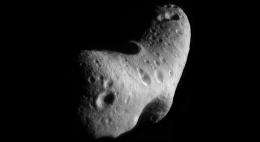
This image, taken by NASA's Near Earth Asteroid Rendezvous mission in 2000, shows a close-up view of Eros, an asteroid with an orbit that takes it somewhat close to Earth. NASA's Spitzer Space Telescope observed Eros and dozens of other near-Earth asteroids as part of an ongoing survey to study their sizes and compositions using infrared light. Image credit: NASA/JHUAPL

(PhysOrg.com) -- New research from NASA's Spitzer Space Telescope reveals that asteroids somewhat near Earth, termed near-Earth objects, are a mixed bunch, with a surprisingly wide array of compositions. Like a piñata filled with everything from chocolates to fruity candies, these asteroids come in assorted colors and compositions. Some are dark and dull; others are shiny and bright. The Spitzer observations of 100 known near-Earth asteroids demonstrate that the objects’ diversity is greater than previously thought.

The findings are helping astronomers better understand near-Earth objects as a whole -- a population whose physical properties are not well known.

"These rocks are teaching us about the places they come from," said David Trilling of Northern Arizona University, Flagstaff, lead author of a new paper on the research appearing in the September issue of . "It's like studying pebbles in a streambed to learn about the mountains they tumbled down."

After nearly six years of operation, in May 2009, Spitzer used up the needed to chill its . It is now operating in a so-called "warm" mode (the actual temperature is still quite cold at 30 Kelvin, or minus 406 degrees Fahrenheit). Two of Spitzer's infrared channels, the shortest-wavelength detectors on the observatory, are working perfectly.

One of the mission's new "warm" programs is to survey about 700 near-Earth objects, cataloguing their individual traits. By observing in infrared, Spitzer is helping to gather more accurate estimates of asteroids' compositions and sizes than what is possible with visible light alone. observations of an won't differentiate between an asteroid that is big and dark, or small and light. Both rocks would reflect the same amount of visible sunlight. Infrared data provide a read on the object's temperature, which then tells an astronomer more about the actual size and composition. A big, dark rock has a higher temperature than a small, light one because it absorbs more sunlight.

Trilling and his team have analyzed preliminary data on 100 near-Earth asteroids so far. They plan to observe 600 more over the next year. There are roughly 7,000 known near-Earth objects out of a population expected to number in the tens to hundreds of thousands.

"Very little is known about the physical characteristics of the near-Earth population," said Trilling. "Our data will tell us more about the population, and how it changes from one object to the next. This information could be used to help plan possible future space missions to study a near-Earth object."

The data show that some of the smaller objects have surprisingly high albedos (an albedo is a measurement of how much sunlight an object reflects). Since asteroid surfaces become darker with time due to exposure to solar radiation, the presence of lighter, brighter surfaces for some asteroids may indicate that they are relatively young. This is evidence for the continuing evolution of the near-Earth object population.

In addition, the fact that the asteroids observed so far have a greater degree of diversity than expected indicates that they might have different origins. Some might come from the main belt between Mars and Jupiter, and others could come from farther out in the solar system. This diversity also suggests that the materials that went into making the asteroids -- the same materials that make up our planets -- were probably mixed together like a big solar-system soup very early in its history.

The research complements that of NASA's Wide-field Infrared Survey Explorer, or WISE, an all-sky infrared survey mission also up in space now. WISE has already observed more than 430 near-Earth objects -- of these, more than 110 are newly discovered.

In the future, both Spitzer and WISE will tell us even more about the "flavors" of near-Earth objects. This could reveal new clues about how the cosmic objects might have dotted our young planet with water and organics -- ingredients needed to kick-start life.

Provided by JPL/NASA (news : web)

Filter


Move the slider to adjust rank threshold, so that you can hide some of the comments.


Display comments: newest first

omatumr
Sep 03, 2010

Rank: 2 / 5 (1)
As I vaguely recall, there were reports many years ago that chemical composition of asteroids varied with distance from the Sun.

a.) Iron-rich asteroids and planets are closer to the Sun.

b.) Carbon-rich asteroids and planets are further from the Sun.

I will try to find the reference.

With kind regards,
Oliver K. Manuel
omatumr
Sep 03, 2010

Rank: 3 / 5 (1)
Found it!

"the asteroid belt is, “... evidently a transition region between the hot, inner solar system, where high temperature condensates accreted into small bodies and eventually into rocky planets, and the cold, outer solar system where volatile ices condensed along with high- and low-temperature minerals” [Chapman, C.R.: 1998, “Solar-system - 2 shades beyond Neptune”, Nature 392, 16-17].

With kind regards,
Oliver K. Manuel
Former NASA Principal
Investigator for Apollo
Rank 5 /5 (8 votes)
Related Stories
Relevant PhysicsForums posts
  • Titan's lack of impact craters
    created18 hours ago
  • Real pictures of black hole eating a star?
    createdFeb 08, 2012
  • Hypothetical way to travel faster than light, but not technically exceed lightspeed
    createdFeb 06, 2012
  • How do scientists monitor the Sun's activity?
    createdFeb 05, 2012
  • Search patterns in observational studies
    createdFeb 05, 2012
  • Derivation of Pogson's law
    createdFeb 03, 2012
  • More from Physics Forums - General Astronomy

More news stories

Humans may have helped the decline of African rainforests 3000 years ago

(PhysOrg.com) -- Large areas of rainforests in Central Africa mysteriously disappeared over three thousand years ago, to be replaced by savannas. The prevailing theory has been that the cause was a change ...

Space & Earth / Environment

created just added | popularity not rated yet | comments 0 | with audio podcast report

New views show old NASA Mars landers

(PhysOrg.com) -- The High Resolution Imaging Science Experiment (HiRISE) camera on NASA's Mars Reconnaissance Orbiter recorded a scene on Jan. 29, 2012, that includes the first color image from orbit showing ...

Space & Earth / Space Exploration

created 21 hours ago | popularity 4.9 / 5 (7) | comments 9 | with audio podcast

Black holes and star formation

(PhysOrg.com) -- It has long been recognized that galaxy mergers or even close interactions can play a vital role in shaping the morphology of galaxies. One way they can do so, it is thought, is by triggering ...

Space & Earth / Astronomy

created 20 hours ago | popularity 4.1 / 5 (7) | comments 5 | with audio podcast

Deconstructing a mystery: What caused Snowmaggedon?

In the quiet after the storms, streets and cars had all but disappeared under piles of snow. The U.S. Postal Service suspended service for the first time in 30 years. Snow plows struggled to push the evidence ...

Space & Earth / Earth Sciences

created 13 hours ago | popularity 4.7 / 5 (3) | comments 1 | with audio podcast

Ocean microbe communities changing, but long-term environmental impact is unclear

As oceans warm due to climate change, water layers will mix less and affect the microbes and plankton that pump carbon out of the atmosphere – but researchers say it's still unclear whether these processes ...

Space & Earth / Earth Sciences

created 15 hours ago | popularity 5 / 5 (2) | comments 2 | with audio podcast


Japan scientist makes 'Avatar' robot

A Japanese-developed robot that mimics the movements of its human controller is bringing the Hollywood blockbuster "Avatar" one step closer to reality.

Fighting crimes against biodiversity: How to catch a killer weed

Invasive species which have the potential to destroy biodiversity and influence global change could be tracked and controlled in the same way as wanted criminals, according to new research from Queen Mary, University of London.

Metastatic breast cancer hitches a free ride from the immune system

Inflammatory breast cancer (IBC) is the most lethal form of breast cancer . It spreads easily through the lymphatic and blood vessels, forming metastasis which can lead to multi-organ failure. New research published in BioMed ...

A novel method for simultaneously measuring blood pressure and arterial stiffness

Arterial stiffness due to is a major contributor to cardiovascular disease but is very difficult to measure. It also can influence blood pressure readings since these rely on the time taken for arteries to return to normal ...

India's global pharmacy role threatened by EU pact

(AP) -- Efforts by India and the European Union to strengthen trade are threatening India's ability to deliver lifesaving medicines to the world's poorest, analysts say as the two sides push through protracted ...

US video game sales fall 34 percent in January

(AP) -- U.S. retail sales of video game hardware, software and accessories fell 34 percent in January from a year earlier to $751 million due to the lack of new game titles, according to market researcher NPD Group.