NASA catches heavy rainfall happening in Category 4 Earl as it approaches the US
September 2, 2010
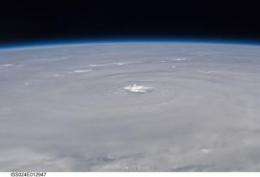
Photographed by an Expedition 24 crew member on the International Space Station, this is an oblique view of the eye (just above center frame) of Hurricane Earl (at this time a category 4), centered just north of the Virgin Islands near 19.3 north latitude and 64.7 west longitude packing 115-kilometer winds. The photo was taken with a digital still camera using a 35mm lens. Credit: NASA MSFC
Hurricane Earl is still a powerful category four hurricane on the Saffir-Simpson Scale as it approaches the North Carolina coast today. NASA's Tropical Rainfall Measuring Mission (TRMM) satellite observed the high rates rain was falling within Earl, in some areas more than 2 inches per hour. Today, the Global Hawk unmanned aircraft is also flying into the eye of Hurricane Earl at altitudes of 60,000 feet to gather information about the storm.
Hurricane Earl became the most powerful hurricane of the 2010 Atlantic season early on September 2 when its sustained winds reached 120 kts (~138 mph). It was still intensifying when the TRMM satellite passed near its location on 2 September 2010 at 0602 UTC (2:02 a.m. EDT). The TRMM Microwave Imager (TMI) data were used in the rainfall analysis that showed heavy rainfall, particularly in the northwest quadrant of Earl's very distinct circular eye. TRMM is managed by NASA and the Japanese Space Agency, and images are created at NASA's Goddard Space Flight Center, Greenbelt, Md.
As NASA's Genesis and Rapid Intensification experiment (GRIP) continues to investigate tropical cyclones until Sept. 30, the unmanned Global Hawk aircraft was making fly overs of Hurricane Earl today to gather data from 60,000 feet high, into the lower levels of the stratosphere. This data will help scientists learn about the rapid intensification of Earl, who went from a Category 2 to a Category 4 hurricane earlier this week.
In addition to the GRIP Mission, astronauts aboard the International Space Station are also capturing Hurricane Earl on video and in photographs. These images complement the Global Hawk's view closer to Earth. In addition, NASA satellites, such as the Aqua satellite are capturing views of Earl . The Moderate Resolution Imaging Spectroradiometer (MODIS) instrument has been providing high-resolution views of Earl's clouds since it was born. To see an image from Sept. 1 at 18:01 UTC (2:01 p.m. EDT) of Hurricane Earl as it was moving through the Bahamas, go here.
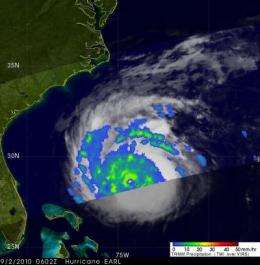
The TRMM satellite observed the high rates (red) rain was falling within Earl, in some areas more than 2 inches per hour.In this image an Infrared GOES-EAST satellite image captured at close to the same time was warped to match the TRMM satellite image in order to show parts of EARL not seen by TRMM. Credit: NASA/SSAI, Hal Pierce
Today, September 2, Hurricane warnings extend from North Carolina north to Massachusetts, including Cape Cod and the islands, with tropical storm warnings that include Virginia, eastern Maryland, New Jersey, New York, Connecticut and Rhode Island. Hurricane Earl's eye is expected to stay off-shore and eastern North Carolina and eastern Massachusetts have the strongest warnings.
At 11 a.m. EDT on September 2, Hurricane Earl had maximum sustained winds near 140 mph. It was 300 miles south of Cape Hatteras, NC, and 765 miles south-southwest of Nantucket, Mass. near 30.9N and 74.8W. It is moving north at 18 mph and has a minimum central pressure of 932 millibars.
For complete watches and warnings, and forecast track, go to the National Hurricane Center's webpage: www.nhc.noaa.gov.
NASA satellite imagery indicates this is a large storm, with hurricane force winds extend outward up to 90 miles from the center and tropical storm force winds extend outward up to 230 miles.
-
Hurricane warnings posted on US East Coast, NASA sees Earl's heavy rainfall
Sep 01, 2010 |
not rated yet |
0
-
Bermuda in warnings as the GOES-13 Satellite catches Fiona approaching
Sep 02, 2010 |
not rated yet |
0
-
GOES-13 catches 3 tropical cyclones thrashing through the Atlantic
Aug 31, 2010 |
not rated yet |
0
-
NASA's TRMM satellite sees heavy rainfall in Hurricane Alex
Jun 30, 2010 |
not rated yet |
0
-
NASA's TRMM satellite sees Hurricane Celia's moderate rainfall
Jun 22, 2010 |
not rated yet |
0
-
Engineers build first sub-10-nm carbon nanotube transistor
Feb 01, 2012 |
4.9 / 5 (30) |
30
-
Something old, something new: Evolution and the structural divergence of duplicate genes
Jan 31, 2012 |
4.6 / 5 (7) |
1
-
The hidden nanoworld of ice crystals: Revealing the dynamic behavior of quasi-liquid layers
Jan 30, 2012 |
5 / 5 (3) |
1
-
Stock market network reveals investor clustering
Jan 27, 2012 |
3.9 / 5 (23) |
8
-
Of microchemistry and molecules: Electronic microfluidic device synthesizes biocompatible probes
Jan 26, 2012 |
5 / 5 (1) |
0
-
Wind Waves in Reservoir ~ Wind run-up and Wind set-up
Feb 08, 2012
-
Balance of oxygen in the atmosphere
Feb 01, 2012
-
The case for a methanol-based economy
Jan 30, 2012
-
Weather in a rotating cylinder
Jan 25, 2012
-
Importance of difference between SVP over ice and water?
Jan 19, 2012
-
Ozone and atmosphere sampling
Jan 16, 2012
- More from Physics Forums - Earth
More news stories
NASA's TRMM satellite sees Cyclone Jasmine in 3-D
Data from NASA's TRMM satellite was used to create a 3-Dimensional look at Cyclone Jasmine, currently moving through the South Pacific Ocean.
Space & Earth / Earth Sciences
16 minutes ago |
not rated yet |
0
Deconstructing a mystery: What caused Snowmaggedon?
In the quiet after the storms, streets and cars had all but disappeared under piles of snow. The U.S. Postal Service suspended service for the first time in 30 years. Snow plows struggled to push the evidence ...
Space & Earth / Earth Sciences
1 hour ago |
5 / 5 (1) |
0
|
New views show old NASA Mars landers
(PhysOrg.com) -- The High Resolution Imaging Science Experiment (HiRISE) camera on NASA's Mars Reconnaissance Orbiter recorded a scene on Jan. 29, 2012, that includes the first color image from orbit showing ...
Space & Earth / Space Exploration
9 hours ago |
4.9 / 5 (7) |
4
|
Tidal forces could squeeze out planetary water
Alien planets might experience tidal forces powerful enough to remove all their water, leaving behind hot, dry worlds like Venus, researchers said.
Space & Earth / Space Exploration
7 hours ago |
5 / 5 (1) |
1
|
NASA sees Tropical Storm 12S - a possible threat to Madagascar
The twelfth tropical depression formed in the Southern Indian Ocean today and quickly became a tropical storm, dubbed Tropical Storm 12S. NASA's Aqua satellite passed over the storm and captured infrared data that revealed ...
Space & Earth / Earth Sciences
2 hours ago |
not rated yet |
0
'Dark plasmons' transmit energy
Microscopic channels of gold nanoparticles have the ability to transmit electromagnetic energy that starts as light and propagates via "dark plasmons," according to researchers at Rice University.
Decoding the molecular machine behind E. coli and cholera
Scientists from Queen Mary, University of London have discovered the workings behind some of the bacteria that kill hundreds of thousands every year, possibly paving the way for new antibiotics that could treat infections ...
Deadly bird parasite evolves at exceptionally fast rate
A new study of a devastating bird disease that spread from poultry to house finches in the mid-1990s reveals that the bacteria responsible for the disease evolves at an exceptionally fast rate. What's more, ...
Flexible paper robots
(PhysOrg.com) -- These inexpensive robots can stretch, bend and twist under control, and lift objects up to 120 times their own weight. Being soft, they can apply gentle and even pressure, and adapt to varied ...
Cell biologists describes mechanism by which some people may be more susceptible to colon cancer
An international research team led by cell biologists at the University of California, Riverside has uncovered a new insight into colon cancer, the third leading cause of cancer-related deaths in the United ...
New method makes culture of complex tissue possible in any lab
Scientists at the University of California, San Diego have developed a new method for making scaffolds for culturing tissue in three-dimensional arrangements that mimic those in the body. This advance, published online in ...
