NASA sees Depression Nine become Gaston then back to a depression
September 2, 2010
NASA sees Depression Nine become Gaston then back to a depression

Enlarge

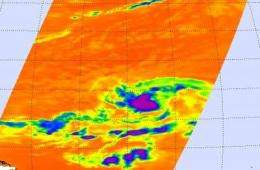
AIRS infrared image taken Sept. 2 at 0423 UTC (12:23 a.m. EDT) showed that Tropical Depression Gaston seemed to have a compact circulation with some high, cold thunderstorm cloud tops (purple) around its center of circulation. Those clouds reached so high into the troposphere that they were colder than -63 degrees Fahrenheit. It later weakened as it encountered dry, stable air. Credit: NASA/JPL, Ed Olsen

Tropical Depression Nine strengthened yesterday into Tropical Storm Gaston, but today it ran into dry and stable air and weakened back into a depression again.

When NASA's Aqua satellite flew over Gaston early this morning, Sept. 2 at 0423 UTC (12:23 a.m. EDT), the infrared image taken from the Atmospheric Infrared Sounder (AIRS) instrument showed that Tropical Depression Gaston seemed to have a compact circulation with some high, cold thunderstorm cloud tops around its center of circulation. Those clouds reached so high into the troposphere that they were colder than -63 degrees Fahrenheit. Later this morning, Gaston encountered some stable and drier air, weakening it back to a tropical depression.

Visible and late this morning showed deep convection (rapidly rising air that forms thunderstorms that power the cyclone) had decreased considerably since the AIRS image was captured, and convection and is limited to a broken band over the western and northern part of the circulation.

At 11 a.m. EDT today, Gaston's were near 35 mph, although some re- strengthening is possible as it moves into a better environment. The center of Gaston was about 970 miles west of the southernmost Cape Verde Islands, or about 1500 miles east of the Lesser Antilles near latitude 14.0 north and longitude 38.9 west. The depression is moving toward the west-northwest near 7 mph and should continue in that direction for the next couple of days. Estimated minimum central pressure is 1008 millibars.

Even though Gaston is in an area of warm waters and upper level winds that will allow it to develop, the dry and stable air is keeping it weak, so re-strengthening is likely to be a slow process. For now, it is no threat to land.

Provided by NASA's Goddard Space Flight Center (news : web)


Rank not rated yet
Relevant PhysicsForums posts
  • Wind Waves in Reservoir ~ Wind run-up and Wind set-up
    createdFeb 08, 2012
  • Balance of oxygen in the atmosphere
    createdFeb 01, 2012
  • The case for a methanol-based economy
    createdJan 30, 2012
  • Weather in a rotating cylinder
    createdJan 25, 2012
  • Importance of difference between SVP over ice and water?
    createdJan 19, 2012
  • Ozone and atmosphere sampling
    createdJan 16, 2012
  • More from Physics Forums - Earth

More news stories

Ocean microbe communities changing, but long-term environmental impact is unclear

As oceans warm due to climate change, water layers will mix less and affect the microbes and plankton that pump carbon out of the atmosphere – but researchers say it's still unclear whether these processes ...

Space & Earth / Earth Sciences

created 1 hour ago | popularity not rated yet | comments 0 | with audio podcast

Researchers create 3-D laser maps that show how earthquake changes landscape

Geologists have a new tool to study how earthquakes change the landscape down to a few inches, and it's giving them insight into how earthquake faults behave. In the Feb. 10 issue of the journal Science, a team ...

Space & Earth / Earth Sciences

created 1 hour ago | popularity 5 / 5 (1) | comments 0 | with audio podcast

Tidal forces could squeeze out planetary water

Alien planets might experience tidal forces powerful enough to remove all their water, leaving behind hot, dry worlds like Venus, researchers said.

Space & Earth / Space Exploration

created 5 hours ago | popularity 5 / 5 (1) | comments 1 | with audio podcast

La Nina going away, but too late for Texas drought

(AP) -- Federal weather forecasters say the La Nina weather phenomenon that contributed to the southwestern U.S. drought is winding down.

Space & Earth / Environment

created 1 hour ago | popularity not rated yet | comments 0

New views show old NASA Mars landers

(PhysOrg.com) -- The High Resolution Imaging Science Experiment (HiRISE) camera on NASA's Mars Reconnaissance Orbiter recorded a scene on Jan. 29, 2012, that includes the first color image from orbit showing ...

Space & Earth / Space Exploration

created 7 hours ago | popularity 4.9 / 5 (7) | comments 3 | with audio podcast


Hydrogen from acidic water: Researchers develop potential low cost alternative to platinum for splitting water

A technique for creating a new molecule that structurally and chemically replicates the active part of the widely used industrial catalyst molybdenite has been developed by researchers with the Lawrence Berkeley ...

To perform with less effort, practice beyond perfection

Whether you are an athlete, a musician or a stroke patient learning to walk again, practice can make perfect, but more practice may make you more efficient, according to a surprising new University of Colorado Boulder study.

Scientists identify most lethal known species of prion protein

Scientists from the Florida campus of The Scripps Research Institute have identified a single prion protein that causes neuronal death similar to that seen in "mad cow" disease, but is at least 10 times more ...

US workers are 'giving away the store,' costing firms billions

Nearly 70 percent of the nation's service employees give away free goods and services – from hamburgers to cable TV – costing companies billions of dollars a year, according to a groundbreaking study.

New prenatal genetic test is much more powerful at detecting fetal abnormalities

A nationwide, federally funded study has found that testing a developing fetus' DNA through chromosomal microarray (CMA) provides more information about potential disorders than does the standard method of prenatal testing, ...

Barriers fall between TV, Internet

You say TV, I say Internet. Toe-mate-o, toe-mah-to.