Chemists discover method to create high-value chemicals from biomass
September 2, 2010
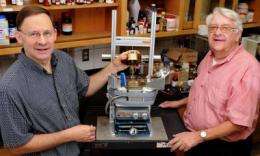
Iowa State University's Ronald Holtan, left, and Walter Trahanovsky are using high-pressure vessels like this to create high-value chemicals from biomass. Credit: Photo by Bob Elbert/Iowa State University
Iowa State University researchers have found a way to produce high-value chemicals such as ethylene glycol and propylene glycol from biomass rather than petroleum sources.
Walter Trahanovsky, an Iowa State professor of chemistry who likes to write out the chemical structures of compounds when he talks about his science, was looking to produce sugar derivatives from cellulose and other forms of biomass using high-temperature chemistry. And so he and members of his research group studied the reactions of cellulosic materials in alcohols at high temperatures and pressures.
They analyzed the products of the reactions using nuclear magnetic resonance spectroscopy. Early experiments produced the expected sugar derivatives. Additional work, however, clearly revealed significant yields of ethylene glycol and propylene glycol.
"It was a real surprise," Trahanovsky said. "These products were unexpected, so we never looked for them. But they were always there."
Uses for ethylene glycol include auto antifreeze, polyester fabrics and plastic bottles. Propylene glycol has many uses, including as a food additive, a solvent in pharmaceuticals, a moisturizer in cosmetics and as a coolant in liquid cooling systems.
Conversion of biomass to fuels and other chemicals can require strong acids or other harsh and expensive compounds. These processes also generate chemical wastes that have to be collected for safe disposal.
The Iowa State researchers say they have found a technology that is simpler yet effective and also better for the environment.
"There is potential here," said Trahanovsky. "It's not a wild dream to think this could be developed into a practical process."
The biomass conversion process is based on the chemistry of supercritical fluids, fluids that are heated under pressure until their liquid and gas phases merge. In this case, Trahanovsky said the key results are significant yields of ethylene glycol, propylene glycol and other chemicals with low molecular weights. He said the process also produces alkyl glucosides and levoglucosan that can be converted into glucose for ethanol production or other uses.
All this happens without the use of any expensive reagents such as acids, enzymes, catalysts or hydrogen gas, Trahanovsky said. The process even works when there are impurities in the biomass.
The Iowa State University Research Foundation Inc. has filed for a patent of the technology.
The research has been supported by grants from the Iowa Energy Center. Other Iowa State researchers who have contributed to the project include Ronald Holtan, a postdoctoral research associate in chemistry; Norm Olson, the project manager of the Iowa Energy Center's BECON facility near Nevada; Joseph Marshall, a former graduate student; and Alyse Hurd and Kyle Quasdorf, former undergraduate students.
Trahanovsky said the research team is still working to develop and improve the conversion technology.
And he does think the technology could be useful to industry.
"The starting materials for this are cheap," Trahanovsky said. "And the products are reasonably high-value chemicals."
-
New Ways to Use Biomass
Sep 22, 2008 |
not rated yet |
0
-
Chemically squeezing every drop of ethanol from corn
Mar 09, 2006 |
not rated yet |
0
-
Researchers developing system to efficiently convert biomass to ethanol
Mar 20, 2008 |
not rated yet |
0
-
Turning corn fiber into ethanol
Jun 01, 2006 |
not rated yet |
0
-
Iowa State researchers developing clean, renewable energy for ethanol industry
Mar 09, 2009 |
not rated yet |
0
-
Engineers build first sub-10-nm carbon nanotube transistor
Feb 01, 2012 |
4.9 / 5 (30) |
30
-
Something old, something new: Evolution and the structural divergence of duplicate genes
Jan 31, 2012 |
4.6 / 5 (7) |
1
-
The hidden nanoworld of ice crystals: Revealing the dynamic behavior of quasi-liquid layers
Jan 30, 2012 |
5 / 5 (3) |
1
-
Stock market network reveals investor clustering
Jan 27, 2012 |
3.9 / 5 (23) |
8
-
Of microchemistry and molecules: Electronic microfluidic device synthesizes biocompatible probes
Jan 26, 2012 |
5 / 5 (1) |
0
-
Safe nitrogen compound to decompose a 500 deg C in a furnace?
4 hours ago
-
[ask]electron inside drinking water
23 hours ago
-
How to avoid formation of Lithium Chromate ???
Feb 08, 2012
-
how to choose a reduced or oxidated form in a redox
Feb 08, 2012
-
Mesomeric effect in acids.
Feb 08, 2012
-
Looking for a safe endothermic chemical reaction
Feb 07, 2012
- More from Physics Forums - Chemistry
More news stories
Hydrogen from acidic water: Researchers develop potential low cost alternative to platinum for splitting water
A technique for creating a new molecule that structurally and chemically replicates the active part of the widely used industrial catalyst molybdenite has been developed by researchers with the Lawrence Berkeley ...
7 hours ago |
5 / 5 (9) |
10
|
New method makes culture of complex tissue possible in any lab
Scientists at the University of California, San Diego have developed a new method for making scaffolds for culturing tissue in three-dimensional arrangements that mimic those in the body. This advance, published online in ...
4 hours ago |
5 / 5 (3) |
0
|
Flexible paper robots
(PhysOrg.com) -- These inexpensive robots can stretch, bend and twist under control, and lift objects up to 120 times their own weight. Being soft, they can apply gentle and even pressure, and adapt to varied ...
5 hours ago |
5 / 5 (4) |
2
|
Engineers find inspiration for new materials in Piranha-proof armor
(PhysOrg.com) -- Its a matchup worthy of a late-night cable movie: put a school of starving piranha and a 300-pound fish together, and who comes out the winner?
14 hours ago |
4.3 / 5 (3) |
2
|
Materials that shrink when heated
One common reason that people with fillings experience toothache is that their fillings expand at a different rate to the original tooth when, for example, drinking a hot drink. Contrary to intuition, however, ...
6 hours ago |
not rated yet |
1
'Dark plasmons' transmit energy
Microscopic channels of gold nanoparticles have the ability to transmit electromagnetic energy that starts as light and propagates via "dark plasmons," according to researchers at Rice University.
Ultraviolet protection molecule in plants yields its secrets
Lying around in the sun all day is hazardous not just for humans but also for plants, which have no means of escape. Ultraviolet (UV) radiation from the sun can damage proteins and DNA inside cells, leading ...
FDA-approved drug rapidly clears amyloid from the brain, reverses Alzheimer's symptoms in mice
Neuroscientists at Case Western Reserve University School of Medicine have made a dramatic breakthrough in their efforts to find a cure for Alzheimer's disease. The researchers' findings, published in the journal Science, show t ...
Anyone can learn to be more inventive, cognitive researcher says
There will always be a wild and unpredictable quality to creativity and invention, says Anthony McCaffrey, a cognitive psychology researcher at the University of Massachusetts Amherst, because an "Aha moment" is rare and ...
Cell biologists describes mechanism by which some people may be more susceptible to colon cancer
An international research team led by cell biologists at the University of California, Riverside has uncovered a new insight into colon cancer, the third leading cause of cancer-related deaths in the United ...
Deadly bird parasite evolves at exceptionally fast rate
A new study of a devastating bird disease that spread from poultry to house finches in the mid-1990s reveals that the bacteria responsible for the disease evolves at an exceptionally fast rate. What's more, ...