Cheaper, better solar cell is full of holes
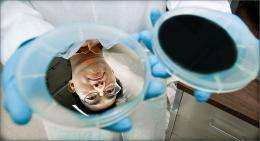
A new low-cost etching technique developed at the U.S. Department of Energy's National Renewable Energy Laboratory can put a trillion holes in a silicon wafer the size of a compact disc.
As the tiny holes deepen, they make the silvery-gray silicon appear darker and darker until it becomes almost pure black and able to absorb nearly all colors of light the sun throws at it.
At room temperature, the black silicon wafer can be made in about three minutes. At 100 degrees F, it can be made in less than a minute.
The breakthrough by NREL scientists likely will lead to lower-cost solar cells that are nonetheless more efficient than the ones used on rooftops and in solar arrays today.
R&D Magazine recently awarded the NREL team one of its R&D 100 awards for Black Silicon Nanocatalytic Wet-Chemical Etch. Called "the Oscars of Invention," the R&D 100 awards recognize the most significant scientific breakthroughs of the year.
Howard Branz, the principal investigator for the project, said his team got interested in late 2006 after he heard a talk by a scientist from the Technical University of Munich. The scientist described how his team had created black silicon by laying down a thin gold layer using a vacuum deposition technique. Quickly, NREL senior scientist Qi Wang and senior engineer Scott Ward gave it a try.
"We always ride on the shoulders of others," Branz said. "We started by replicating the Munich experiment."
Packets of Light, Golden Holes
Think of light as coming in little packets. Each packet is a photon, which potentially can be changed into an electron for solar energy. If the photon bounces off the surface of a solar cell, that's energy lost. Some of the light normally bounces off when it hits an object, but a 'black silicon' wafer will absorb all the light that hits it.
The human eye perceives the wafer as black because almost no sunlight reflects back to the retina. And that is because the trillion holes in the wafer's surface do a much better job of absorbing the wavelengths of light than a solid surface does.
It's roughly the same reason that ceiling tiles with holes in them absorb sound better than ceiling tiles without holes. Scientists by the late 19th century had already done experiments to show that what works for absorbing sound also works for absorbing light.
The team from Munich used evaporation techniques that require expensive vacuum pumps to lay down a very thin layer of gold, perhaps 10 atoms thick, Branz said. When a mixture of hydrogen peroxide and hydrofluoric acid was poured on the thin gold layer, nanoparticles of gold bored into the smooth surface of the wafer, making billions of holes.
The NREL team knew right away that the vacuum pumps and evaporative equipment needed to deposit the gold were too costly to become commercially viable.
NREL's Goal: Simplify the Process, Lower the Cost
"Our thinking was that if the goal is to make it cheaper, we want to avoid vacuum deposition completely," Branz said.
In a string of outside-the-box insights combined with some serendipity, Branz and colleagues Scott Ward, Vern Yost and Anna Duda greatly simplified that process.
Rather than laying the gold with vacuums and pumps, why not just spray it on? Ward suggested.
Rather than layering the gold and then adding the acidic mixture, why not mix it all together from the outset? Dada suggested.
In combination, those two suggestions yielded even better results.
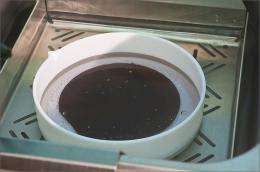
The scientists put a suspended solution of gold nanoparticles, called colloidal gold, on the silicon surface, and let the water evaporate overnight to leave just the gold, which then etched into the wafer. The wafer turned nearly as black as with the evaporated gold.
A Lucky Accident
And then, as is often the case with important scientific breakthroughs, serendipity entered.
NREL technician and chemist Vern Yost noticed after a time that he wasn't getting such good results, and assumed it was because an old batch of colloidal nanoparticles had somehow clumped together. So he tried to separate them with aqua regia, a highly corrosive mixture of nitric acid and hydrochloric acid. Aqua regia is Latin for regal water, and refers to a liquid that can dissolve the royal metals such as silver and gold.
The aqua regia treatment got the process working better than ever, and a little investigation found that the aqua regia had reacted with the gold to form a solution of chloroauric acid.
Voila! Chloroauric acid is less expensive than colloidal gold and actually is the chemical precursor that industry uses to make colloidal gold.
Could the same black-silicon etching result be achieved by substituting the inexpensive chloroauric acid for costly colloidal gold, and then mixing it as before with hydrogen peroxide and hydrofluoric acid? Yost and Branz wondered.
Yes, it worked. "Chloroauric acid is much cheaper than colloidal gold," Branz said. "In essence, by skipping a few steps, they were able to make gold nanoparticles from the chloroauric acid at the same time as they were etching holes into the silicon with the gold they had made."
Once the concept was understood and the mix of materials solved, the actual making of a black silicon wafer became quite simple.
"You take a beaker, put a silicon wafer in, pour in the chloroauric acid, pour in the hydrofluoric acid and hydrogen peroxide, and wait," Branz said.
As little as 20 seconds later, the silvery silicon wafer turns black.
"Our method gives a blacker silicon and would replace an expensive vacuum deposition system with a single, cheap, wet etch step," Branz said.
Cheaper Process Also Makes a Better Material
They tested their black silicon and found that the much-lower-cost recipe containing chloroauric acid quickly reduced the unwanted reflection to less than 2 percent. The more costly approach using conventional silicon nitride anti-reflection layers stalled out at about 3 to 7 percent reflection. As an added bonus, black silicon prevents reflection of low-angle morning and afternoon sunlight far better than the conventional antireflection layer.
To understand why their inexpensive approach worked so well, the team brought in NREL optics expert and senior scientist Paul Stradins and NREL electron microscopists Bobby To and Kim Jones. The trio found that the black silicon squelched reflection so well because the holes were smaller in diameter than the solar wavelengths.
That's crucial, because if the holes were as big as these light wavelengths, the light rays would recognize a "sharp interface," just as they would if they encountered a stainless steel counter. Any sharp interface causes the light from the sun to reflect from the surface before it can enter the solar cell and be changed into electricity.
Another reason the sunlight never feels a sharp interface when it hits the silicon is that all those trillions of holes are bored to different depths, because of the randomness of the etch rate of each nanoparticle. Because of the variable depths of the holes, the rays very gradually move from air to silicon. The light never encounters an abrupt change from air to solid surface, so it doesn't bounce off the wafer.
But Will it Work in a Solar Cell?
Next was the formidable challenge of using the technology to make a workable solar cell.
Hao-Chi Yuan, a postdoctoral researcher, was added to the team to figure out how best to work this new kind of silicon into a solar cell, make the solar cells and determine the strengths and weaknesses of this new kind of cell. Yuan, along with Yost, Branz and NREL engineer Matthew Page worked to determine the ideal depths and diameters of the holes if the goal is to turn photons into electrons.
To keep a solar cell at or near the record 16.8 percent efficiency rate they'd achieved, they realized the holes had to adhere to the "Goldilocks" principle. The holes must be "just right": deep enough to block reflections, but not so deep that they spoil the solar cell.
Specifically, they found the best results occurred when the trillions of holes were on average about 500 nanometers or half a micron deep, and their diameters just a little bit narrower than the smallest wavelength of light. (How small? The diameter of 40 holes, added together, would be the thickness of a human hair.)
If the holes were much deeper, the solar cell would have trouble pulling all of the solar-generated electrons out. Efficiencies would be so low no one would want to put the cells on their roof.
Happily, that combination of depth and diameter can be achieved with a 3-minute wet-etch soak at room temperature.
Industry's Acutely Interested
Though they will be cheaper to manufacture, NREL's best solar cells are still a few tenths of a percent less efficient than the conventional type. But the low reflection means a jump in photovoltaic efficiency of at least 1 percentage point could be achieved. The team is still working to wrest a bit more efficiency from the black silicon cells. The solar cell world has become a game of inches, Branz said, so "even half a percentage point bump in efficiency at reduced cost would be huge."
Solar cell companies are interested in licensing the technology from NREL.
"We've had several companies come visit here to learn more about it," Chris Harris, associate director of licensing in NREL's commercialization and technology transfer division, said. "The interest is high.
"This is certainly a significant advantage in an industry where everyone is competing for market share and the cost per watt is a key selling feature," Harris added. "Black silicon provides an added benefit on top of any other improvements in efficiency a company can get."
Al Goodrich, a senior cost analyst for NREL's PV manufacturing division, found that making the black silicon wafers requires about a third less energy than adding the conventional anti-reflection layer to the finished solar cell.
The one-step process also is a lot easier on the environment.
The technology would replace a process that uses dangerous silane gas, as well as cleaning gases such as nitrogen trifluoride, which has 17,000 times more punch than carbon dioxide in contributing to global warming. A switch to the black silicon wet etch technology would mean huge reductions in greenhouse gases, and improvements in the energy payback for resulting PV devices. It also reduces the capital costs of starting a factory line by about 10 percent, because it replaces several expensive vacuum vapor tools with a simple wet bath, Goodrich said.
NREL estimates that the black silicon can reduce cell conversion costs by 4 to 8 percent, while using widely available industrial materials and equipment.
"That's big," Goodrich added. "The people who are interested in this technology recognize that that difference is valuable real estate."
More information: Learn more about photovoltaics research at NREL.
Provided by National Renewable Energy Laboratory


