Most new farmland comes from cutting tropical forest: researcher
September 3, 2010 BY LOUIS BERGERON
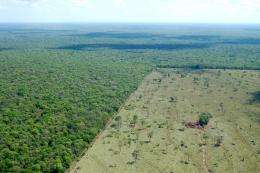
Clear cutting for agriculture in Brazilian Pantanal.
(PhysOrg.com) -- A new study led by a Stanford researcher shows that more than 80 percent of the new farmland created in the tropics between 1980 and 2000 came from felling forests, which sends carbon into the atmosphere and drives global warming. But the research team also noted that big agribusiness has largely replaced small farmers in doing most of the tree cutting in Brazil and Indonesia, which may make it easier to rein in the trend.
Global agricultural expansion cut a wide swath through tropical forests during the 1980s and 1990s. More than half a million square miles of new farmland - an area roughly the size of Alaska - was created in the developing world between 1980 and 2000, of which over 80 percent was carved out of tropical forests, according to Stanford researcher Holly Gibbs.
"This has huge implications for global warming, if we continue to expand our farmland into tropical forests at that rate," said Gibbs, a postdoctoral researcher in the Department of Environmental Earth System Science, who led the study.
Gibbs and colleagues at several other universities analyzed Landsat satellite data and images from the United Nations to reach their conclusions. Theirs is the first study to map and quantify what types of land have been replaced by the immense area of new farmland developed across the tropical forest belt during the 1980s and 1990s.
While this huge increase was happening within the tropics, agricultural land in the non-tropical countries actually decreased in area.
The study was published this week in the online Early Edition of the Proceedings of the National Academy of Sciences.
The United Nations Food and Agriculture Organization estimates that to keep pace with increasing demand, global agricultural production will have to keep increasing, possibly even doubling by 2050. That would likely lead to millions of additional acres of tropical forest being felled over the next 40 years.
Direct impact on carbon released into atmosphere
"Every million acres of forest that is cut releases the same amount of carbon into the atmosphere as 40 million cars do in a year," Gibbs said.
Most of the carbon released comes from burning the forests, but even if the trees are simply cast aside, the bulk of the carbon from the plants makes its way into the atmosphere during decomposition, she said.
Gibbs and her colleagues found that about 55 percent of the tropical forests that had been cut between 1980 and 2000 were intact forests and another 28 percent were forests that had experienced some degradation, such as some small-scale farming, logging or gathering of wood and brush for cooking or heating fuel.
"The tropical forests store more than 340 billion tons of carbon, which is 40 times the total current worldwide annual fossil fuel emissions," Gibbs said. "If we continue cutting down these forests, there is a huge potential to further contribute to climate change."
The increasing demand for agricultural production stems in part from the ever-growing number of people on the planet, who all want to eat. Additionally, members of the growing middle class in emerging economies such as China and India are showing interest in eating more meat, which further intensifies demand. And incentives to grow crops for biofuel production have increased.
But Gibbs and her colleagues also observed some encouraging signs. The patterns of change in the locations they analyzed made it clear that during the 1990s, less of the deforestation was done by small family farms than was the case in the 1980s and more was done by large, corporate-run farms. Big agribusiness tends to be more responsive to global economic signals as well as pressure campaigns from advocacy organizations and consumer groups than individual small farmers.
In Brazil, where a pattern had developed of expanding soy production by direct forest clearing and by pushing cattle ranching off pastureland and into forested areas, a campaign by Greenpeace and others resulted in agreements by key companies to rein in their expansion. Instead, they worked to increase production on land already in agricultural use.
'Seeing positive changes'
"These farmers effectively increased the yield of soy on existing lands and they have also increased the head of cattle per acre by a factor of five or six," Gibbs said. "It is exciting that we are starting to see how responsive industry can be to consumer demands. We really are seeing positive changes in this area."
Along with wiser use of land already cleared, Gibbs said, improvements in technology and advances in yield intensification also could slow the expansion of farming into the forests.
Other studies that analyzed land use changes between 2000 and 2007 have shown that the pace of cutting down the tropical forests has begun to slow in some regions.
But as long as the human population on the planet continues to grow, the pressure to put food on the table, feed in the barnyard and fuel in the gas tank will continue to grow, too.
"It is critical that we focus our efforts on reducing rates of deforestation while at the same time restoring degraded lands and improving land management across the tropics," Gibbs said. "The good news is that pressure from consumer groups and nongovernmental organizations combined with international climate agreements could provide a real opportunity to shift the tide in favor of forest conservation rather than farmland expansion."
In addition to her position at the Department of Environmental Earth System Science, Gibbs is affiliated with Stanford's Woods Institute for the Environment. Jon Foley, a professor of ecology, evolution and behavior, and director of the Institute on the Environment at the University of Minnesota, was Gibbs' PhD adviser when the research was begun. He is a coauthor of the paper.
-
A 'red flag' for expanding biofuels in the tropics
Jul 09, 2008 |
not rated yet |
0
-
Biofuels boom could fuel rainforest destruction, researcher warns
Feb 14, 2009 |
not rated yet |
0
-
One-fifth of fossil-fuel emissions absorbed by threatened forests
Feb 18, 2009 |
not rated yet |
0
-
First-ever 'State of the Carbon Cycle Report' finds troubling imbalance
Nov 14, 2007 |
not rated yet |
0
-
Urban growth, farm exports drive tropical deforestation
Feb 07, 2010 |
not rated yet |
0
-
Engineers build first sub-10-nm carbon nanotube transistor
Feb 01, 2012 |
4.9 / 5 (31) |
30
-
Something old, something new: Evolution and the structural divergence of duplicate genes
Jan 31, 2012 |
4.6 / 5 (7) |
1
-
The hidden nanoworld of ice crystals: Revealing the dynamic behavior of quasi-liquid layers
Jan 30, 2012 |
5 / 5 (3) |
1
-
Stock market network reveals investor clustering
Jan 27, 2012 |
3.9 / 5 (23) |
8
-
Of microchemistry and molecules: Electronic microfluidic device synthesizes biocompatible probes
Jan 26, 2012 |
5 / 5 (1) |
0
-
Discrepancy between oxygen and carbon-dioxide levels
Feb 09, 2012
-
where gems are found in the world
Feb 09, 2012
-
Wind Waves in Reservoir ~ Wind run-up and Wind set-up
Feb 08, 2012
-
Balance of oxygen in the atmosphere
Feb 01, 2012
-
The case for a methanol-based economy
Jan 30, 2012
-
Weather in a rotating cylinder
Jan 25, 2012
- More from Physics Forums - Earth
More news stories
Humans may have helped the decline of African rainforests 3000 years ago
(PhysOrg.com) -- Large areas of rainforests in Central Africa mysteriously disappeared over three thousand years ago, to be replaced by savannas. The prevailing theory has been that the cause was a change ...
Could Venus be shifting gear?
(PhysOrg.com) -- ESAs Venus Express spacecraft has discovered that our cloud-covered neighbour spins a little slower than previously measured. Peering through the dense atmosphere in the infrared, the ...
Space & Earth / Space Exploration
15 hours ago |
5 / 5 (7) |
7
|
NASA budget will axe Mars deal with Europe: scientists
US President Barack Obama's budget proposal to be submitted next week for 2013 will cut NASA's budget by 20 percent and eliminate a major partnership with Europe on Mars exploration, scientists said Thursday.
Space & Earth / Space Exploration
18 hours ago |
5 / 5 (2) |
18
Mars Science Laboratory computer issue resolved
(PhysOrg.com) -- Engineers have found the root cause of a computer reset that occurred two months ago on NASA's Mars Science Laboratory and have determined how to correct it.
Space & Earth / Space Exploration
16 hours ago |
4.7 / 5 (6) |
3
|
Two new moons for Jupiter
Advances in technology have lead to the discovery of new planets outside of our Solar System, and now even new moons in our own backyard.
Space & Earth / Space Exploration
15 hours ago |
4 / 5 (1) |
7
Google users warned of threat to smartphone wallets
Users of Google smartphone wallets were being warned on Friday that there is a way to crack pass codes intended to thwart thieves from going on illicit shopping sprees.
Anonymous knocks CIA website offline (Update)
The website of the Central Intelligence Agency was inaccessible on Friday after the hacker group Anonymous claimed to have knocked it offline.
New error-correcting codes guarantee the fastest possible rate of data transmission
Error-correcting codes are one of the triumphs of the digital age. Theyre a way of encoding information so that it can be transmitted across a communication channel such as an optical fiber o ...
New power source discovered
(PhysOrg.com) -- Researchers at the Massachusetts Institute of Technology (MIT) and RMIT University have made a breakthrough in energy storage and power generation.
Complex wiring of the nervous system may rely on a just a handful of genes and proteins
Researchers at the Salk Institute have discovered a startling feature of early brain development that helps to explain how complex neuron wiring patterns are programmed using just a handful of critical genes. ...
The power of estrogen -- male snakes attract other males
A new study has shown that boosting the estrogen levels of male garter snakes causes them to secrete the same pheromones that females use to attract suitors, and turned the males into just about the sexiest ...
Sep 03, 2010
Rank: 2 / 5 (3)
twiddling with economy is twiddling with the environment as man is part of reality just as much as anything else is.
socialist policy and its burdens tend to lead to shortcuts in which that which cant protest (nature) suffer THE MOST. while the 180 degree rhetoric keeps the termites working on the mound and project in which they cant grasp their part in.
Sep 03, 2010
Rank: 5 / 5 (1)
Using the provided numbers:
More than 500,000 square miles of new farmland.
80% from rain forests.
640 acres per square mile.
Every 1,000,000 acres of rain forest = 40,000,000 cars worth of carbon - a 1:40 ratio.
500,000 x .8 x 640 = 400,000,000 acres.
This means that per the provided numbers at a 1:40 ratio the equivalent of carbon added to the atmosphere is as much as 16 billion cars?
Sep 03, 2010
Rank: 5 / 5 (1)
Oh! But it's friendly Carbon. /sarc
Sep 03, 2010
Rank: 3.7 / 5 (3)
Sep 03, 2010
Rank: 2.3 / 5 (4)
Biofuels are causing most of the demand for new farmland, poetic justice upon greenies. Biofuels are also displacing local food crops, driving up prices and brutalizing the poorest people.
All in all, the greenie ideas are disasters. Greenies have killed more people than Hitler and communism combined by their war on DDT, war on Norman Borlaug's green revolution, and now promoting biofuels. Greenies are biofools.
Sep 03, 2010
Rank: not rated yet
Sep 03, 2010
Rank: not rated yet
Lenin said something about "useful idiots".
Sep 05, 2010
Rank: not rated yet
Your math is missing one factor - each acre is 40 cars FOR ONE YEAR. So the total of 16 billion cars*years is only 800 million cars for the 20 years between 1980 and 2000.
It is still a big number.
And that is how agriculture even on a pre-industrial scale added a lot of CO2 to the air through soil degradation.
And some of the recently-cleared land is even worse - supplying palm oil for europe turned Indonisia into the world's 4th largest CO2 emitted from plantations on what had been rain forest on tropical peat bogs.