Review: mTrip iPhone app uses augmented reality
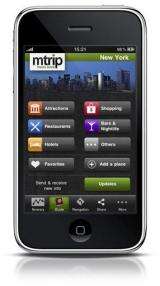
(AP) -- The new iPhone application mTrip is a travel guide and then some: It uses the latest in smart phone technology to make it easier to stay on track in a foreign locale.
But isn't getting lost part of the fun of traveling? For me, yes. For others, maybe not.
So-called "augmented reality" became more widely available about a year ago and takes advantage of a smart phone's GPS and compass features, along with access to high-speed wireless networks, to mash up super-local Web content with the world that surrounds you.
It works like this: You turn on the application, hit the augmented reality button and then look through your phone's camera at the Brooklyn Bridge or the Empire State Building. Icons pop up that show you other points of interest, or restaurants within a half mile of your location, whether the restaurant is open, and what reviewers are saying about it.
The feature feels a bit like being in a "Matrix" film, but in a good way. I used the application for New York. Being a local, I was impressed with the restaurant selections and shopping options that popped up when I pointed my camera down Broadway in SoHo, or more off-the-beaten-path locations like my neighborhood, Carroll Gardens in Brooklyn.
The mTrip developers partnered with Sparks, a massive travel guide company, to provide content but also rely on user-generated reviews and suggestions. There's a spot in the app that allows you to send a new place back to mTrip for reviews and additions to its list.
The app also has something called mTrip genius, which works similarly to the genius feature in iTunes. You note whether you want more or fewer parks, religion or monuments, and it designs an itinerary for you.
Overall, I felt the app was a bit busy, offering perhaps so much it could distract the user from the travel at hand, but developer Frederic de Pardieu noted it's not necessary to use every feature offered.
"We give you options," he said. "You do with them what you like."
The first phones with Google's Android operating system, which enables augmented reality, came out in the past year. The iPhone became augmented-reality friendly with the compass that debuted in June 2009 on the iPhone 3GS. Apple also recently joined Google in making it possible for software developers to overlay images on the phone's camera view.
mTrip doesn't specify that you need a newer phone to use this feature. I don't have one and had to spend a while wrangling a newer phone to borrow in order to test the app, so beware before buying that you have the right device to take full advantage.
That said, augmented reality still feels like it hasn't fully arrived. The technology can generally pinpoint location to within 30 feet if the user is outdoors, but inside you're lost. Businesses I saw on the screen weren't actually in front of me, though they were nearby. But I'm not sure I'd have known that if I was using the app in a foreign city. Often tags sometimes just kind of dart around on the screen and it honestly didn't make it easier to FIND the locale, simply noting the locale existed.
Another problem: Using GPS for extended periods sucked up the battery life on both my phone and my borrowed iPhone 4 quicker than usual.
Developers are dreaming big about the concept, but it's not necessarily for everyone. It was cool, but when the initial ooh-aah value wore off, I found myself wanting to walk around and look at the world. John Boris, executive vice president for Lonely Planet in the U.S., said the feature can only do so much.
"Travelers want to be able to fold up their phone and see physically in a virtual world what is around them," he said. "We can help you get to the heart of the place, but we can't carry you around."
Lonely Planet has Compass Guides that use the augmented reality feature with the Google Android, all in international cities.
"It's the continuing evolution of the traveler's toolkit," Boris said. "It's an important component of today and for tomorrow. But, there will be another piece of technology right around the corner."
©2010 The Associated Press. All rights reserved. This material may not be published, broadcast, rewritten or redistributed.


