Taking the 'search' out of search and rescue
September 3, 2010 by Christina Coleman and Lori Keesey
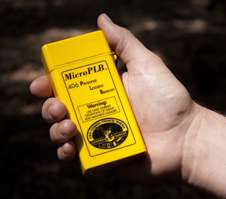
A MicroPLB Type GXL handheld device used to transmit distress signals — similar to the one Abby Sunderland was given by Microwave Monolithics Inc. (MMInc.)before her journey. All 406 MHz emergency beacons should be registered, and Search and Rescue authorities encourage owners of these beacons to do so as registration will help rescue forces find persons in distress faster in an emergency. Credit: NASA's Goddard Space Flight Center, Rebecca Roth
Their emergencies happened hundreds, if not thousands, of miles from one another, but the captain whose vessel had become disabled near Kamalino, Hawaii, the pilot who crashed onto the Knik Glacier near Anchorage, Alaska, and the hiker who suffered a compound fracture while hiking near Merritt, Washington, all share a common experience: They were plucked to safety in the weeks leading up to the Labor Day weekend due to NASA technology.
With these rescues, the total number of people saved so far this year because of technologies NASA created for the international Search and Rescue Satellite-Aided Tracking (SARSAT) program is 186. “We had 195 saves last year in the U.S.,” said LT Shawn Maddock, the SARSAT Operations Support Officer for the National Oceanic and Atmospheric Administration (NOAA), the agency that manages the SARSAT program in the U.S. “We’re on pace to exceed that number this year.”
“That’s the beauty of this program,” said NASA Search and Rescue Mission Manager Dave Affens. In the 30 years since the system began operations, it has saved more than 28,000 lives worldwide and 6,420 in the U.S. “Our motto here is ‘taking the search out of search and rescue,’ so we want to reduce that part to a minimum,” he added.
Although Affens takes personal pleasure knowing that his work contributed to thousands of lives saved, perhaps the one rescue that he believes most clearly demonstrates the value of space-based search and rescue system is the one involving 16-year-old Abby Sunderland, who was saved in June after floating helplessly in the Indian Ocean about 2,000 miles from Madagascar after a violent storm had damaged her 40-foot vessel, Wild Eyes. “Without NASA technology, she may have lost her life. This case was more interesting than most because we contributed to every aspect of it,” Affens said.
This video is not supported by your browser at this time.
The DASS is the next-generation search and rescue system. Under this system, the instruments used to relay the emergency beacon signals will be installed on the U.S. military’s Global Position System (GPS), a constellation of 24 spacecraft operating in mid-Earth orbits. When one emergency signal goes off at least four satellites will be in view and Search and Rescue authorities can begin processing the signal to determine its precise location almost instantly. Credit: NASA's Goddard Space Flight Center
In the ultimate display of NASA spin-off technology, Abby’s life was changed with a small yellow device the size of a BlackBerry™. Fortunately, she was carrying a MicroPLB Type GXL handheld device -- developed under a NASA Small Business Innovation Research (SBIR) program award to Microwave Monolithics Inc. (MMInc.) in Simi Valley, California. The company had given Abby the device before she tried to break the record of sailing non-stop around the world, previously held by her older brother.NASA had provided Microwave Monolithics with the specifications to design the beacon, which relayed her distress signal to a SARSAT satellite, 22,500 miles away in space. When Abby activated the beacon, the satellite, equipped with NASA-developed repeater technology, then relayed the signal to the U.S. via the international satellite-aided search and rescue network now comprised of 40 participating nations. Eight minutes later, the U.S. Coast Guard’s Pacific Area Command in Alameda, California, contacted her parents using information she provided when she registered her beacon with NOAA. And less than an hour later, two NOAA weather satellites, launched by NASA, used NASA technology to pinpoint her location.
“We developed the concept of detecting distress signals by the satellite, relaying it to ground stations where the locations were calculated. We then launched the distress-detection device on a NOAA weather satellite, tested the concept, and approved the system for operational use,” Affens explained.
Ultimately, a French fishing vessel, which was 400 miles from Abby’s location when the distress signal was detected, was directed to her location to perform the rescue.
Affens and his team are now developing new technology to further take the “search out of search and rescue” with new technology that is sure to increase the number of rescues and lives saved in which SARSAT has assisted, he said.
Engineers at NASA’s Goddard Space Flight Center in Greenbelt, Maryland, along with NOAA, the Coast Guard, and the Air Force, are developing a new search and rescue system that will detect and locate distress signals from beacons in less than five minutes. The current system, which places repeaters on weather satellites, can actually take up to an hour or more to locate the distress signal depending on the position of the satellite.
The Distress Alerting Satellite System, or DASS, will be more efficient because the repeater technology will be placed on the Air Force’s Global Positioning System (GPS), instead of NOAA weather satellites. Using the constellation of 24 GPS spacecraft operating in mid-Earth orbit, “we would be able to identify distress signals faster and with a greater level of precision,” Affens said.
The new GPS-based system is now being tested. Currently 10 of the 20 GPS satellites are flying the proof-of-concept DASS equipment and an additional 12 are planned. Goddard is testing the technology before transitioning to a final system after 2015, which will be deployed on the Air Force’s Block III GPS satellites. “The bottom-line here is that within one minute, we’ll know where the distress signals come from,” said Mickey Fitzmaurice, a space systems engineer for NOAA’s SARSAT program. “It is the future.”
-
NASA develops enhanced search and rescue technologies
May 24, 2010 |
not rated yet |
0
-
NASA, NOAA set to launch NOAA-N Prime satellite
Jan 22, 2009 |
not rated yet |
0
-
NASA postpones satellite launch
May 11, 2005 |
not rated yet |
0
-
NASA, NOAA set to launch new environmental satellite
May 04, 2005 |
not rated yet |
0
-
New Environmental Satellite Successfully Launched
Feb 06, 2009 |
not rated yet |
0
-
Engineers build first sub-10-nm carbon nanotube transistor
Feb 01, 2012 |
4.9 / 5 (30) |
30
-
Something old, something new: Evolution and the structural divergence of duplicate genes
Jan 31, 2012 |
4.6 / 5 (7) |
1
-
The hidden nanoworld of ice crystals: Revealing the dynamic behavior of quasi-liquid layers
Jan 30, 2012 |
5 / 5 (3) |
1
-
Stock market network reveals investor clustering
Jan 27, 2012 |
3.9 / 5 (23) |
8
-
Of microchemistry and molecules: Electronic microfluidic device synthesizes biocompatible probes
Jan 26, 2012 |
5 / 5 (1) |
0
-
Empirical data regarding shower heads and water
2 hours ago
-
feed hold button on CNC lathe
21 hours ago
-
Mechanics of Solids ( Final exam question) please help!
23 hours ago
-
RFAC in Fortran
Feb 09, 2012
-
dynamics 2/32
Feb 08, 2012
-
dynamics
Feb 08, 2012
- More from Physics Forums - General Engineering
More news stories
Soraa LED light may dim 50-watt halogen rivals
(PhysOrg.com) -- Soraa, a Fremont, California company founded in 2008, this week launched its first product, a light that uses LEDS (light emitting diodes). The "Soraa LED MR16 lamp" is the "perfect" replacement ...
Samsung can continue selling Galaxy tabs in Germany: court
South Korea's Samsung Electronics can continue to sell its Galaxy Tab 10.1N tablet computer in Germany, a German court ruled Thursday, rejecting a bid by arch-rival Apple to have them banned.
20 hours ago |
3.7 / 5 (3) |
3
Digital photos could put kids at risk
A study published in the International Journal of Electronic Security and Digital Forensics this month suggests that parents and carers could be putting children at risk if they upload digital photos that are automatically "geota ...
16 hours ago |
5 / 5 (1) |
3
Google launches Chrome browser for Android smartphones
With more and more people connecting to the Internet through a phone or a tablet instead of a PC, Google Inc. is bringing its fast-growing browser, Chrome, to the newest Android-powered mobile devices.
18 hours ago |
5 / 5 (4) |
0
Model analyzes shape-memory alloys for use in earthquake-resistant structures
Recent earthquake damage has exposed the vulnerability of existing structures to strong ground movement. At the Georgia Institute of Technology, researchers are analyzing shape-memory alloys for their potential ...
16 hours ago |
5 / 5 (1) |
0
|
'Dark plasmons' transmit energy
Microscopic channels of gold nanoparticles have the ability to transmit electromagnetic energy that starts as light and propagates via "dark plasmons," according to researchers at Rice University.
FDA-approved drug rapidly clears amyloid from the brain, reverses Alzheimer's symptoms in mice
Neuroscientists at Case Western Reserve University School of Medicine have made a dramatic breakthrough in their efforts to find a cure for Alzheimer's disease. The researchers' findings, published in the journal Science, show t ...
Hydrogen from acidic water: Researchers develop potential low cost alternative to platinum for splitting water
A technique for creating a new molecule that structurally and chemically replicates the active part of the widely used industrial catalyst molybdenite has been developed by researchers with the Lawrence Berkeley ...
Ultraviolet protection molecule in plants yields its secrets
Lying around in the sun all day is hazardous not just for humans but also for plants, which have no means of escape. Ultraviolet (UV) radiation from the sun can damage proteins and DNA inside cells, leading ...
Anyone can learn to be more inventive, cognitive researcher says
There will always be a wild and unpredictable quality to creativity and invention, says Anthony McCaffrey, a cognitive psychology researcher at the University of Massachusetts Amherst, because an "Aha moment" is rare and ...
Engineers find inspiration for new materials in Piranha-proof armor
(PhysOrg.com) -- Its a matchup worthy of a late-night cable movie: put a school of starving piranha and a 300-pound fish together, and who comes out the winner?