Increase in Cambodia's vultures gives hope to imperiled scavengers
September 3, 2010
Increase in Cambodia's vultures gives hope to imperiled scavengers

Enlarge

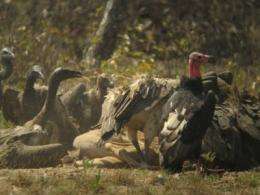
This “venue” of vultures (a group of vultures can also be called a “committee” or a “wake”) in this image includes slender billed (left), white-rumped (m), and red-headed vultures (right), all of which have persisted in Cambodia while other vulture populations in Asia have all but vanished. Credit: Hugh Wright

While vultures across Asia teeter on the brink of extinction, the vultures of Cambodia are increasing in number, providing a beacon of hope for these threatened scavengers, according to the Wildlife Conservation Society (WCS) and other members of the Cambodia Vulture Conservation Project.

Researchers report that record numbers of vultures have been counted in Cambodia's annual vulture census, with 296 birds of three species found at multiple sites across the Northern and Eastern Plains of Cambodia by the Cambodia Vulture Conservation Project, a partnership of conservationists led by the .

The record count means that Cambodia is home to the only increasing population of vultures in Asia. Specifically, the census indicates that the country's population of white-rumped vultures is increasing; populations of red-headed and slender billed vultures were found to be stable. All three of Cambodia's vulture species are listed as "Critically Endangered" by the World Conservation Union (IUCN).

Vulture populations in Southeast Asia are primarily threatened by the declining number of large herbivores in the region, but have been largely unaffected by a far greater threat to Asia's vultures: the veterinary drug diclofenac. Widely used as an anti-inflammatory drug for cattle in South Asia, diclofenac is toxic to vultures, causing death through and visceral gout to birds that feed on the cattle carcasses and has led to global population declines higher than 99 percent in some vulture species.

The census success follows a record breeding season for vultures in Cambodia. This year, a total of 36 vulture chicks fledged from colonies across the north and east of the country, an increase from last year's total of 19 chicks.

Vulture conservation efforts in Cambodia are the result of a number of activities promoted by the Cambodia Vulture Conservation Project. For instance, vulture nests are protected by local community members who are paid a small fee for their support. This ensures that vulture nesting success is greatly improved and also benefits local community members who often have few other sources of income during the dry season, which coincides with the vulture breeding season. Vulture food sources are supplemented by 'vulture restaurants,' feeding stations that also give visitors the opportunity to see these huge birds up close.

"By protecting nests and supplementing food supplies, we are saving some of the world's largest and most charismatic birds," stated Dr. Hugo Rainey, WCS technical advisor to the Cambodia Vulture Conservation Project. "Nowhere else in Asia do vultures have such a promising future."

While conservationists can point to recent successes in the conservation of Cambodia's vultures, they also warn of the rising threat of agricultural pesticides to the birds. Since December 2008, more than 20 vultures are known to have died from consuming domestic animals that had been poisoned accidentally by the inappropriate use of pesticides. This practice may also present a risk to human health.

Song Chansocheat, Ministry of Environment and WCS Vulture Project Manager, commented that "Cambodia is the only Asian country where diclofenac is rarely used and vulture populations are managed. We have been monitoring vultures since 2004 and there have been increasing numbers of poisoned birds recently. Educating people about the risk to wildlife and people from incorrect use of poisons is important."

"Cambodia has become a critical source site for vultures, one that we need to protect as a means of saving these ecologically valuable birds," said Joe Walston, director of the Wildlife Conservation Society's Asia Program.

Provided by Wildlife Conservation Society (news : web)


Rank not rated yet
Related Stories
Relevant PhysicsForums posts
  • Protease cleavage
    created4 hours ago
  • Pertubance in a model
    created11 hours ago
  • Cancer drugs and Alzheimer's, Oh my!
    created19 hours ago
  • Squishing cells
    created20 hours ago
  • Any books/articles for evolutionary stable strategy models in humans?
    createdFeb 09, 2012
  • Science behind the bore feeling?
    createdFeb 09, 2012
  • More from Physics Forums - Biology

More news stories

The power of estrogen -- male snakes attract other males

A new study has shown that boosting the estrogen levels of male garter snakes causes them to secrete the same pheromones that females use to attract suitors, and turned the males into just about the sexiest ...

Biology / Plants & Animals

created 9 hours ago | popularity 5 / 5 (3) | comments 0 | with audio podcast

Grass to gas: Researchers' genome map speeds biofuel development

Researchers at the University of Georgia have taken a major step in the ongoing effort to find sources of cleaner, renewable energy by mapping the genomes of two originator cells of Miscanthus x giganteus, a large perenn ...

Biology / Biotechnology

created 6 hours ago | popularity 3.7 / 5 (3) | comments 0 | with audio podcast

Experts reveal how plants don't get sunburn

(PhysOrg.com) -- Experts at the University of Glasgow have discovered how plants survive the harmful rays of the sun.

Biology / Cell & Microbiology

created 9 hours ago | popularity 5 / 5 (2) | comments 0 | with audio podcast

Protein libraries in a snap

(PhysOrg.com) -- A Rice University undergraduate will depart with not only a degree but also a possible patent for his invention of an efficient way to create protein libraries, an important component of biomolecular ...

Biology / Cell & Microbiology

created 13 hours ago | popularity 5 / 5 (2) | comments 0 | with audio podcast

Miami battling invasion of giant African snails

No one knows how they got there. But an invasion of African giant snails has southern Florida in a panic over potential crop damage, disease and general yuckiness surrounding the slimy gastropods.

Biology / Ecology

created 13 hours ago | popularity 4 / 5 (1) | comments 4


Google users warned of threat to smartphone wallets

Users of Google smartphone wallets were being warned on Friday that there is a way to crack pass codes intended to thwart thieves from going on illicit shopping sprees.

Anonymous knocks CIA website offline (Update)

The website of the Central Intelligence Agency was inaccessible on Friday after the hacker group Anonymous claimed to have knocked it offline.

Complex wiring of the nervous system may rely on a just a handful of genes and proteins

Researchers at the Salk Institute have discovered a startling feature of early brain development that helps to explain how complex neuron wiring patterns are programmed using just a handful of critical genes. ...

NASA sees wide-eyed cyclone Jasmine

Cyclone Jasmine's eye has opened wider on NASA satellite imagery, as it moves through the Southern Pacific Ocean.

NASA sees Giovanna reach cyclone strength, threaten Madagascar

Tropical Storm 12S built up steam and became a cyclone on February 10, 2012 as NASA's Terra satellite passed overhead. Residents of east-central Madagascar should prepare for this cyclone to make landfall ...

Putting the squeeze on planets outside our solar system

(PhysOrg.com) -- Using high-powered lasers, scientists at Lawrence Livermore National Laboratory and collaborators discovered that molten magnesium silicate undergoes a phase change in the liquid state, abruptly ...