Fox spit helped Forest Service confirm rare find
September 3, 2010
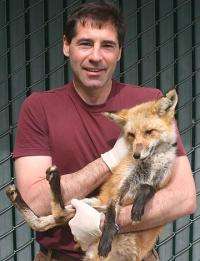
UC Davis wildlife genetics researcher Ben Sacks holds a native Sacramento Valley red fox (Vulpes vulpes patwin). (UC Davis photo)
(PhysOrg.com) -- Three weeks ago, when U.S. Forest Service biologists thought they had found a supposedly extinct fox in the mountains of central California, they turned to UC Davis for confirmation.
Photographs taken by a Forest Service trail camera in Sonora Pass seemed to show a Sierra Nevada red fox (Vulpes vulpes necator) biting a bait bag of chicken scraps. That would be an amazing discovery, since no sighting of that species has been verified south of Mount Lassen, 200 miles away, since the mid-1990s.
The biologists shipped the bait bag to wildlife genetics researchers Ben Sacks and Mark Statham at the UC Davis Veterinary Genetics Laboratory. Since 2006, they have radically altered our understanding of red foxes in California, supplying information crucial to conservation efforts.
Sacks and Statham scraped saliva from the tooth punctures on the bag and analyzed the DNA within. Before you could say spit, they had the answer: definitely a Sierra Nevada red fox.
“This is the most exciting animal discovery we have had in California since the wolverine in the Sierra two years ago -- only this time, the unexpected critter turned out to be home-grown, which is truly big news,” Sacks said. (The wolverine was an immigrant from Wyoming).
Four years ago, Sacks began analyzing California red fox DNA collected from scat, hair and saliva from live animals, and skin and bones from museum specimens. Until then, the expert consensus was that any red fox in the Central Valley and coastal regions of the state was a descendant of Eastern red foxes (V.v. fulva) brought here in the 1860's for hunting and fur farms.
Sacks and his colleagues have confirmed that red fox populations in coastal lowlands, the San Joaquin Valley and Southern California were indeed introduced from the eastern United States (and Alaska). But they have also shown that:
• There are native California red foxes still living in the Sierra Nevada.
• The native red foxes in the Sacramento Valley (V.v. patwin) are a subspecies genetically distinct from those in the Sierra.
• The two native California subspecies, along with Rocky Mountain and Cascade red foxes (V.v. macroura and V. v. cascadensis), formed a single large western population until the end of the last ice age, when the three mountain subspecies followed receding glaciers up to mountaintops, leaving the Sacramento Valley red fox isolated at low elevation.
Sacks' extensive research program focuses on canids, especially red foxes (evolution, ecology and conservation) and dogs (genetics, geographic origins and spread). He and his students also are working on other carnivores, including disease ecology and interactions among fishers, bobcats, coyotes and gray foxes, and population genetics of ringtails and coyotes.
More information: http://www.vgl.ucd … dcg/home.php
-
Tasmania plans to eradicate red foxes
Nov 20, 2006 |
not rated yet |
0
-
Study: Foxes can't outfox coyotes
May 25, 2006 |
not rated yet |
0
-
Preliminary DNA analysis completed on California wolverine
Apr 03, 2008 |
not rated yet |
0
-
Origins of wolverine in California genetically verified
Apr 29, 2009 |
not rated yet |
0
-
Hunting ban not helping foxes in Britain
Nov 02, 2007 |
not rated yet |
0
-
Engineers build first sub-10-nm carbon nanotube transistor
Feb 01, 2012 |
4.9 / 5 (30) |
30
-
Something old, something new: Evolution and the structural divergence of duplicate genes
Jan 31, 2012 |
4.6 / 5 (7) |
1
-
The hidden nanoworld of ice crystals: Revealing the dynamic behavior of quasi-liquid layers
Jan 30, 2012 |
5 / 5 (3) |
1
-
Stock market network reveals investor clustering
Jan 27, 2012 |
3.9 / 5 (23) |
8
-
Of microchemistry and molecules: Electronic microfluidic device synthesizes biocompatible probes
Jan 26, 2012 |
5 / 5 (1) |
0
-
Squishing cells
1 hour ago
-
Any books/articles for evolutionary stable strategy models in humans?
12 hours ago
-
Science behind the bore feeling?
19 hours ago
-
Homo Sapien vs. Chimpanzee - Divergence Timeline
23 hours ago
-
a single mRNA strand is attached to sevaral ribosomes?
Feb 08, 2012
-
Oestrogen and FSH
Feb 07, 2012
- More from Physics Forums - Biology
More news stories
Ultraviolet protection molecule in plants yields its secrets
Lying around in the sun all day is hazardous not just for humans but also for plants, which have no means of escape. Ultraviolet (UV) radiation from the sun can damage proteins and DNA inside cells, leading ...
9 hours ago |
5 / 5 (4) |
0
|
Deadly bird parasite evolves at exceptionally fast rate
A new study of a devastating bird disease that spread from poultry to house finches in the mid-1990s reveals that the bacteria responsible for the disease evolves at an exceptionally fast rate. What's more, ...
7 hours ago |
5 / 5 (2) |
0
|
Decoding the molecular machine behind E. coli and cholera
Scientists from Queen Mary, University of London have discovered the workings behind some of the bacteria that kill hundreds of thousands every year, possibly paving the way for new antibiotics that could treat infections ...
7 hours ago |
not rated yet |
0
|
Deciding to go left or right: Researchers use device to determine that lower animals can navigate too
For decades, scientists have associated binary decision making opting to go left or right with higher-ranking animals, including humans. A team of Harvard researchers, however, is rewriting that ...
15 hours ago |
not rated yet |
2
|
New research reveals why fishermen keep fishing despite dwindling catches
Half of fishermen would not give up their livelihood in the face of drastically declining catches according to research led by the University of East Anglia (UEA).
7 hours ago |
not rated yet |
0
'Dark plasmons' transmit energy
Microscopic channels of gold nanoparticles have the ability to transmit electromagnetic energy that starts as light and propagates via "dark plasmons," according to researchers at Rice University.
FDA-approved drug rapidly clears amyloid from the brain, reverses Alzheimer's symptoms in mice
Neuroscientists at Case Western Reserve University School of Medicine have made a dramatic breakthrough in their efforts to find a cure for Alzheimer's disease. The researchers' findings, published in the journal Science, show t ...
Hydrogen from acidic water: Researchers develop potential low cost alternative to platinum for splitting water
A technique for creating a new molecule that structurally and chemically replicates the active part of the widely used industrial catalyst molybdenite has been developed by researchers with the Lawrence Berkeley ...
Anyone can learn to be more inventive, cognitive researcher says
There will always be a wild and unpredictable quality to creativity and invention, says Anthony McCaffrey, a cognitive psychology researcher at the University of Massachusetts Amherst, because an "Aha moment" is rare and ...
New method makes culture of complex tissue possible in any lab
Scientists at the University of California, San Diego have developed a new method for making scaffolds for culturing tissue in three-dimensional arrangements that mimic those in the body. This advance, published online in ...
Cell biologists describes mechanism by which some people may be more susceptible to colon cancer
An international research team led by cell biologists at the University of California, Riverside has uncovered a new insight into colon cancer, the third leading cause of cancer-related deaths in the United ...
Sep 03, 2010
Rank: 1 / 5 (3)
There is a reason people/scientists should take an ethics arguement class in college.
Sep 03, 2010
Rank: 5 / 5 (2)
If you'll notice, the fox in the picture is of the species V. v. patwin, not V. v. necator.
Additionally, necator was not thought to be extinct (it is listed as a threatened species though). The article is making mention of the location in which the fox was observed. The species was identified using DNA from a bite bag, not from collecting samples in person.
There is a reason people should take reading comprehension classes in college.
Sep 04, 2010
Rank: not rated yet
LOL
This is so true for too many people.
People just skim things at best; is this Twitter-style reading comprehension now?
Great to see native animals still surviving out there!!