Moving toward greener chemistry
September 3, 2010 by Anne Trafton
Phosphorus, a mineral element found in rocks and bone, is a critical ingredient in fertilizers, pesticides, detergents and other industrial and household chemicals. Once phosphorus is mined from rocks, getting it into these products is hazardous and expensive, and chemists have been trying to streamline the process for decades.
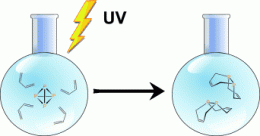
MIT chemistry professor Christopher Cummins and one of his graduate students, Daniel Tofan, have developed a new way to attach phosphorus to organic compounds by first splitting the phosphorus with ultraviolet light. Their method, described in the Aug. 26 online edition of Angewandte Chemie, eliminates the need for chlorine, which is usually required for such reactions and poses health risks to workers handling the chemicals.
While the new reaction cannot produce the quantities needed for large-scale production of phosphorus compounds, it opens the door to a new field of research that could lead to such industrial applications, says Bertrand, who was not involved in the research.
Extracting phosphorus
Most natural phosphorus deposits come from fossilized animal skeletons, which are especially abundant in dried-up seabeds. Those phosphorus deposits exist as phosphate rock, which usually includes impurities such as calcium and other metals that must be removed.
Purifying the rock produces white phosphorus, a molecule containing four phosphorus atoms. White phosphorous is tetrahedral, meaning it resembles a four-cornered pyramid in which each corner atom is bound to the other three. Known as P4, white phosphorus is the most stable form of molecular phosphorus. (There are also several polymeric forms, the most common of which are black and red phosphorus, which consist of long chains of broken phosphorus tetrahedrons.)
For most industrial uses, phosphorus has to be attached one atom at a time, so single atoms must be detached from the P4 molecule. This is usually done in two steps. First, three of the atoms in P4 are replaced with chlorine, resulting in PCl3 — a phosphorus atom bound to three chlorine atoms.
Those chlorine atoms are then displaced by organic (carbon-containing) molecules, creating a wide variety of organophosphorus compounds such as those found in pesticides. However, this procedure is both wasteful and dangerous — chlorine gas was used as a chemical weapon during World War I — so chemists have been trying to find new ways to bind phosphorus to organic compounds without using chlorine.
A new reaction
Cummins has long been fascinated with phosphorus, in part because of its unusual tetrahedral P4 formation. Phosphorus is in the same column of the periodic table as nitrogen, whose most stable form is N2, so chemists expected that phosphorus might form a stable P2 structure. However, that is not the case.
For the past few years, Cummins' research group has been looking for ways to break P4 into P2 in hopes of attaching the smaller phosphorus molecule to organic compounds. In the new study, Cummins drew inspiration from a long overlooked paper, published in 1937, which demonstrated that P4 could be broken into two molecules of P2 with ultraviolet light. In that older study, P2 then polymerized into red posphorus.
Cummins decided to see what would happen if he broke apart P4 with UV light in the presence of organic molecules that have an unsaturated carbon-carbon bond (meaning those carbon atoms are able to grab onto other atoms and form new bonds). After 12 hours of UV exposure, he found that a compound called a tetra-organo diphosphane had formed, which includes two atoms of phosphorus attached to two molecules of the organic compound.
This suggests, but does not conclusively prove, that P2 forms and then immediately bonds to the organic molecule. In future studies, Cummins hopes to directly observe the P2 molecule, if it is indeed present.
Cummins also plans to investigate what other organophosphorus compounds can be synthesized with ultraviolet light, including metallic compounds. He has already created a nickel-containing organophosphorus molecule, which could have applications in electronics.
More information: "Photochemical Incorporation of Diphosphorus Units into Organic Molecules" by Daniel Tofan and Christopher C. Cummins. Angewandte Chemie, 26 August, 2010.
Provided by Massachusetts Institute of Technology (news : web)
-
Maryland to ban phosphorus in soap
Mar 23, 2007 |
not rated yet |
0
-
Synthesis with a template: Carbon-free fullerene analogue
Apr 30, 2009 |
not rated yet |
0
-
Meteorites Could Play a Key Role in Earth Life
Aug 24, 2004 |
not rated yet |
0
-
Converting Nitrogen to a More Useful Form
Jan 09, 2007 |
not rated yet |
0
-
Overlooked element could be part of dream team for quantum computing
Aug 16, 2010 |
not rated yet |
0
-
Engineers build first sub-10-nm carbon nanotube transistor
Feb 01, 2012 |
4.9 / 5 (30) |
30
-
Something old, something new: Evolution and the structural divergence of duplicate genes
Jan 31, 2012 |
4.6 / 5 (7) |
1
-
The hidden nanoworld of ice crystals: Revealing the dynamic behavior of quasi-liquid layers
Jan 30, 2012 |
5 / 5 (3) |
1
-
Stock market network reveals investor clustering
Jan 27, 2012 |
3.9 / 5 (23) |
8
-
Of microchemistry and molecules: Electronic microfluidic device synthesizes biocompatible probes
Jan 26, 2012 |
5 / 5 (1) |
0
-
Stoichiometry
2 hours ago
-
Boiling and melting point of impure substances
3 hours ago
-
Safe nitrogen compound to decompose a 500 deg C in a furnace?
10 hours ago
-
[ask]electron inside drinking water
Feb 08, 2012
-
How to avoid formation of Lithium Chromate ???
Feb 08, 2012
-
how to choose a reduced or oxidated form in a redox
Feb 08, 2012
- More from Physics Forums - Chemistry
More news stories
Hydrogen from acidic water: Researchers develop potential low cost alternative to platinum for splitting water
A technique for creating a new molecule that structurally and chemically replicates the active part of the widely used industrial catalyst molybdenite has been developed by researchers with the Lawrence Berkeley ...
13 hours ago |
5 / 5 (10) |
11
|
Engineers find inspiration for new materials in Piranha-proof armor
(PhysOrg.com) -- Its a matchup worthy of a late-night cable movie: put a school of starving piranha and a 300-pound fish together, and who comes out the winner?
19 hours ago |
4.3 / 5 (3) |
2
|
Flexible paper robots
(PhysOrg.com) -- These inexpensive robots can stretch, bend and twist under control, and lift objects up to 120 times their own weight. Being soft, they can apply gentle and even pressure, and adapt to varied ...
11 hours ago |
5 / 5 (5) |
2
|
New method makes culture of complex tissue possible in any lab
Scientists at the University of California, San Diego have developed a new method for making scaffolds for culturing tissue in three-dimensional arrangements that mimic those in the body. This advance, published online in ...
10 hours ago |
5 / 5 (4) |
0
|
Materials that shrink when heated
One common reason that people with fillings experience toothache is that their fillings expand at a different rate to the original tooth when, for example, drinking a hot drink. Contrary to intuition, however, ...
12 hours ago |
5 / 5 (2) |
1
'Dark plasmons' transmit energy
Microscopic channels of gold nanoparticles have the ability to transmit electromagnetic energy that starts as light and propagates via "dark plasmons," according to researchers at Rice University.
FDA-approved drug rapidly clears amyloid from the brain, reverses Alzheimer's symptoms in mice
Neuroscientists at Case Western Reserve University School of Medicine have made a dramatic breakthrough in their efforts to find a cure for Alzheimer's disease. The researchers' findings, published in the journal Science, show t ...
Ultraviolet protection molecule in plants yields its secrets
Lying around in the sun all day is hazardous not just for humans but also for plants, which have no means of escape. Ultraviolet (UV) radiation from the sun can damage proteins and DNA inside cells, leading ...
Soraa LED light may dim 50-watt halogen rivals
(PhysOrg.com) -- Soraa, a Fremont, California company founded in 2008, this week launched its first product, a light that uses LEDS (light emitting diodes). The "Soraa LED MR16 lamp" is the "perfect" replacement ...
Anyone can learn to be more inventive, cognitive researcher says
There will always be a wild and unpredictable quality to creativity and invention, says Anthony McCaffrey, a cognitive psychology researcher at the University of Massachusetts Amherst, because an "Aha moment" is rare and ...
Explained: Sigma
It's a question that arises with virtually every major new finding in science or medicine: What makes a result reliable enough to be taken seriously? The answer has to do with statistical significance -- but ...
Sep 04, 2010
Rank: not rated yet