Missing piece inspires new look at Mars puzzle
September 3, 2010
Missing piece inspires new look at Mars puzzle

Enlarge

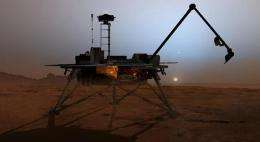
In this artist's concept illustration, NASA's Phoenix Mars Lander begins to shut down operations as winter sets in. Image Credit: NASA/JPL-Calech/University of Arizona

(PhysOrg.com) -- Experiments prompted by a 2008 surprise from NASA's Phoenix Mars Lander suggest that soil examined by NASA's Viking Mars landers in 1976 may have contained carbon-based chemical building blocks of life.

"This doesn't say anything about the question of whether or not life has existed on Mars, but it could make a big difference in how we look for evidence to answer that question," said Chris McKay of NASA's Ames Research Center, Moffett Field, Calif. McKay coauthored a study published online by the - Planets, reanalyzing results of Viking's tests for in .

The only organic chemicals identified when the Viking landers heated samples of Martian soil were chloromethane and dichloromethane -- chlorine compounds interpreted at the time as likely contaminants from cleaning fluids. But those chemicals are exactly what the new study found when a little -- the surprise finding from Phoenix -- was added to desert soil from Chile containing organics and analyzed in the manner of the Viking tests.

"Our results suggest that not only organics, but also perchlorate, may have been present in the soil at both Viking landing sites," said the study's lead author, Rafael Navarro-González of the National Autonomous University of Mexico, Mexico City.

Organics can come from non-biological or biological sources. Many meteorites raining onto Mars and Earth for the past 5 billion years contain organics. Even if Mars has never had life, scientists before Viking anticipated that Martian soil would contain organics from meteorites.
Missing piece inspires new look at Mars puzzle
Enlarge

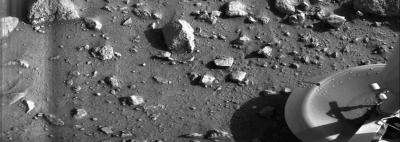
This is the first photograph ever taken on the surface of the planet Mars. It was obtained by Viking 1 just minutes after the spacecraft landed successfully early today. Image Credit: NASA

"The lack of organics was a big surprise from the Vikings," McKay said. "But for 30 years we were looking at a jigsaw puzzle with a piece missing. Phoenix has provided the missing piece: perchlorate. The perchlorate discovery by Phoenix was one of the most important results from Mars since Viking." Perchlorate, an ion of chlorine and oxygen, becomes a strong oxidant when heated. "It could sit there in the Martian soil with organics around it for billions of years and not break them down, but when you heat the soil to check for organics, the perchlorate destroys them rapidly," McKay said.

This interpretation proposed by Navarro-González and his four co-authors challenges the interpretation by Viking scientists that Martian organic compounds were not present in their samples at the detection limit of the Viking experiment. Instead, the Viking scientists interpreted the chlorine compounds as contaminants. Upcoming missions to Mars and further work on meteorites from Mars are expected to help resolve this question.

The Curiosity rover that NASA's Mars Science Laboratory mission will deliver to Mars in 2012 will carry the Sample Analysis at Mars (SAM) instrument provided by Goddard Space Flight Center, Greenbelt, Md. In contrast to Viking and Phoenix, Curiosity can rove and thus analyze a wider variety of rocks and samples. SAM can check for organics in Martian soil and powdered rocks by baking samples to even higher temperatures than Viking did, and also by using an alternative liquid-extraction method at much lower heat. Combining these methods on a range of samples may enable further testing of the new report's hypothesis that oxidation by heated perchlorates that might have been present in the Viking samples was destroying organics.

One reason the chlorinated organics found by were interpreted as contaminants from Earth was that the ratio of two isotopes of chlorine in them matched the three-to-one ratio for those isotopes on Earth. The ratio for them on Mars has not been clearly determined yet. If it is found to be much different than Earth's, that would support the 1970s interpretation.

If organic compounds can indeed persist in the surface soil of Mars, contrary to the predominant thinking for three decades, one way to search for evidence of life on could be to check for types of large, complex organic molecules, such as DNA, that are indicators of biological activity. "If organics cannot persist at the surface, that approach would not be wise, but if they can, it's a different story," McKay said.

The Phoenix mission was led by Principal Investigator Peter H. Smith of the University of Arizona, Tucson, with project management at NASA's Jet Propulsion Laboratory, Pasadena, Calif. The Phoenix finding of perchlorate was reported by JPL's Michael Hecht and co-authors.

Provided by JPL/NASA (news : web)

4.6 /5 (18 votes)  

Filter


Move the slider to adjust rank threshold, so that you can hide some of the comments.


Display comments: newest first

omatumr
Sep 03, 2010

Rank: 1.2 / 5 (5)
Yes, perhaps, but the fact is that they looked for evidence of life on Mars and found none.

I understand NASA's desire for a discovery that would likely increase funding for NASA, but self-deception usually provides only a short term "high".

Remember Superman's vulnerability to Kryptonite and the report in ~1970 from analysis of Apollo samples that some mysterious process was making Krypton on the Moon?

With kind regards,
Oliver K. Manuel
Former NASA Principal
Investigator for Apollo
eachus
Sep 04, 2010

Rank: 5 / 5 (2)
The caption on the picture was right when initially released--on July 20th, 1976--but is just under thirty-five years out of date today. ;-)
Nyloc
Sep 04, 2010

Rank: 3 / 5 (1)
I've always maintained that the headline should have read, "No Earth-Life Found on Mars". It's a fallacy to look for "us" on another world. Instead, we need to use a broader definition of "life" that includes other possible life-forms.

We learn every day that Earth life is, itself, full of surprises. From hot ocean vents to deep within the earth, life has shown itself to be very resourceful and adaptable. Why, the, expect that alien environments may be even more surprising?

We must keep open minds.
deatopmg
Sep 04, 2010

Rank: 1.7 / 5 (3)
"This doesn't say anything about the question of whether or not life has existed on Mars, but it could make a big difference in how we look for evidence to answer that question," said Chris McKay

Even tough they have specifically NOT looked for any life since the Viking missions. THis latest mission continues that trend. One of the Viking life detection experiments showed diurnal emissions of C14 CO2 for 1 1/2 months from a mysterious "unknown chemical reaction". Perchlorate would not do that.

Ever increasing PR but Never A Straight Answer
Rank 4.6 /5 (18 votes)
Related Stories
Relevant PhysicsForums posts
  • Titan's lack of impact craters
    created3 hours ago
  • Real pictures of black hole eating a star?
    created21 hours ago
  • Hypothetical way to travel faster than light, but not technically exceed lightspeed
    createdFeb 06, 2012
  • How do scientists monitor the Sun's activity?
    createdFeb 05, 2012
  • Search patterns in observational studies
    createdFeb 05, 2012
  • Derivation of Pogson's law
    createdFeb 03, 2012
  • More from Physics Forums - General Astronomy

More news stories

Ocean microbe communities changing, but long-term environmental impact is unclear

As oceans warm due to climate change, water layers will mix less and affect the microbes and plankton that pump carbon out of the atmosphere – but researchers say it's still unclear whether these processes ...

Space & Earth / Earth Sciences

created 1 hour ago | popularity not rated yet | comments 0 | with audio podcast

Researchers create 3-D laser maps that show how earthquake changes landscape

Geologists have a new tool to study how earthquakes change the landscape down to a few inches, and it's giving them insight into how earthquake faults behave. In the Feb. 10 issue of the journal Science, a team ...

Space & Earth / Earth Sciences

created 1 hour ago | popularity 5 / 5 (1) | comments 0 | with audio podcast

Tidal forces could squeeze out planetary water

Alien planets might experience tidal forces powerful enough to remove all their water, leaving behind hot, dry worlds like Venus, researchers said.

Space & Earth / Space Exploration

created 5 hours ago | popularity 5 / 5 (1) | comments 1 | with audio podcast

La Nina going away, but too late for Texas drought

(AP) -- Federal weather forecasters say the La Nina weather phenomenon that contributed to the southwestern U.S. drought is winding down.

Space & Earth / Environment

created 1 hour ago | popularity not rated yet | comments 0

New views show old NASA Mars landers

(PhysOrg.com) -- The High Resolution Imaging Science Experiment (HiRISE) camera on NASA's Mars Reconnaissance Orbiter recorded a scene on Jan. 29, 2012, that includes the first color image from orbit showing ...

Space & Earth / Space Exploration

created 7 hours ago | popularity 4.9 / 5 (7) | comments 3 | with audio podcast


Hydrogen from acidic water: Researchers develop potential low cost alternative to platinum for splitting water

A technique for creating a new molecule that structurally and chemically replicates the active part of the widely used industrial catalyst molybdenite has been developed by researchers with the Lawrence Berkeley ...

To perform with less effort, practice beyond perfection

Whether you are an athlete, a musician or a stroke patient learning to walk again, practice can make perfect, but more practice may make you more efficient, according to a surprising new University of Colorado Boulder study.

Scientists identify most lethal known species of prion protein

Scientists from the Florida campus of The Scripps Research Institute have identified a single prion protein that causes neuronal death similar to that seen in "mad cow" disease, but is at least 10 times more ...

US workers are 'giving away the store,' costing firms billions

Nearly 70 percent of the nation's service employees give away free goods and services – from hamburgers to cable TV – costing companies billions of dollars a year, according to a groundbreaking study.

New prenatal genetic test is much more powerful at detecting fetal abnormalities

A nationwide, federally funded study has found that testing a developing fetus' DNA through chromosomal microarray (CMA) provides more information about potential disorders than does the standard method of prenatal testing, ...

Barriers fall between TV, Internet

You say TV, I say Internet. Toe-mate-o, toe-mah-to.