Moonstruck primates: Owl monkeys need moonlight as much as a biological clock for nocturnal activity
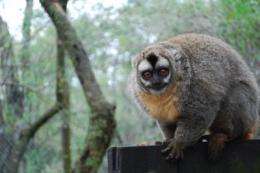
An international collaboration led by a University of Pennsylvania anthropologist has shown that environmental factors, like temperature and light, play as much of a role in the activity of traditionally nocturnal monkeys as the circadian rhythm that regulates periods of sleep and wakefulness.
The study also indicates that when the senses relay information on these environmental factors, it can influence daily activity and, in the case of a particular monkey species, may have even produced evolutionary change. It is possible, according to the study results, that changes in sensitivity to specific environmental stimuli may have been an essential key for evolutionary switches between diurnal and nocturnal habits in primates. The study also provides data to better understand all life cycles.
Researchers set out to examine the hypothesis that masking, the chronobiology term for the stimulation or inhibition of activity, was largely caused by changing environmental factors that affected the Azara's owl monkeys' internal timing system, or synchronized circadian rhythm. Put simply, changes in temperature and light make Azara's owl monkeys the only anthropoid primate (monkeys, apes and humans) with a propensity for both early bird and night owl behavior.
The observational nature of field studies has generally limited science's understanding of the mechanisms responsible for the change in activity patterns of these species, whose behavior traditionally takes place in the dimmest of light. Researchers monitored the activity of these wild owl monkeys continually for as long as 18 months using actimeter collars fitted to them.
The results represent the first long-term study of wild primates providing direct evidence for environmental masking, according to researchers.
The data indicate that, although regular daytime activity is represented by the output of a circadian clock, nocturnality is the result of fine-tuned masking of circadian rhythmicity by environmental light and temperature.
Specifically, date showed that nocturnal activity was more consolidated during the relatively warmer months of September to March than during the colder months of April to August, when temperatures in the Argentine province of Formosa regularly fall below 10ºC. Throughout the year, nocturnal activity was higher during full-moon nights than during new-moon ones, and these peaks of nocturnal activity were consistently followed by mornings of low activity. Conversely, new-moon nights were usually followed by mornings of higher diurnal activity than mornings following full-moon nights.
"The behavioral outcome for these owl monkeys is nocturnal activity maximized during relatively warm, moonlit nights," said Eduardo Fernández-Duque, lead investigator and an assistant professor in the Department of Anthropology in Penn's School of Art and Sciences.
"While laboratory studies have pointed to the importance of masking in determining the environmental factors that cause animals to switch from nocturnal activity patterns to diurnal ones or vice versa, our study underscores the importance of masking in determining the daily activity patterns of animals living in the wild. It also suggests that moonlight is a key adaptation for the exploitation of the nocturnal niche by primates," he said.
Conclusive evidence for the direct masking effect of light was provided when three full lunar eclipses completely shadowed moonlight, coinciding with diminished monkey activity. Temperature also negatively masked locomotor activity, and this masking was manifested even under optimal light conditions.
"If there was a biological clock that they were depending on to regulate this activity, you could expect the activity to continue even in the absence of lunar light," said Horacio de la Iglesia of the Department of Biology at the University of Washington.
Primates — even humans — conduct their daily tasks in patterns ranging from nocturnality to diurnality, with a few species showing activity both during day and night. Among anthropoids (monkeys, apes and humans), nocturnality is only present in the Central and South American owl monkey genus Aotus. But unlike other tropical Aotus species, the Azara's owl monkeys (A. azarai) of the subtropics, and this study, have actually switched their activity pattern from strict nocturnality to one that also includes regular daytime activity. The phenomenon led researchers to question the causes of such a behavioral change.
"Harsher climate, food availability and the lack of predators or daytime competition have all been proposed as factors favoring evolutionary switches in primate activity patterns," Fernández-Duque said.
"The lunar day has not been a stable force as much as the solar day to evolutionarily select for a clock," de la Iglesia said. "We still have to prove it in the lab, but the evidence in this paper points to a lack of a lunar biological clock."
More information: The article appears in the current issue of the journal PLoS ONE.
Provided by University of Pennsylvania


