Expert warns of complacency after swine flu fizzle
September 5, 2010 By MIN LEE , Associated Press Writer
Expert warns of complacency after swine flu fizzle (AP)

Enlarge

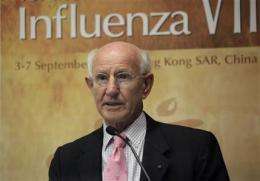
Robert Webster, chairman of the Department of Virology and Molecular Biology at St. Jude Children's Research Hospital in Memphis, Tenn., attends the Options for the Control of Influenza conference in Hong Kong Sunday, Sept. 5, 2010 in Hong Kong. Webster urged health authorities around the world to stay vigilant even though the recent swine flu pandemic was less deadlier than expected, warning that bird flu could spark the next global outbreak. (AP Photo/Vincent Yu)

(AP) -- A leading virus expert urged health authorities around the world Sunday to stay vigilant even though the recent swine flu pandemic was less deadly than expected, warning that bird flu could spark the next global outbreak.

A official also defended the U.N.'s health body against accusations that it wasted governments' money and enriched pharmaceutical companies with its strong warnings during the swine flu outbreak's early days last year.

WHO declared the swine flu pandemic over last month. The latest death toll is just over 18,600 - far below the millions that were once predicted. The head of the global health body has credited good preparation and luck, since the H1N1 swine flu virus didn't mutate as some had feared.

But speaking to reporters on the sidelines of an influenza conference in Hong Kong, researcher Robert Webster warned against complacency.

"We may think we can relax and influenza is no longer a problem. I want to assure you that that is not the case," said Webster, chairman of the virology and molecular biology department at St. Jude Children's Research Hospital in Memphis, Tennessee.

Webster predicted that the next pandemic could be sparked by a virus that spreads from water fowl to pigs and then onto humans - such as the H5N1 strain of , which has killed 300 people over the past seven years. He noted that after several years of decline, the number of bird flu cases in humans increased in 2009, lifted by an uptick of cases in Egypt.

"H5N1 can kill 61 percent of humans infected, but it doesn't know how to spread from human to human. But don't trust it because it could acquire that capacity. So we must stay vigilant," he said.

Sylvie Briand, head of WHO's global influenza program, said its surveillance has shown that the bird isn't capable now of jumping between humans except in rare cases of close personal contact, but echoing Webster, warned: "These are viruses that are evolving. They are changing all the time."

Both experts said it was difficult to predict when - or if - bird flu might set off a new pandemic.

"We don't understand enough about the virus to make predictions," Webster said.

University of Hong Kong microbiologist Malik Peiris said scientists are closely monitoring mutations by influenza viruses - including bird flu viruses - but it's hard to determine which mutations are most likely to spread among humans.

Briand also defended WHO against accusations that it hyped the , saying it was acting with limited information when the virus first surfaced and adjusted its response when it became clear the outbreak wasn't as serious as expected.

WHO received at least $170 million from member states to deal with the outbreak, some of which was invested in immunization programs long after the virus strain was known to provoke only mild illness in most of those infected. Governments spent many times that amount buying vaccines and antiviral medicines that are now being junked.

European legislators have repeatedly accused WHO of overstating the danger of swine flu and playing into the hands of the pharmaceutical industry, which has earned millions from the outbreak since it began in April 2009.

"We prepared for the worst and hoped for the best. And as the information became available, there was adaptation of the plan and adaptation of the recommendations in order to really tailor the response to the reality," Briand said. "But it took some time."

©2010 The Associated Press. All rights reserved. This material may not be published, broadcast, rewritten or redistributed.


Rank not rated yet
Related Stories
Relevant PhysicsForums posts

More news stories

Anyone can learn to be more inventive, cognitive researcher says

There will always be a wild and unpredictable quality to creativity and invention, says Anthony McCaffrey, a cognitive psychology researcher at the University of Massachusetts Amherst, because an "Aha moment" is rare and ...

Medicine & Health / Psychology & Psychiatry

created 2 hours ago | popularity 4.5 / 5 (2) | comments 0 | with audio podcast

Cell biologists describes mechanism by which some people may be more susceptible to colon cancer

An international research team led by cell biologists at the University of California, Riverside has uncovered a new insight into colon cancer, the third leading cause of cancer-related deaths in the United ...

Medicine & Health / Cancer

created 2 hours ago | popularity 5 / 5 (1) | comments 0 | with audio podcast

FDA-approved drug rapidly clears amyloid from the brain, reverses Alzheimer's symptoms in mice

Neuroscientists at Case Western Reserve University School of Medicine have made a dramatic breakthrough in their efforts to find a cure for Alzheimer's disease. The researchers' findings, published in the journal Science, show t ...

Medicine & Health / Neuroscience

created 6 hours ago | popularity 5 / 5 (26) | comments 1 | with audio podcast

Focus on self-improvement, rather than winning, benefits young athletes

Underserved youth athletes report more life skill and character development when their coaches place greater emphasis on creating caring climates instead of focusing on competition, according to research from ...

Medicine & Health / Psychology & Psychiatry

created 2 hours ago | popularity 5 / 5 (1) | comments 0

Researchers weigh in on ethics of H5N1 research

(Medical Xpress) -- In a commentary on the biosecurity controversy surrounding publication of bird flu research details, a bioethicist and a vaccine expert at Johns Hopkins reaffirm that "all scientists have an affirmativ ...

Medicine & Health / Other

created 4 hours ago | popularity not rated yet | comments 0 | with audio podcast


'Dark plasmons' transmit energy

Microscopic channels of gold nanoparticles have the ability to transmit electromagnetic energy that starts as light and propagates via "dark plasmons," according to researchers at Rice University.

Ultraviolet protection molecule in plants yields its secrets

Lying around in the sun all day is hazardous not just for humans but also for plants, which have no means of escape. Ultraviolet (UV) radiation from the sun can damage proteins and DNA inside cells, leading ...

New method makes culture of complex tissue possible in any lab

Scientists at the University of California, San Diego have developed a new method for making scaffolds for culturing tissue in three-dimensional arrangements that mimic those in the body. This advance, published online in ...

Hydrogen from acidic water: Researchers develop potential low cost alternative to platinum for splitting water

A technique for creating a new molecule that structurally and chemically replicates the active part of the widely used industrial catalyst molybdenite has been developed by researchers with the Lawrence Berkeley ...

Deadly bird parasite evolves at exceptionally fast rate

A new study of a devastating bird disease that spread from poultry to house finches in the mid-1990s reveals that the bacteria responsible for the disease evolves at an exceptionally fast rate. What's more, ...

Flexible paper robots

(PhysOrg.com) -- These inexpensive robots can stretch, bend and twist under control, and lift objects up to 120 times their own weight. Being soft, they can apply gentle and even pressure, and adapt to varied ...