New self-assembling photovoltaic technology that repairs itself
September 5, 2010 by David L. Chandler
New self-assembling photovoltaic technology that repairs itself

Enlarge

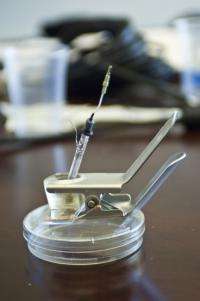
This proof-of-concept version of the photoelectrochemical cell, which was used for laboratory tests, contains a photoactive solution made up of a mix of self-assembling molecules (in a glass cylinder held in place by metal clamp) with two electrodes protruding from the top, one made of platinum (the bare wire) and the other of silver (in a glass tube). Photo: Patrick Gillooly

Plants are good at doing what scientists and engineers have been struggling to do for decades: converting sunlight into stored energy, and doing so reliably day after day, year after year. Now some MIT scientists have succeeded in mimicking a key aspect of that process.

One of the problems with harvesting sunlight is that the sun’s rays can be highly destructive to many materials. Sunlight leads to a gradual degradation of many systems developed to harness it. But plants have adopted an interesting strategy to address this issue: They constantly break down their light-capturing molecules and reassemble them from scratch, so the basic structures that capture the sun’s energy are, in effect, always brand new.

That process has now been imitated by Michael Strano, the Charles and Hilda Roddey Associate Professor of Chemical Engineering, and his team of graduate students and researchers. They have created a novel set of self-assembling molecules that can turn sunlight into electricity; the molecules can be repeatedly broken down and then reassembled quickly, just by adding or removing an additional solution. Their paper on the work was published on Sept. 5 in Nature Chemistry.

Strano says the idea first occurred to him when he was reading about plant biology. “I was really impressed by how plant cells have this extremely efficient repair mechanism,” he says. In full summer sunlight, “a leaf on a tree is recycling its proteins about every 45 minutes, even though you might think of it as a static photocell.”

One of Strano’s long-term research goals has been to find ways to imitate principles found in nature using nanocomponents. In the case of the molecules used for photosynthesis in plants, the reactive form of oxygen produced by sunlight causes the proteins to fail in a very precise way. As Strano describes it, the oxygen “unsnaps a tether that keeps the protein together,” but the same proteins are quickly reassembled to restart the process.

This action all takes place inside tiny capsules called chloroplasts that reside inside every plant cell — and which is where photosynthesis happens. The chloroplast is “an amazing machine,” Strano says. “They are remarkable engines that consume carbon dioxide and use light to produce glucose,” a chemical that provides energy for metabolism.

To imitate that process, Strano and his team, supported by grants from the MIT Energy Initiative, the Eni Solar Frontiers Center at MIT and the Department of Energy, produced synthetic molecules called phospholipids that form disks; these disks provide structural support for other molecules that actually respond to light, in structures called reaction centers, which release electrons when struck by particles of light. The disks, carrying the reaction centers, are in a solution where they attach themselves spontaneously to carbon nanotubes — wire-like hollow tubes of carbon atoms that are a few billionths of a meter thick yet stronger than steel and capable of conducting electricity a thousand times better than copper. The nanotubes hold the phospholipid disks in a uniform alignment so that the reaction centers can all be exposed to sunlight at once, and they also act as wires to collect and channel the flow of electrons knocked loose by the reactive molecules.

The system Strano’s team produced is made up of seven different compounds, including the carbon nanotubes, the phospholipids, and the proteins that make up the reaction centers, which under the right conditions spontaneously assemble themselves into a light-harvesting structure that produces an electric current. Strano says he believes this sets a record for the complexity of a self-assembling system. When a surfactant — similar in principle to the chemicals that BP has sprayed into the Gulf of Mexico to break apart oil — is added to the mix, the seven components all come apart and form a soupy solution. Then, when the researchers removed the surfactant by pushing the solution through a membrane, the compounds spontaneously assembled once again into a perfectly formed, rejuvenated photocell.

“We’re basically imitating tricks that nature has discovered over millions of years” — in particular, “reversibility, the ability to break apart and reassemble,” Strano says. The team, which included postdoctoral researcher Moon-Ho Ham and graduate student Ardemis Boghossian, came up with the system based on a theoretical analysis, but then decided to build a prototype cell to test it out. They ran the cell through repeated cycles of assembly and disassembly over a 14-hour period, with no loss of efficiency.

Strano says that in devising novel systems for generating electricity from light, researchers don’t often study how the systems change over time. For conventional silicon-based photovoltaic cells, there is little degradation, but with many new systems being developed — either for lower cost, higher efficiency, flexibility or other improved characteristics — the degradation can be very significant. “Often people see, over 60 hours, the efficiency falling to 10 percent of what you initially saw,” he says.

The individual reactions of these new molecular structures in converting sunlight are about 40 percent efficient, or about double the efficiency of today’s best solar cells. Theoretically, the efficiency of the structures could be close to 100 percent, he says. But in the initial work, the concentration of the structures in the solution was low, so the overall efficiency of the device — the amount of electricity produced for a given surface area — was very low. They are working now to find ways to greatly increase the concentration.

Philip Collins ’90, associate professor of experimental and condensed-matter physics at the University of California, Irvine, who was not involved in this work, says, “One of the remaining differences between man-made devices and biological systems is the ability to regenerate and self-repair. Closing this gap is one promise of nanotechnology, a promise that has been hyped for many years. Strano's work is the first sign of progress in this area, and it suggests that ‘nanotechnology’ is finally preparing to advance beyond simple nanomaterials and composites into this new realm.”

Provided by Massachusetts Institute of Technology (news : web)

4.9 /5 (26 votes)  

Filter


Move the slider to adjust rank threshold, so that you can hide some of the comments.


Display comments: newest first

HealingMindN
Sep 05, 2010

Rank: 5 / 5 (2)
[quote]When a surfactant — similar in principle to the chemicals that BP has sprayed into the Gulf of Mexico to break apart oil — is added to the mix, the seven components all come apart and form a soupy solution...[/quote]

That reminds me: What is being done to clean up that corexit from the Gulf?
Arikin
Sep 06, 2010

Rank: not rated yet
BP and the US government are still cleaning. It will take years... Bet it is fun having your company be a representation of disaster.

But back to the article, this is a great exercise. Sometimes you get nice surprises you get your hands dirty and try the theories out.
tkjtkj
Sep 06, 2010

Rank: not rated yet
This sounds like nice work!
..tho i'd not use the words 'spontaneously reassemble' when that action requires external influence: passing the fluid thru a filter. That process requires work from an outside source. Let's hope a fully self-contained device is in their future!

keijo
Sep 06, 2010

Rank: not rated yet
Well it seemed to be that the filtration thru the membrane was just a test to show the self assembly and not a part of the energy generation cycle. So in that sense the system should be self contained. Or that's atleast how I understood this.
antialias_physorg
Sep 06, 2010

Rank: 5 / 5 (1)
While the subject of the article is good this first sentence is not:
"Plants are good at doing what scientists and engineers have been struggling to do for decades: converting sunlight into stored energy, "

Plants have an average energy efficiency of only 3%. From sunlight to stored chemical energy (as sugars) and back.
ForFreeMinds
Sep 12, 2010

Rank: not rated yet
This seems like a fantastic advance. I'd like to have seen some information on the cost of the energy produced, yet, it offers the potential for future improvements.

The efficiency isn't so important as the economics IMHO, but something I expect will improve.
tkjtkj
Sep 12, 2010

Rank: not rated yet
Well it seemed to be that the filtration thru the membrane was just a test to show the self assembly and not a part of the energy generation cycle. So in that sense the system should be self contained. Or that's atleast how I understood this.


yes, i see now that your interpretation seems more correct .. thanks for pointing out my misunderstanding.

Rank 4.9 /5 (26 votes)
Relevant PhysicsForums posts
  • Corrosion Tests on Magnesium
    created10 hours ago
  • polyethylene copper nanocomposite
    created16 hours ago
  • Output of xrd analysis
    createdFeb 08, 2012
  • Transport phenomena problem based on problems 18.B11 and 19B.6 from Bird, stewart, lw
    createdFeb 06, 2012
  • Help with material selection - Car Piston
    createdFeb 05, 2012
  • Name of the steel alloy?!!?
    createdFeb 02, 2012
  • More from Physics Forums - Materials & Chemical Engineering

More news stories

'Dark plasmons' transmit energy

Microscopic channels of gold nanoparticles have the ability to transmit electromagnetic energy that starts as light and propagates via "dark plasmons," according to researchers at Rice University.

Nanotechnology / Nanophysics

created 6 hours ago | popularity 5 / 5 (4) | comments 0 | with audio podcast

Nanotube therapy takes aim at breast cancer stem cells

Wake Forest Baptist Medical Center researchers have again proven that injecting multiwalled carbon nanotubes (MWCNTs) into tumors and heating them with a quick, 30-second laser treatment can kill them.

Nanotechnology / Bio & Medicine

created 11 hours ago | popularity 5 / 5 (1) | comments 0 | with audio podcast

Inspired by steel, nanomanufacturing gets wear-resistant carbide tip

(PhysOrg.com) -- Scientists at the University of Pennsylvania, the University of Wisconsin-Madison and IBM Research - Zurich have fabricated an ultrasharp silicon carbide tip possessing such high strength ...

Nanotechnology / Nanophysics

created 16 hours ago | popularity 5 / 5 (3) | comments 1 | with audio podcast

New technology platform for molecule-based electronics

Researchers at the Nano-Science Center at the University of Copenhagen have developed a new nano-technology platform for the development of molecule-based electronic components using the wonder material graphene. At the same ...

Nanotechnology / Nanomaterials

created 13 hours ago | popularity 5 / 5 (2) | comments 0

Australians risking skin cancer to avoid nanoparticles

More than three in five Australians are concerned enough about the health implications of nanoparticles in sunscreens to want to know more about their impact. And while the initial scientific information released suggests ...

Nanotechnology / Bio & Medicine

created 14 hours ago | popularity 5 / 5 (1) | comments 0


Hydrogen from acidic water: Researchers develop potential low cost alternative to platinum for splitting water

A technique for creating a new molecule that structurally and chemically replicates the active part of the widely used industrial catalyst molybdenite has been developed by researchers with the Lawrence Berkeley ...

FDA-approved drug rapidly clears amyloid from the brain, reverses Alzheimer's symptoms in mice

Neuroscientists at Case Western Reserve University School of Medicine have made a dramatic breakthrough in their efforts to find a cure for Alzheimer's disease. The researchers' findings, published in the journal Science, show t ...

Ultraviolet protection molecule in plants yields its secrets

Lying around in the sun all day is hazardous not just for humans but also for plants, which have no means of escape. Ultraviolet (UV) radiation from the sun can damage proteins and DNA inside cells, leading ...

Anyone can learn to be more inventive, cognitive researcher says

There will always be a wild and unpredictable quality to creativity and invention, says Anthony McCaffrey, a cognitive psychology researcher at the University of Massachusetts Amherst, because an "Aha moment" is rare and ...

Cell biologists describes mechanism by which some people may be more susceptible to colon cancer

An international research team led by cell biologists at the University of California, Riverside has uncovered a new insight into colon cancer, the third leading cause of cancer-related deaths in the United ...

Flexible paper robots

(PhysOrg.com) -- These inexpensive robots can stretch, bend and twist under control, and lift objects up to 120 times their own weight. Being soft, they can apply gentle and even pressure, and adapt to varied ...