US mulls approval of genetically engineered salmon
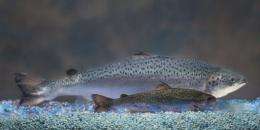
US authorities have begun to consider approval for the first time the sale of genetically engineered salmon, a move that some say could open the door to more transgenic animals on American dinner tables.
A US Food and Drug Administration panel has set a hearing for September 19-20 to consider a proposal by Massachusetts-based AquaBounty Technologies for production and sale of a new Atlantic salmon with a growth hormone gene from the Chinook salmon that allows it to grow faster.
The company said the genetic change allows the fish to grow to market size in half the time of conventional salmon but that in all other respects, its AquAdvantage salmon "are identical to other Atlantic salmon."
The new strain of salmon can help meet rising demand for fish and reduce pressure on wild fish stocks, the firm contends. It says it can avoid the pollution, disease and other problems associated with saltwater fish farms by raising the salmon at inland facilities.
"The benefit of this technology is that because the fish grows more efficiently it can be grown faster and closer to population centers," says Ron Stotish, chief executive of the group, which is publicly traded in London.
Stotish, who said the firm hopes to sell its salmon eggs in the US, Canada and elsewhere, argues that new technologies are needed for a global population quickly depleting fish and other food supplies.
"I think this technology can be a tremendous aid to assuring a safe and sustainable food supply," he told AFP.
But environmental and food safety groups are raising fierce objections, saying this could not only endanger wild salmon but open the door to other kinds of genetically modified animal foods that may pose health or environmental dangers.
If approved, the salmon would be the first transgenic animal allowed for US human consumption, although officials have approved a goat with genetic modifications to produce an anti-clotting treatment.
Critics of the new salmon say approval could exacerbate the problem of farmed fish escaping from tanks and breeding with wild counterparts, with unpredictable results.
Jaydee Hanson, a policy analyst at the Center for Food Safety, a Washington-based watchdog group, said the company was basing its application on the "fiction" that introducing genes into an animal is the same as using drugs.
"Because the company is claiming this is a drug it has to demonstrate this is safe in the animal, but it doesn't have to show it is safe for people to eat," he told AFP.
The center was among a coalition of 31 groups urging the FDA to reject the application, and Hanson said approval could open the door to a variety of other kinds of genetically engineered animals ranging from tilapia to pigs to cows.
AquaBounty has pledged safeguards that include only using land-based facilities instead of ocean pens to prevent accidental release, and breeding that leads to sterile females.
Stotish said the new salmon are "the most studied fish in the world" and that regulators have considered a variety of scenarios.
"AquaBounty has taken unprecedented steps to assure that the fish cannot interact with wild populations," he said. "Not only are they all sterile females, as a condition of approval they will be raised in land-based contained aquaculture systems -- making escape into the wild an impossibility."
The FDA, in a preliminary assessment on the risks, said the likelihood of escape into the wild is "extremely small." As a result, it said the new salmon "are highly unlikely to cause any significant effects on the environment."
Critics remain unconvinced of the merits of transgenic salmon, derided by some as "Frankenfood."
"We all know there is a great appetite for salmon, but the solution is not to farm' genetically engineered versions to put more on our dinner tables; the solution is to work to bring our wild salmon populations back," says Jonathan Rosenfield, president of the SalmonAID Foundation, a coalition of commercial, tribal, and sports fishing interests.
If the FDA approves the request, it will then consider whether to label the salmon as genetically modified -- a move which might lead consumers to shun the fish.
But Hanson of the Center for Food Safety said that a special label would be warranted.
"Our position is that given the data we've seen it shouldn't be approved but if it is approved, it should be labeled," he said.
"If they don't label it, all other US farmed salmon is going to be assumed to be genetically engineered, so it would damage the industry."
(c) 2010 AFP


