Studying transition between insulating and conducting states in complex oxides
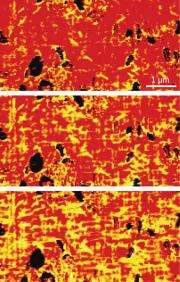
When water freezes or boils, its atomic structure undergoes a phase transition in response to temperature change. Phase transitions are common in nature, and have been exploited to make devices such as digital memories. Complex oxides, which involve multiple cationic elements that enable fine tuning of properties, exhibit a particularly rich set of phase transitions because electrons in these materials are correlated with each other, leading to collective behavior and complex self-organized patterns.
Some phase transitions in complex oxides, including one called ‘colossal magnetoresistance’, can lead to drastic changes in conductivity and magnetism, with potential application to computing devices. However, the mechanisms behind these transitions remain imperfectly understood. Now, Masashi Kawasaki of the RIKEN Advanced Science Institute, Japan, Wako, Zhi-Xun Shen of Stanford University, USA, and their colleagues have produced unprecedented images of an important phase transition in a thin film made from the complex oxide, manganite.
Colossal transition under the microscope
The transition in question is characterized by an increase in the manganite film conductivity by a factor of 10,000 on application of a magnetic field at low temperature, and is an example of colossal magnetoresistance. The resulting transition has been previously characterized in terms of local magnetization, atomic displacement and density of available electronic states. A microscopic and spatially resolved picture of the film conductivity during the transition, however, has proven elusive. This is partly due to the difficulty of measuring large resistivity changes under extreme temperatures and magnetic fields and to the requirement for high-quality films with atomically flat surfaces and distinct phase transition behavior.
Kawasaki, Shen and colleagues solved the first problem by constructing a microwave impedance microscope able to operate over a wide range of temperatures and magnetic fields, but with internal shielding to prevent these conditions from interfering with the measurement. Their microscope works by passing a fine tip over the surface of the manganite film while applying microwave-frequency electrical excitation. This allows it to distinguish between conducting and insulating portions of the film even if they are structurally identical. In addition, the researchers were able to grow high-quality, single-crystal, thin manganite films by using pulsed-laser deposition, allowing phase transitions to be clearly observed.
Networking is important
This combination of an advanced microscope and high-quality thin film allowed the researchers to map the conductivity across a manganite film as it underwent the transition from low to high conductivity. The onset of the high conductivity state was accompanied by the formation of highly conducting manganite filaments aligned along two crystal axes of the underlying substrate made from the strontium titanium oxide (STO). These filaments, which consisted of a highly conducting metallic-like phase of manganite, began to form at very low magnetic fields, below the strengths required for the phase transition to complete, and grew as the magnetic field increased. At very high fields, the filaments formed an interconnected network across which charges could travel, or ‘percolate’. Using a numerical model of the film as a network of random resistors, the team was able to reproduce the observed phase change behavior, confirming the network’s importance.
When the manganite was switched to its insulating state, and then back to its high-conductivity state, the filaments reappeared in the same locations. According to Kawasaki, Shen and colleagues, this suggests that filament direction was not completely random, but was set by disorder and strain in the film, which result from the boundary between the film’s metallic and insulating phases, as well as from strain between the film and the underlying STO substrate. The ordered growth of filaments during the phase transition is reminiscent of the self-organized patterning of snowflakes that accompanies water’s phase change from liquid to solid.
Moving beyond silicon
The observed filament growth represents the first microscopic view of thin film conductivity during the colossal magnetoresistance phase transition, with direct implications for the science in this field. It may also be useful for future ‘post-silicon’ or ‘post-CMOS’ electronic devices. “Most proposed post-CMOS devices mimic existing silicon technologies like diodes and transistors,” says Kawasaki. “The directional nature of the phase separation that we have observed may allow for a completely new method to process and transfer information.” Such a technology would exploit the fact that insulating and metallic phases of the manganite thin film involve different electronic orbitals and can be controlled. Therefore, it may be possible to effectively store information in electron orbitals, rather than in charge quantity or electron spin as is done in other devices. The research team has dubbed this new approach ‘orbitronics’.
In fact, Kawasaki notes that the potential to develop radically new electronics devices is what first sparked the RIKEN team’s interest in manganite thin films. “We were thinking about using electronic phase separation for future electronics,” he explains. “It was a fortuitous meeting with Zhi-Xun Shen at a workshop in Okinawa in 2009 that led to the present work.” Shen had been developing a novel microwave impedance microscope at Stanford and was looking for interesting high-quality films to characterize with it. When the RIKEN team presented their manganite thin film and explained its phase separation properties, Shen had what he wanted.
While the new data may have an immediate impact on the colossal magnetoresistance community, Kawasaki says the RIKEN team’s original focus on new devices has been well served: “This is a step forwards in a long-term basic research program directed towards creating an entirely new kind of electronics.”
More information: Lai, K., Nakamura, M., Kundhikanjana, W., Kawasaki, M., Tokura, Y., Kelly, M.A. & Shen, Z.-X. Mesoscopic percolating resistance network in a strained manganite thin film. Science 329, 190-193 (2010).
Provided by RIKEN


