A dimmer view of Earth
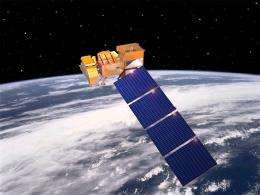
When Stanford climate scientist Christopher Field looks at visual feeds from a satellite monitoring deforestation in the Amazon basin, he sees images streaked with white lines devoid of data.
The satellite, Landsat 7, is broken. And it's emblematic of the nation's battered satellite environmental monitoring program. The bad news: It's only going to get worse, unless the federal agencies criticized for their poor management of the satellite systems over the past decade stage a fast turnaround. Many, however, view that prospect as a long shot.
"I would say our ability to observe the Earth from space is at grave risk of dying from neglect," said Field, director of the Department of Global Ecology at the Carnegie Institution for Science at Stanford University.
Inez Fung, a noted climatologist at the University of California-Berkeley, was shocked as she scanned a recent federal report warning of impending gaps in the country's ability to monitor Earth from space.
The federal document, released in May, listed cuts in climate-monitoring sensors from the next generation of Earth-observing satellites. The current satellites beam down many types of indispensable data about the planet, such as ocean currents, ozone levels and snow cover, as well as the pictures we see every day on TV weathercasts.
But key instruments on the new satellites have been eliminated: Gone is a sensor that would relay new data about the atmosphere and environmental conditions in the ocean and along coastal areas. The movement of pollutants and greenhouse gases would have been under the instrument's mechanical gaze, as well.
Also absent is a critical sensor that monitors temperature changes over time on Earth.
"That's like if you have a sick patient, and then say, 'I have no more thermometers,' " Fung said.
In all, nine new climate instruments on the next generation of satellites were canceled or their capabilities scaled back in 2006, according to the Government Accountability Office report. The office is the investigative arm of the U.S. Congress, assessing the performance of federal agencies.
Combined with a five-year delay in launching these next-generation satellites, with the first scheduled to blast off in 2011, these canceled or "degraded" instruments leave the nation facing critical gaps in satellite monitoring of the planet beginning in 2015, the report stated. And a National Academy of Sciences analysis of the disarray in the satellite program stressed that because of Earth's growing population, it's more crucial than ever to monitor pollution, water quality, land use and other environmental conditions.
Many blame the cuts on Bush administration policies that favored manned moon and Mars missions over shoring up aging Earth-observing satellite systems. Critics cite a 30 percent decline between 2000 and 2006 in NASA's Earth science budget -- which funds environmental satellites -- as evidence of the administration's lukewarm support of keeping an eye on the planet's condition. The National Academy of Sciences report, along with a chorus of experts in the field, also warns that the country is at risk of losing its worldwide technological leadership in Earth-observing satellites.
Other casualties of the 2006 cuts include an instrument for tracking airborne particles such as sea spray, smog, volcanic ash and smoke -- all factors contributing to the warming or cooling of the planet. The inclusion of a new instrument for monitoring soil moisture was canceled, which would have yielded information valuable to, among others, farmers and those monitoring the spread of deserts worldwide.
These cuts spell a 46 percent decline in data about the Earth's conditions that these new satellites were designed to provide, and the Government Accountability Office report concluded that because of the trouble-plagued satellite program, "our nation's ability to understand climate change may be limited."
Those in the field use harsher language.
Many Earth-monitoring satellites "are really in desperate shape," said Field, with Stanford's Carnegie Institution.
He copes with the neglect daily. Field and his staff rely on data from Landsat 7, a satellite that malfunctioned in 2003 and is limping along at two-thirds its capacity. For example, when it flies over the Amazon basin, where it's used to monitor rain forest deforestation, it sends images marred by white lines showing where the satellite failed to gather data. To back up that defective machine, they use data sent by a 28-year-old satellite, Landsat 5, which was designed to last three years.
"Landsat 7 is just basically broken," Field said. He considers it a "miracle" that Landsat 5 still functions.
In the 1960s, the United States began using satellites to observe its lands, oceans, atmosphere and the space environment near Earth. The satellites continuously monitor the planet's dynamic environment, and allow humans to peer into inaccessible places. Information beamed by these spacecraft is now essential for forecasting weather, tracking conditions on Earth and in its atmosphere, and projecting long-term climate trends.
With satellite data, rising sea levels can be monitored, helping communities on islands and along coastal areas plan. Satellites help farmers assess soil conditions before planting, allow foresters to examine logging activities, let water managers monitor the mountain snowpack that provides water to cities, and track the migration of wildlife such as buffalo and elephants.
Satellite data are also essential for crafting international agreements for reducing global warming, said Molly Macauley, an economist with Resources for the Future, a research institute in Washington, D.C.
Field echoed many of his colleagues' views in saying the cuts also reflect a lack of support for climate monitoring in particular during the Bush administration. Former President George W. Bush held that there was insufficient information to conclude global warming was caused by human activity, but that the economic harm of regulating heat-trapping gases was certain.
A May 2 article in Defense Industry Daily noted that "one of the most controversial decisions" after the 2006 reduction in satellite sensors was the fact that the National Oceanic and Atmospheric Administration and the Department of Defense "apparently chose not to seek additional funding" to retain the climate instruments. The agencies, along with NASA, jointly managed one of the programs, NPOESS. The other, GOES-R, is managed solely by the National Oceanic and Atmospheric Administration.
Had the agencies received more funding at that earlier stage, subsequent cost increases and launch delays could have been avoided, the prime contractor on the satellite program testified before Congress, according to the article. The NPOESS program, at nearly $14 billion in cost, is now more than $7 billion over its original estimate.
Jumping into the fray, the National Academy of Sciences in 2007 released a 455-page report on the nation's environmental satellite program, offering the most comprehensive recommendations to date for getting it back on track. Chief among them was an infusion of money for Earth-observing satellites. And the funding decline in the years before the report's release put the country's ability to monitor the climate and severe weather "at great risk," the academy report warned.
"There was a decreased emphasis on Earth observations" during the Bush administration, Field said. "That was because NASA was so strongly focused on the moon and Mars."
In 2004, Bush announced that NASA would turn its focus to more manned space missions. The first goal was returning humans to the moon by 2020, and establishing a lunar launchpad for staffed missions to Mars. He proposed a $12 billion budget for the first five years, with $11 billion diverted from existing NASA programs.
The Obama administration remains committed to manned space flights, but it canceled the projected $108 billion return-to-moon plan, called Constellation, a move that's angered some in Congress. Instead, the administration is seeking international and commercial partnerships for developing manned missions to asteroids and to Mars. The administration also proposed increased funding of $2.4 billion for Earth observation research at NASA.
The White House stated that it's committed to "minimizing -- if not eliminating -- potential gaps in data" in Earth-monitoring satellite activities in the coming decades.
"The urgency to maintain the continuity ... that's out in front of everybody," said Mark Mulholland, a senior official with the National Oceanic and Atmospheric Administration. "Certainly in the last couple of years there's been an increasing emphasis at the administration level on climate monitoring," he added.
David Powner, a Government Accountability Office auditor and lead author of the GAO reports, said it's clear that stronger leadership is needed for the nation's environmental satellite program, and he said that job belongs to the Office of Science and Technology Policy in the White House.
"We pinned it on OSTP," he said. "They have the responsibility to coordinate these interagency-type, long-term issues."
Without that kind of oversight, Powner said, agencies commonly focus on their own priorities, and fail to commit to long-term plans -- an approach essential for the complex job of designing and launching Earth-observing satellites.
A senior analyst with the technology policy office "did not agree or disagree with our recommendations," the report stated.
Field concurred with Powner's position. He described the dearth of leadership as another serious gap in the nation's Earth-observing satellite program.
"There's nobody in the federal system that's really responsible for ensuring the kind of long-term observations that you want on a planet that's changing," he said.
(c) 2010, Contra Costa Times (Walnut Creek, Calif.).
Distributed by McClatchy-Tribune Information Services.


