LCLS comes online

September 6, 2010 By Jared Sagoff
LCLS comes online

Enlarge

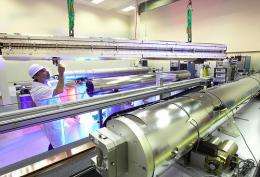
A SLAC researcher works on the newly-opened Linac Coherent Light Source. Image courtesy of SLAC.

The recently opened Linac Coherent Light Source (LCLS) at the SLAC National Accelerator Laboratory (SNAL) provides scientists around the world with a brilliant new tool to understand fundamental properties of atoms and materials at previously unreachable dimensions.

Its birth, however, could not have occurred without the expertise of Argonne scientists.

The LCLS is a very powerful example of an X-ray free-electron laser, which comprises a series of magnetic structures called undulators that provide precise magnetic fields through which an travels. Electrons are forced to oscillate back and forth as they traverse through the undulators, producing large quantities of X-rays. These X-rays then interact with the electrons that generated them, causing the electrons to bunch at particular wavelengths -- this new bunch pattern dramatically boosts the intensity of the produced X-rays.

The precision and stability specifications required of the undulators at LCLS exceed those at Argonne’s own Advanced Photon Source (APS) and other light-source facilities around the world. The pulses of X-ray from LCLS will be shorter than those produced at storage ring sources, resulting in an instantaneous brightness a billion times larger than can be produced by any other X-ray source available now or in the near future.

The LCLS now joins the other DOE light sources: the APS, the Advanced Light Source at Lawrence Berkeley National Laboratory and the at Brookhaven National Laboratory. Taken together, they provide the U.S. with a series of state-of-the-art, complementary research tools needed to carry out revolutionary research.

To get to this point, SLAC asked Argonne scientists to help build the undulator system, taking the technology already used at the APS to the next level. "Argonne was tapped to participate in this project because of its expertise with the APS undulators," said J. Murray Gibson, Argonne’s associate laboratory director for photon sciences. "An X-ray laser such as LCLS opens up new scientific frontiers and represents an immense technical achievement for the United States. We could not have done this without the partnership of national laboratories, universities and industry.”

The electron and photon beams within the LCLS undulator must travel on a straight trajectory that can only deviate by a few dozen micrometers. Members of the Argonne Accelerator Systems Division Diagnostics and RF groups, in collaboration with the APS Engineering Support Division Controls and Mechanical Engineering groups and Stanford Linear Accelerator Center scientists, developed a novel technology that provides measurements of the beam trajectory with sub-micron resolution. The information obtained from this monitor is then fed back to the steering magnets controlling the beam as it passes through the undulator.

The undulators themselves were designed and constructed by the Accelerator Systems Division's Magnetic Devices and Accelerator Physics Groups, together with the Mechanical Engineering Group.

“These advanced characteristics will aid scientists in discovering and probing new states of matter, understanding and following chemical reactions and biological processes in real time, imaging chemical and structural properties of materials on the nanoscale, and many new and exciting discoveries we cannot even imagine today,” added Marion White, senior physicist at the APS. “The LCLS will enable revolutionary new science.”

Provided by Argonne National Laboratory (news : web)

4.6 /5 (9 votes)  

Filter


Move the slider to adjust rank threshold, so that you can hide some of the comments.


Display comments: newest first

Husky
Sep 07, 2010

Rank: 5 / 5 (1)
not to mention could do heavy actinide burning in a hybrid linac assisted nuclear reactor setup, oops i mentioned it...
Shootist
Sep 07, 2010

Rank: not rated yet
is that bad? lessening the nasty long lived radio-isotopes, i mean?
Rank 4.6 /5 (9 votes)
Related Stories
Relevant PhysicsForums posts
  • Wind Turbine Power
    created1 hour ago
  • Steam Table issues
    created3 hours ago
  • electrostatic induction in a conductor should be immpossible
    created6 hours ago
  • Help! Physics Momentum/Impulse problem!
    created9 hours ago
  • Gauss' law cubes, how to prove
    created11 hours ago
  • what is significance of torque
    created12 hours ago
  • More from Physics Forums - General Physics

More news stories

SLAC, Stanford team focuses on high-energy electrons to treat cancer

Accelerator physicists at SLAC and cancer specialists from Stanford are working on a new technology that could dramatically reduce the time needed for cancer radiation treatments. The team ran an initial experiment ...

Physics / General Physics

created 44 minutes ago | popularity not rated yet | comments 0

Measurements from high-energy collisions lead to better understanding of why meson particles disappear

For several years, physicists at the Relativistic Heavy Ion Collider (RHIC) at Brookhaven National Laboratory (BNL), USA, have studied an unusual state of matter called the quark–gluon plasma, which they ...

Physics / General Physics

created 1 hour ago | popularity not rated yet | comments 0

Quantum physicist explains $100K offer for proof scaled-up quantum computing is impossible

(PhysOrg.com) -- MIT researcher Scott Aaronson has certainly riled the physics community with his offer this past Friday, of $100,000 to anyone who can prove that scaled-up quantum computing is impossible. ...

Physics / Quantum Physics

created Feb 08, 2012 | popularity 4.1 / 5 (11) | comments 32 | with audio podcast weblog

Explained: Sigma

It's a question that arises with virtually every major new finding in science or medicine: What makes a result reliable enough to be taken seriously? The answer has to do with statistical significance -- but ...

Physics / General Physics

created Feb 09, 2012 | popularity 5 / 5 (13) | comments 26

Physicists 'record' magnetic breakthrough

An international team of scientists has demonstrated a revolutionary new way of magnetic recording which will allow information to be processed hundreds of times faster than by current hard drive technology.

Physics / General Physics

created Feb 07, 2012 | popularity 4.5 / 5 (39) | comments 14 | with audio podcast


The power of estrogen -- male snakes attract other males

A new study has shown that boosting the estrogen levels of male garter snakes causes them to secrete the same pheromones that females use to attract suitors, and turned the males into just about the sexiest ...

Could Venus be shifting gear?

(PhysOrg.com) -- ESA’s Venus Express spacecraft has discovered that our cloud-covered neighbour spins a little slower than previously measured. Peering through the dense atmosphere in the infrared, the ...

Experts reveal how plants don't get sunburn

(PhysOrg.com) -- Experts at the University of Glasgow have discovered how plants survive the harmful rays of the sun.

Team isolates nerve cells involved in storing long term memory and gene proteins associated with them

(Medical Xpress) -- A research team in Taiwan has succeeded in isolating two nerve cells in fruit fly brains that are believed to be the major players in allowing for the formation of long term memories. Furthermore, ...

Fool's gold may prove an unlikely alternative to overexploited catalytic materials

Catalytic materials, which lower the energy barriers for chemical reactions, are used in everything from the commercial production of chemicals to catalytic converters in car engines. However, with current catalytic materials ...

News of plaque-clearing drug tops week of major advances against Alzheimer's disease

In the last eight days, scientists have delivered a powerful one-two punch in the fight to defeat Alzheimer's disease. At the same time, the White House and members of Congress are proposing increases in Alzheimer's research ...